
Thai Basil
Thai basil is an aromatic herb used fresh in curries, stir-fries, soups, and noodle dishes.
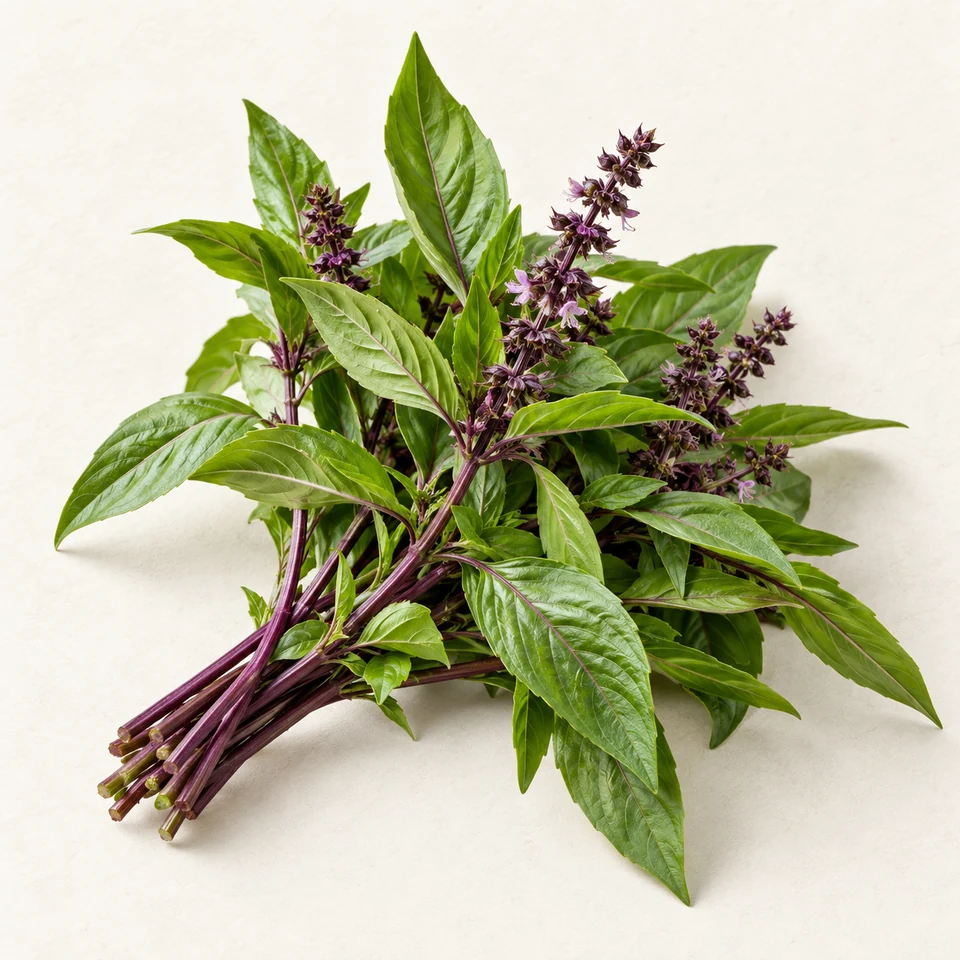
About Thai Basil
Thai sweet basil is the fresh leafy herb commonly known in Thai cooking as horapha. It is used in curries, stir-fries, soups, noodle dishes, and salads, usually added near the end of cooking or scattered over the finished food. Its stronger aroma makes it especially useful when a dish needs a fresh herbal lift.
The leaves have a distinctive anise-like, peppery fragrance with mild sweetness and hints of clove or mint. They are tender and slightly springy when fresh, then soften quickly in hot sauce or steam while releasing their aroma. Prolonged cooking dulls the fragrance and darkens the leaves.
Thai sweet basil is sold as loose leaves or leafy sprigs, with green leaves and often purple-tinged stems or flower spikes. It may be used whole, torn, or roughly chopped. Young leaves are delicate; flowering sprigs are more pungent and may include tender stems.
- Ingredient type
- whole food
FOLLOW IT TO THE PLATE
Where will you meet it?
Explore the dishes that use this ingredient and their country and cuisine connections.
Explore linked dishesON A MENU OR LABEL
Find local names and written forms to help recognise this ingredient.
See local namesWhere thai basil appears
13 linked foodsFind foods to recognise by country and type. Recipes and products vary; these are recorded ingredient connections.
Showing 1–12 of 13
Main dishes


Gaeng Keow Wan Gai
Optional addition
Gaeng Khae
Optional addition
Gaeng Phet
Optional addition
Gaeng Waan Isan
Optional addition
Panang Curry
Optional additionSnacks
Soups

Gaeng Nor Mai
Optional addition
Gaeng Om Isan
Optional addition
Gaeng Om Kai
Optional additionKaeng Liang
Optional additionIngredient connections awaiting review · Coverage is still growing, including packaged snacks.
Name examples awaiting language review. Confirm the specific food or product.
Local names for thai basil
Names and romanised forms to recognise on menus and labels.
โหระพา
horapha
ใบโหระพา
bai horapha
Thai sweet basil
Thai basil
Thai-Basilikum
basilic thaï
albahaca tailandesa
basilico thai
manjericão tailandês
Thaise basilicum
タイバジル
tai bajiru
타이 바질
tai bajil
泰国罗勒
Tàiguó luólè
tai bajiru
Romanised form
tai bajil
Romanised form
Tàiguó luólè
Romanised form
hung quế
Romanised form
húng quế
manjericão-tailandês
horapha
Romanised form
Thai sweet basil
Search alias · Not a confirmed translation
Thai Sweet Basil
Search alias · Not a confirmed translation
Available names only. Languages may be spoken in other countries; a name alone does not identify every ingredient in a dish.
Name not available yet.
A name in English has not been added for thai basil. Choose another language to see its available names.
Thai Basil nutrition & diet
Thai Basil nutritional value
Reference: Sweet basil/ horapha, leaves raw
Per 100 g of the edible portion in the named reference form.
- Calories
- 35.69999999999999kcal
- Protein
- 2.9g
- Carbs
- 4.8g
- Fat
- 0.1g
Per 100 g edible portion. Rojroongwasinkul et al. (2013), Mahidol University and Wageningen University, SMILING Thai Food Composition Table. Energy is the source-calculated energy; carbohydrate is available carbohydrate by difference. Original 2013 reference values, not a current product label or a universal recipe.
Portions & preparation
Use fresh Thai basil leaves and tender stems as the reference form, rather than dried basil or a prepared sauce. Trimmed edible portions and the amount used as a garnish or cooking herb can differ substantially. Record added oil, coconut milk, salt, or other ingredients in the finished dish separately.
Compare the right form: Match fresh Thai basil leaves and tender stems, raw or cooked, not dried basil, oil, or a seasoned sauce.
Diet considerations
Thai basil is a plant-derived herb. Plain fresh leaves generally appear in small culinary portions, but compatibility changes when used in curry paste, sauces, or dishes containing fish sauce, shrimp, meat, dairy, or cereal ingredients. A basil-containing prepared food must be evaluated as its full recipe, including rice or noodles.
AI-authored reading notes · Awaiting editorial review. Measured values, where available, have a separate source above.
Dietary compatibility
- VeganNot established
- VegetarianNot established
- PescatarianNot established
- KetoNot established
- PaleoNot established
- Low-carbNot established
- HalalNot established
- KosherNot established
What these diet assessments mean
- Vegan · Not established
- The available profile does not establish the full composition or processing for this dietary pattern.
- Vegetarian · Not established
- The available profile does not establish the full composition or processing for this dietary pattern.
- Pescatarian · Not established
- The available profile does not establish the full composition or processing for this dietary pattern.
- Keto · Not established
- A defined serving and sourced carbohydrate data are needed before assessing this dietary pattern.
- Paleo · Not established
- The ingredient form and processing have not been assessed against this dietary pattern.
- Low-carb · Not established
- A defined serving and sourced carbohydrate data are needed before assessing this dietary pattern.
- Halal · Not established
- Sourcing, processing and any applicable certification have not been verified. A food name alone does not establish halal status.
- Kosher · Not established
- Sourcing, processing and any applicable certification have not been verified. A food name alone does not establish kosher status.
For the plain ingredient · Awaiting review. Diet compatibility is not allergy suitability or halal/kosher certification. Keto and low-carb depend on the portion.
AI-generated illustration for visual context. It does not identify a particular product or establish allergen content.
Sources & review
Nutrition reference: Thai Food Composition Table, SMILING 2013 — 04065 ↗. Values are scaled from 100 g of the recorded edible form. Individual portions have no assumed fixed weight.
Expanded overview, name examples and nutrition notes are database drafts awaiting editorial review. Numeric nutrition values, where shown, have their own source and food-form reference.
The ingredient description and dish connections come from the draft catalogue and may change after review.
Last recorded verification: .