
Beef Tongue
Beef tongue is a beef organ meat usually simmered until tender and served sliced or in stews.
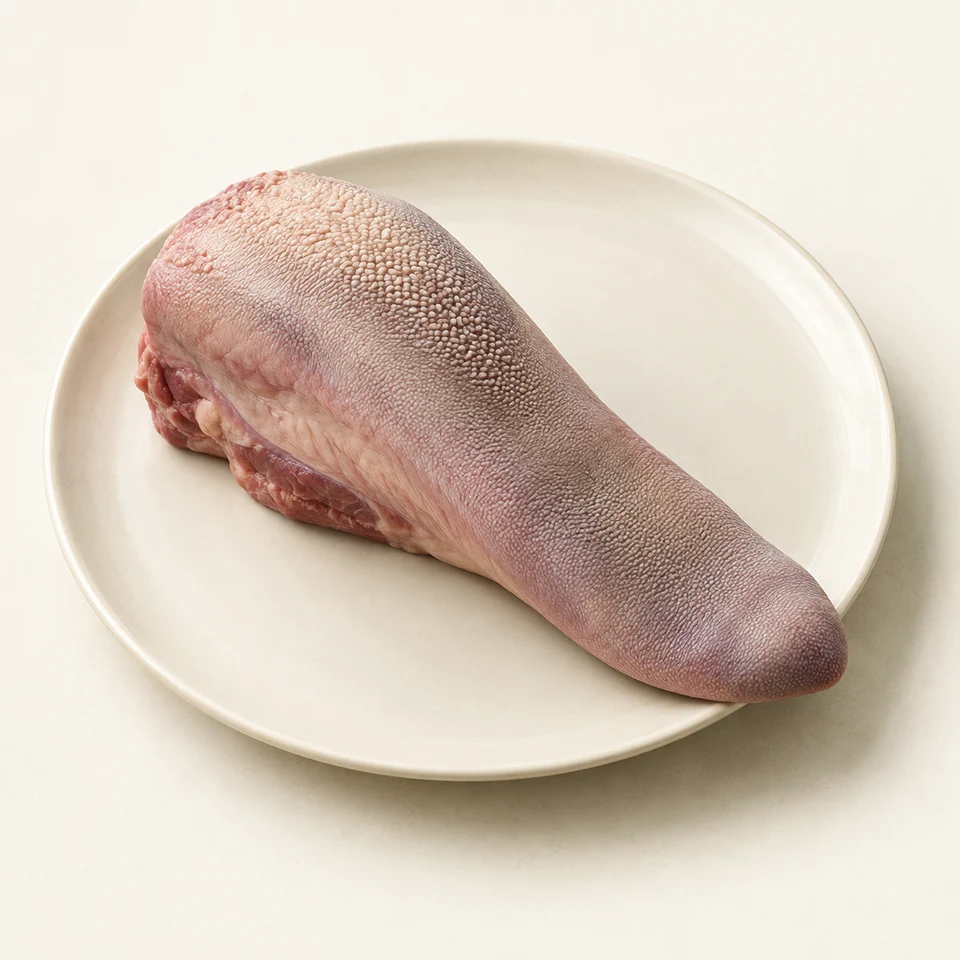
About Beef Tongue
Beef tongue is the muscular tongue of cattle, sold whole or in sections and commonly prepared after cleaning and, in many preparations, removing its outer skin. It may be simmered, braised, roasted, or pressure-cooked, then sliced for sandwiches and cold platters or cut into tacos, stews, and braises.
When cooked until tender, beef tongue is moist and dense with a smooth, fine-grained texture. Its flavour details are not further specified here; seasoned preparations may present it alongside the flavours of their cooking liquids, sauces, or other ingredients.
It has a thick, compact form and is sold whole, in sections, or sliced after cooking. Cleaning, trimming, skin removal, and cooking change the edible portion and texture, while prolonged moist cooking makes the meat tender.
- Ingredient type
- whole food
FOLLOW IT TO THE PLATE
Where will you meet it?
Explore the dishes that use this ingredient and their country and cuisine connections.
Explore linked dishesON A MENU OR LABEL
Find local names and written forms to help recognise this ingredient.
See local namesWhere beef tongue appears
4 linked foodsFind foods to recognise by country and type. Recipes and products vary; these are recorded ingredient connections.
Showing 1–4 of 4
Main dishes

Ingredient connections awaiting review · Coverage is still growing, including packaged snacks.
Name examples awaiting language review. Confirm the specific food or product.
Local names for beef tongue
Names and romanised forms to recognise on menus and labels.
beef tongue
langue de bœuf
lengua de res
牛タン
gyūtan
Rinderzunge
lingua di manzo
língua de boi
rundertong
język wołowy
hovězí jazyk
hovädzí jazyk
говяжий язык
govyazhiy yazyk
яловичий язик
ialovychyi yazyk
sığır dili
μοσχαρίσια γλώσσα
moscharísia glóssa
牛舌
niú shé
소혀
sohyeo
לשון בקר
lashon bakar
marhanyelv
oxfilé
moscharísia glóssa
Romanised form
gyūtan
Romanised form
Beef edible offal, Tongue, Raw
Search alias · Not a confirmed translation
Cooked beef tongue
Search alias · Not a confirmed translation
ialovychyi yazyk
Romanised form
sohyeo
Romanised form
niú shé
Romanised form
govyazhiy yazyk
Romanised form
lashon bakar
Romanised form
Available names only. Languages may be spoken in other countries; a name alone does not identify every ingredient in a dish.
Name not available yet.
A name in English has not been added for beef tongue. Choose another language to see its available names.
Beef Tongue nutrition & diet
Beef Tongue nutritional value
Beef, variety meats and by-products, tongue, raw
Per 100 g of the edible portion in the recorded food form.
- Calories
- 224kcal
- Protein
- 14.9g
- Carbs
- 3.7g
- Fat
- 16.1g
Reference values for the specific food form shown. Other varieties, brands and preparations can differ.
Portions & preparation
Specify whether the tongue is raw, simmered, peeled, sliced, smoked, or otherwise prepared, and use the edible meat after skin removal where appropriate. Cooking changes moisture and texture; added brine, sauces, oils, or fillings should be documented separately from the tongue itself.
Compare the right form: Match references to peeled or unpeeled beef tongue, raw or cooked, with smoking, curing, slicing, and edible-portion conventions specified.
Diet considerations
Beef tongue is an animal-derived cattle organ meat. Plain boiled or roasted tongue differs from cured, smoked, pickled, breaded, or sauced versions. Processing may introduce dairy, cereal ingredients, sweeteners, or other additives; portion size and accompaniments such as bread or potatoes change carbohydrate patterns.
AI-authored reading notes · Awaiting editorial review. Measured values, where available, have a separate source above.
Dietary compatibility
- VeganTypically incompatible
- VegetarianTypically incompatible
- PescatarianTypically incompatible
- KetoMay be compatible
- PaleoMay be compatible
- Low-carbMay be compatible
- HalalNot established
- KosherNot established
What these diet assessments mean
- Vegan · Typically incompatible
- The ingredient profile identifies an animal-derived food or derivative.
- Vegetarian · Typically incompatible
- The profile identifies animal flesh, seafood or a derivative excluded by a vegetarian diet.
- Pescatarian · Typically incompatible
- The profile identifies land-animal meat or a derivative, which is excluded by this pescatarian definition.
- Keto · May be compatible
- The plain form may fit a carbohydrate-restricted diet. Check the portion, added sugar, coatings and sauces against the nutrition values above.
- Paleo · May be compatible
- May fit a paleo pattern, depending on the cut or form, processing and added ingredients.
- Low-carb · May be compatible
- The plain form may fit a carbohydrate-restricted diet. Check the portion, added sugar, coatings and sauces against the nutrition values above.
- Halal · Not established
- Sourcing, processing and any applicable certification have not been verified. A food name alone does not establish halal status.
- Kosher · Not established
- Sourcing, processing and any applicable certification have not been verified. A food name alone does not establish kosher status.
For the plain ingredient · Awaiting review. Diet compatibility is not allergy suitability or halal/kosher certification. Keto and low-carb depend on the portion.
AI-generated illustration for visual context. It does not identify a particular product or establish allergen content.
Sources & review
Nutrition reference: USDA FoodData Central — Beef, variety meats and by-products, tongue, raw ↗. Values are scaled from 100 g of the recorded edible form. Individual portions have no assumed fixed weight.
Expanded overview, name examples and nutrition notes are database drafts awaiting editorial review. Numeric nutrition values, where shown, have their own source and food-form reference.
The ingredient description and dish connections come from the draft catalogue and may change after review.
Last recorded verification: .