
Cockle
Cockles are small edible bivalves commonly steamed, boiled, or added to soups and seafood dishes.
About Cockle
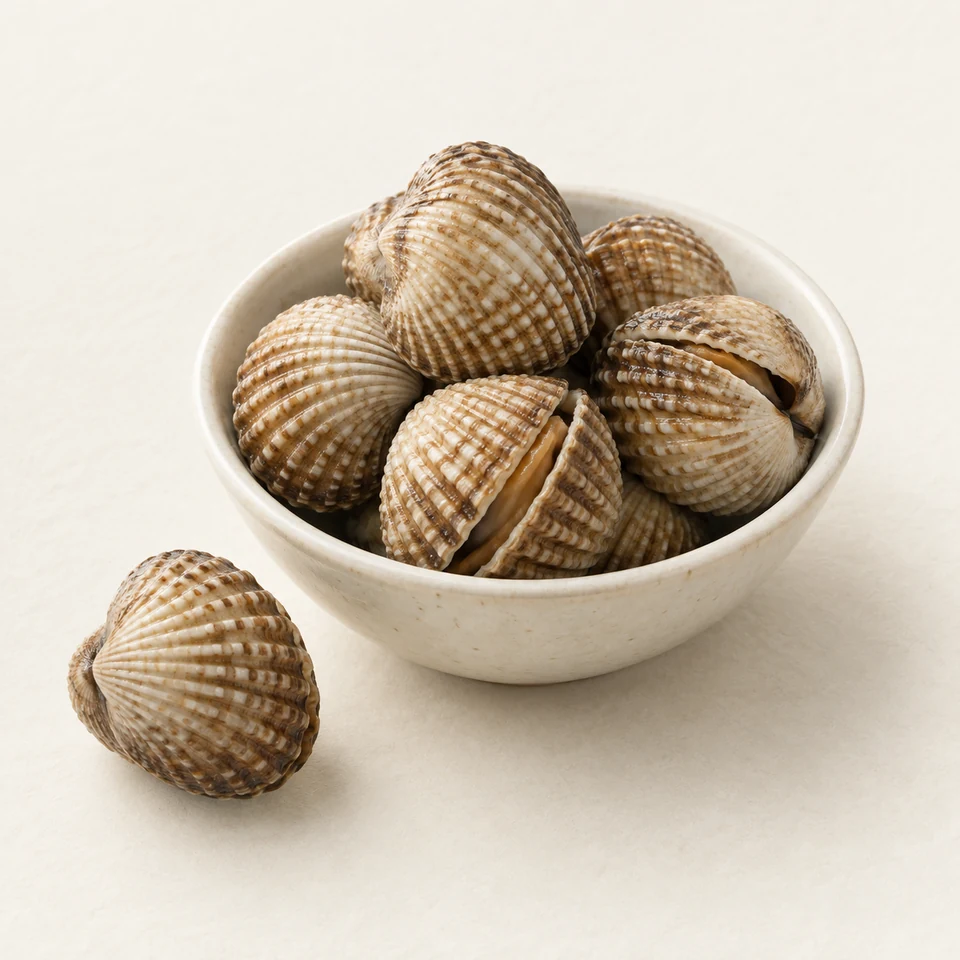
A cockle is a small edible marine bivalve mollusk with a rounded, strongly ribbed shell. It is sold whole or shucked and is used in soups, seafood stews, sauces, pasta, rice dishes, and other preparations where a delicate shellfish flavour is wanted.
Cooked cockle meat is tender and slightly chewy, with a clean, briny flavour that can range from delicate to more pronounced. The meat is usually small, and its juices add savoury sea flavour when the shells are cooked in a broth or sauce.
Whole cockles are commonly steamed or boiled until their shells open, then served in the shell or removed for another dish. They may also be canned, preserved, or sold chilled after shucking. Different species and sizes produce modest differences in shell shape and meat texture.
- Ingredient type
- whole food
FOLLOW IT TO THE PLATE
Where will you meet it?
Explore the dishes that use this ingredient and their country and cuisine connections.
Explore linked dishesON A MENU OR LABEL
Find local names and written forms to help recognise this ingredient.
See local namesWhere cockle appears
6 linked foodsFind foods to recognise by country and type. Recipes and products vary; these are recorded ingredient connections.
Showing 1–6 of 6
Main dishes

Sides

Noodle dishes

Rice dishes

Ingredient connections awaiting review · Coverage is still growing, including packaged snacks.
Name examples awaiting language review. Confirm the specific food or product.
Local names for cockle
Names and romanised forms to recognise on menus and labels.
cockle
berberecho
coque
berbigão
cuore edule
escopinya
Herzmuschel
kokkel
hjertemusling
hjärtmussla
hjerteskjell
hjartarskel
sercówka
srdcovka
srdcovka
srčanka
srčanka
сердцевидка
serdtsevidka
серцевидка
sertsevidka
κυδώνι
kydóni
kalp midyesi
محار القلب
muḥār al-qalb
鸟蛤
niǎogé
ザルガイ
zarugai
새조개
sae-jogae
sò huyết
kerang jantung
lokan hati
kydóni
Romanised form
zarugai
Romanised form
Egg cockle, Dried
Search alias · Not a confirmed translation
Egg cockle, Raw
Search alias · Not a confirmed translation
Egg cockle, Seasoned and dried
Search alias · Not a confirmed translation
muḥār al-qalb
Romanised form
sertsevidka
Romanised form
sae-jogae
Romanised form
niǎogé
Romanised form
serdtsevidka
Romanised form
Available names only. Languages may be spoken in other countries; a name alone does not identify every ingredient in a dish.
Name not available yet.
A name in English has not been added for cockle. Choose another language to see its available names.
Cockle nutrition & diet
Cockle nutritional value
Cockle, raw
Per 100 g of the edible portion in the named reference form.
- Calories
- 41kcal
- Protein
- 8.2g
- Carbs
- 0.0g
- Fat
- 0.9g
Per 100 g edible portion. New Zealand FOODfiles 2024. Copyright The New Zealand Institute for Plant & Food Research Limited and the Ministry of Health (New Zealand), 2024. Original reference values: available carbohydrate and energy (FSANZ). Access and use of these data are subject to https://www.foodcomposition.co.nz/terms/. Other preparations differ.
Portions & preparation
Match the reference to edible cockle meat from the identified species, excluding shell weight. Distinguish raw, steamed, boiled, grilled, fried, canned, smoked, or sauced forms. Record whether liquor, oil, breading, dairy, or other ingredients are consumed, because a plain bivalve differs from a finished dish.
Compare the right form: Use a reference for the identified cockle species and edible meat in the stated preparation; shell-on, canned, breaded, and sauced forms require separate matching.
Diet considerations
Cockle is animal-derived bivalve shellfish. Compatibility changes with frying, breading, canned additives, dairy sauces, animal fats, or accompaniments containing noodles, crumbs, grains, or other cereal ingredients. Plain cooked cockle and a mixed seafood dish need separate assessment, with portion interpreted alongside additions.
AI-authored reading notes · Awaiting editorial review. Measured values, where available, have a separate source above.
Dietary compatibility
- VeganTypically incompatible
- VegetarianTypically incompatible
- PescatarianTypically compatible
- KetoMay be compatible
- PaleoMay be compatible
- Low-carbMay be compatible
- HalalNot established
- KosherTypically incompatible
What these diet assessments mean
- Vegan · Typically incompatible
- The ingredient profile identifies an animal-derived food or derivative.
- Vegetarian · Typically incompatible
- The profile identifies animal flesh, seafood or a derivative excluded by a vegetarian diet.
- Pescatarian · Typically compatible
- Seafood fits this pescatarian definition. Added meat-based stock or other ingredients would need checking separately.
- Keto · May be compatible
- The plain form may fit a carbohydrate-restricted diet. Check the portion, added sugar, coatings and sauces against the nutrition values above.
- Paleo · May be compatible
- May fit a paleo pattern, depending on the cut or form, processing and added ingredients.
- Low-carb · May be compatible
- The plain form may fit a carbohydrate-restricted diet. Check the portion, added sugar, coatings and sauces against the nutrition values above.
- Halal · Not established
- Sourcing, processing and any applicable certification have not been verified. A food name alone does not establish halal status.
- Kosher · Typically incompatible
- This profile identifies shellfish, which does not meet the kosher fish criteria.
For the plain ingredient · Awaiting review. Diet compatibility is not allergy suitability or halal/kosher certification. Keto and low-carb depend on the portion.
AI-generated illustration for visual context. It does not identify a particular product or establish allergen content.
Sources & review
Nutrition reference: New Zealand FOODfiles 2024 — T1 ↗. Values are scaled from 100 g of the recorded edible form. Individual portions have no assumed fixed weight.
Expanded overview, name examples and nutrition notes are database drafts awaiting editorial review. Numeric nutrition values, where shown, have their own source and food-form reference.
The ingredient description and dish connections come from the draft catalogue and may change after review.
Last recorded verification: .