
Gochujang
Gochujang is a thick, fermented Korean chili paste used in sauces, marinades, stews, and dipping preparations.
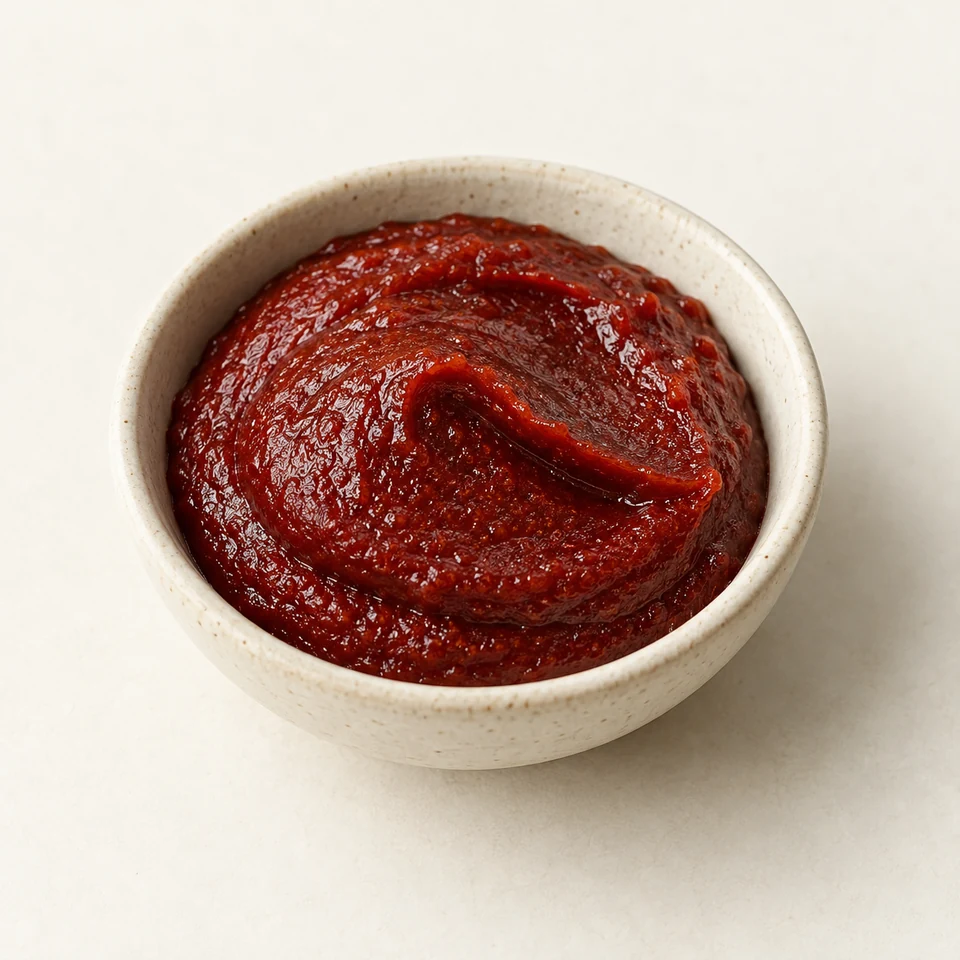
About Gochujang
Gochujang is a thick, fermented Korean chili paste used in sauces, marinades, stews, soups, dipping preparations, rice dishes, and mixed seasonings. It can be stirred directly into a dish or diluted with liquids and other ingredients. Commercial and traditional versions differ in chili intensity, sweetness, thickness, and fermentation character.
Its flavour is layered, combining spiciness and savouriness with sweetness, saltiness, and fermented grain or bean notes. The consistency is smooth to slightly textured, and the paste has a deep red colour. Formulation and fermentation conditions influence how strongly these flavours and textural qualities are expressed.
Gochujang is commonly sold as a ready-to-use paste in sealed tubs or other containers. It may be used thick, diluted, or blended with oil, sugar, broth, or other ingredients. Dilution loosens the paste and makes it spread or pour more readily, while mixing disperses its colour and flavour through sauces, marinades, soups, or seasoned dishes.
- Ingredient type
- paste
Forms & related ingredients
FOLLOW IT TO THE PLATE
Where will you meet it?
Explore the dishes that use this ingredient and their country and cuisine connections.
Explore linked dishesON A MENU OR LABEL
Find local names and written forms to help recognise this ingredient.
See local namesWhere gochujang appears
17 linked foodsFind foods to recognise by country and type. Recipes and products vary; these are recorded ingredient connections.
Showing 1–12 of 17
Main dishes


Sides
Soups

Budae Jjigae
Optional additionSalads

Noodle dishes


Ingredient connections awaiting review · Coverage is still growing, including packaged snacks.
Name examples awaiting language review. Confirm the specific food or product.
Local names for gochujang
Names and romanised forms to recognise on menus and labels.
고추장
gochujang
gochujang
コチュジャン
kochujan
韩式辣椒酱
Hánshì làjiāojiàng
gochujang
Gochujang
gochujang
kochujan
Romanised form
Gochujang, Korean traditional type
Search alias · Not a confirmed translation
Hánshì làjiāojiàng
Romanised form
Available names only. Languages may be spoken in other countries; a name alone does not identify every ingredient in a dish.
Name not available yet.
A name in English has not been added for gochujang. Choose another language to see its available names.
Gochujang nutrition & diet
Gochujang nutritional value
Reference: Gochujang
Per 100 g of the edible portion in the named reference form.
- Calories
- 205kcal
- Protein
- 3.7g
- Carbs
- 51.8g
- Fat
- 1.4g
Per 100 g edible portion. Rural Development Administration, Korean Standard Food Composition Database 10.4 (2026). Original reference food and preparation are shown; product recipes and moisture can differ.
Portions & preparation
Use the exact gochujang recipe and serving context, since fermentation, solids, sweeteners, salt, and dilution vary by brand. A spoonful used in a sauce is not equivalent to the paste alone, and cooking may redistribute it across a larger dish.
Compare the right form: Reference must match the branded fermented Korean chili paste, including recipe, dilution, and whether it is measured alone or in a finished dish.
Diet considerations
Gochujang is a fermented plant-based-style paste, but compatibility is recipe-dependent rather than universal. Brands may include fermented cereal ingredients, soy, sweeteners, fish, or other animal additions. Sauces and marinades can create a more portion-dependent carbohydrate pattern than the undiluted paste.
AI-authored reading notes · Awaiting editorial review. Measured values, where available, have a separate source above.
Dietary compatibility
- VeganMay be compatible
- VegetarianMay be compatible
- PescatarianMay be compatible
- KetoNot established
- PaleoDepends on the version
- Low-carbNot established
- HalalNot established
- KosherNot established
What these diet assessments mean
- Vegan · May be compatible
- The recorded ingredients may fit this pattern. This is not a complete recipe or manufacturing specification; check additions and preparation.
- Vegetarian · May be compatible
- The recorded ingredients may fit this pattern. This is not a complete recipe or manufacturing specification; check additions and preparation.
- Pescatarian · May be compatible
- The recorded ingredients may fit this pattern. This is not a complete recipe or manufacturing specification; check additions and preparation.
- Keto · Not established
- A defined serving and sourced carbohydrate data are needed before assessing this dietary pattern.
- Paleo · Depends on the version
- Optional or variable recorded ingredients: Fermented Soybean Paste; Glutinous rice. Recorded common ingredients: Soybean. This profile falls outside the conventional paleo pattern used here (grains and pseudograins, legumes, dairy or refined sugar). Recipes and products can differ. This profile falls outside the conventional paleo pattern used here (grains and pseudograins, legumes, dairy or refined sugar). Recipes and products can differ.
- Low-carb · Not established
- A defined serving and sourced carbohydrate data are needed before assessing this dietary pattern.
- Halal · Not established
- Sourcing, processing and any applicable certification have not been verified. A food name alone does not establish halal status.
- Kosher · Not established
- Sourcing, processing and any applicable certification have not been verified. A food name alone does not establish kosher status.
For the plain ingredient · Awaiting review. Diet compatibility is not allergy suitability or halal/kosher certification. Keto and low-carb depend on the portion.
AI-generated illustration for visual context. It does not identify a particular product or establish allergen content.
Sources & review
Nutrition reference: Korean Standard Food Composition DB 10.4 — R0050010009a ↗. Values are scaled from 100 g of the recorded edible form. Individual portions have no assumed fixed weight.
Expanded overview, name examples and nutrition notes are database drafts awaiting editorial review. Numeric nutrition values, where shown, have their own source and food-form reference.
The ingredient description and dish connections come from the draft catalogue and may change after review.
Last recorded verification: .