
Mustard Oil
Mustard oil is a pungent cooking oil used for frying, sautéing, pickling, and dressings.
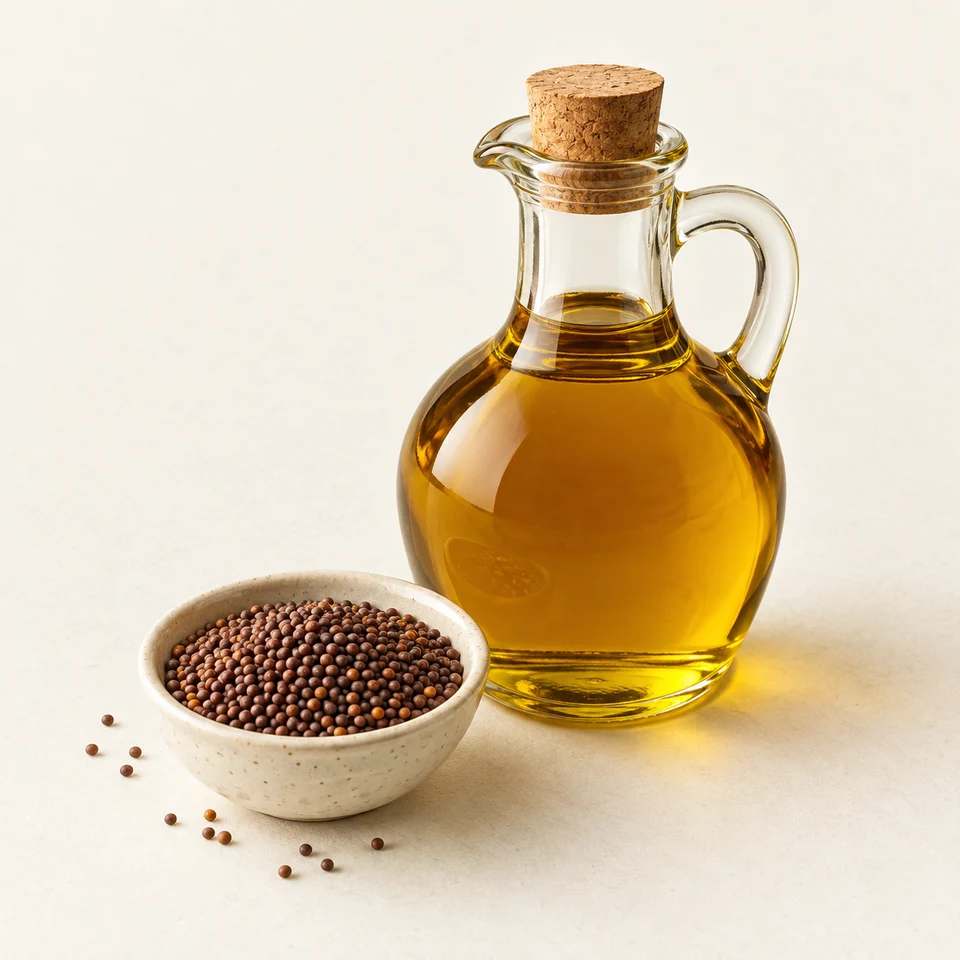
About Mustard Oil
Mustard oil is oil extracted from mustard seed and used as a cooking fat or flavouring. It is suitable for frying, sautéing, shallow cooking, pickling, marinades, and dressings. It is a distinct oil product, not prepared mustard or whole mustard seed.
It is commonly liquid at room temperature, ranging from pale yellow to amber. Pressed oils typically have a pronounced pungent, mustard-like aroma and taste, while refined oils are milder and cleaner. Clarity, colour, and intensity vary with the mustard type and processing.
Mustard oil may be pressed, filtered, refined, or blended. Heating can soften its sharp flavour and release a warmer aroma, while cold use preserves more of its pungency. It may be poured over salads, incorporated into marinades, or used with spices in pickles.
- Ingredient type
- oil
FOLLOW IT TO THE PLATE
Where will you meet it?
Explore the dishes that use this ingredient and their country and cuisine connections.
Explore linked dishesON A MENU OR LABEL
Find local names and written forms to help recognise this ingredient.
See local namesWhere mustard oil appears
25 linked foodsFind foods to recognise by country and type. Recipes and products vary; these are recorded ingredient connections.
Showing 13–24 of 25
Sides


Snacks


Salads

Aloo Sadheko
Optional additionStreet food

Ingredient connections awaiting review · Coverage is still growing, including packaged snacks.
Name examples awaiting language review. Confirm the specific food or product.
Local names for mustard oil
Names and romanised forms to recognise on menus and labels.
mustard oil
सरसों का तेल
sarson kā tel
সরিষার তেল
shorishar tel
huile de moutarde
aceite de mostaza
Senföl
olio di senape
óleo de mostarda
mosterdolie
hardal yağı
горчичное масло
gorchichnoye maslo
гірчична олія
hirchychna oliia
olej musztardowy
ulei de muștar
زيت الخردل
zayt al-khardal
روغن خردل
rowghan-e khardal
سرسوں کا تیل
sarson kā tel
ਸਰ੍ਹੋਂ ਦਾ ਤੇਲ
sarhoṅ dā tel
રાઈનું તેલ
rāīnuṁ tela
मोहरीचे तेल
moharīce tela
கடுகு எண்ணெய்
kaṭuku eṇṇey
ఆవాల నూనె
āvala nūne
ಸಾಸಿವೆ ಎಣ್ಣೆ
sāsive eṇṇe
കടുകെണ്ണ
kaṭukeṇṇa
芥子油
jiè zǐ yóu
からし油
karashi-abura
겨자유
gyeojayu
น้ำมันมัสตาร์ด
nám-man mát-sà-tàt
sāsive eṇṇe
Romanised form
karashi-abura
Romanised form
kaṭuku eṇṇey
Romanised form
zayt al-khardal
Romanised form
hirchychna oliia
Romanised form
gyeojayu
Romanised form
shorishār tel
Romanised form
jiè zǐ yóu
Romanised form
sarson kā tel
Romanised form
kaṭukeṇṇa
Romanised form
sarson kā tel
Romanised form
gorchichnoye maslo
Romanised form
rowghan-e khardal
Romanised form
rāīnuṁ tela
Romanised form
moharīce tela
Romanised form
nám-man mát-sà-tàt
Romanised form
sarhoṅ dā tel
Romanised form
āvala nūne
Romanised form
Available names only. Languages may be spoken in other countries; a name alone does not identify every ingredient in a dish.
Name not available yet.
A name in English has not been added for mustard oil. Choose another language to see its available names.
Mustard Oil nutrition & diet
Mustard Oil nutritional value
Oil, mustard
Per 100 g of the edible portion in the recorded food form.
- Calories
- 884kcal
- Protein
- 0.0g
- Carbs
- 0.0g
- Fat
- 100.0g
Reference values for the specific food form shown. Other varieties, brands and preparations can differ.
Portions & preparation
Confirm that the product is oil pressed or extracted from mustard seed and identify whether it is culinary, blended, refined, or otherwise processed. Reference the amount actually used or retained in cooking; marinades, pickles, and dressings may include substantial additional ingredients.
Compare the right form: Match references to the specified mustard-seed oil form, including culinary or blended product, and distinguish it from mustard-flavoured oils or condiments.
Diet considerations
Mustard oil is plant-derived when it is genuinely made from mustard seed. Compatibility can change if it is blended with animal fats, flavourings, or other oils, or used in recipes containing dairy, meat, fish, egg, or cereals. Its carbohydrate pattern depends on accompanying foods and portion, not the plain oil.
AI-authored reading notes · Awaiting editorial review. Measured values, where available, have a separate source above.
Dietary compatibility
- VeganTypically compatible
- VegetarianTypically compatible
- PescatarianTypically compatible
- KetoMay be compatible
- PaleoMay be compatible
- Low-carbMay be compatible
- HalalNot established
- KosherNot established
What these diet assessments mean
- Vegan · Typically compatible
- The plain ingredient profile is plant, fungal or mineral based. Added ingredients in a prepared product need a separate check.
- Vegetarian · Typically compatible
- The plain ingredient profile is plant, fungal or mineral based. Added ingredients in a prepared product need a separate check.
- Pescatarian · Typically compatible
- The plain ingredient profile is plant, fungal or mineral based. Added ingredients in a prepared product need a separate check.
- Keto · May be compatible
- The plain form may fit a carbohydrate-restricted diet. Check the portion, added sugar, coatings and sauces against the nutrition values above.
- Paleo · May be compatible
- May fit a paleo pattern, depending on the cut or form, processing and added ingredients.
- Low-carb · May be compatible
- The plain form may fit a carbohydrate-restricted diet. Check the portion, added sugar, coatings and sauces against the nutrition values above.
- Halal · Not established
- Sourcing, processing and any applicable certification have not been verified. A food name alone does not establish halal status.
- Kosher · Not established
- Sourcing, processing and any applicable certification have not been verified. A food name alone does not establish kosher status.
For the plain ingredient · Awaiting review. Diet compatibility is not allergy suitability or halal/kosher certification. Keto and low-carb depend on the portion.
AI-generated illustration for visual context. It does not identify a particular product or establish allergen content.
Sources & review
Nutrition reference: USDA FoodData Central — Oil, mustard ↗. Values are scaled from 100 g of the recorded edible form. Individual portions have no assumed fixed weight.
Expanded overview, name examples and nutrition notes are database drafts awaiting editorial review. Numeric nutrition values, where shown, have their own source and food-form reference.
The ingredient description and dish connections come from the draft catalogue and may change after review.
Last recorded verification: .