
Pork rind
Pork rind is pork skin that is commonly boiled, fried, or used as a crisp garnish.
About Pork rind
Pork rind is pig skin prepared as a food, commonly after removing some or all of the underlying fat. The term often refers specifically to skin that has been rendered, dried, fried, or otherwise made crisp, rather than to raw pig skin generally. It is used as a snack, topping, garnish, or textural element in dishes.
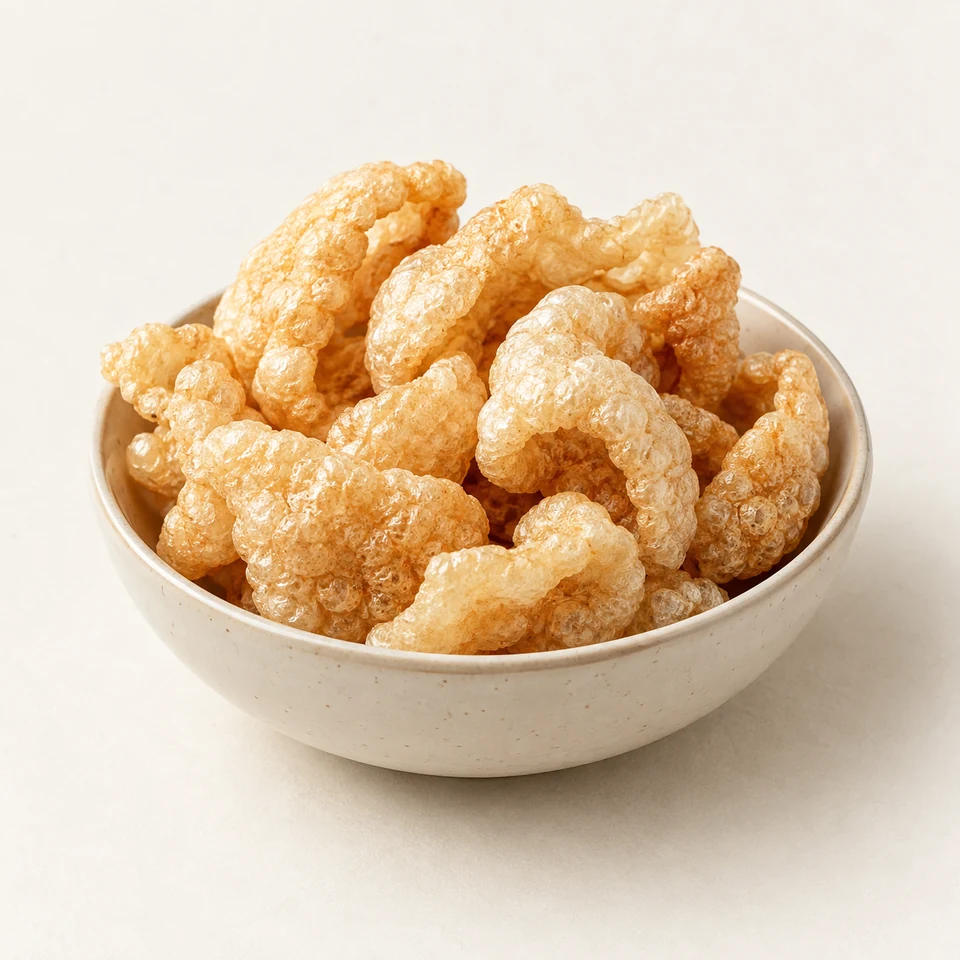
Crisped pork rind is light, brittle, and blistered, with a savoury pork flavour and a pronounced fried or roasted character. Other preparations may be softer and involve boiling before frying or seasoning after cooking. The final texture depends on whether the skin is rendered, dried, fried, boiled, or otherwise processed.
Pork rind may be sold as whole sheets, pieces, curls, or packaged snack-like pieces. Crisped forms have a visibly blistered appearance, while softer cooked rind is described separately in some culinary contexts. Boiling, drying, rendering, frying, and seasoning change its shape, texture, surface, and flavour.
- Ingredient type
- whole food
FOLLOW IT TO THE PLATE
Where will you meet it?
Explore the dishes that use this ingredient and their country and cuisine connections.
Explore linked dishesON A MENU OR LABEL
Find local names and written forms to help recognise this ingredient.
See local namesWhere pork rind appears
16 linked foodsFind foods to recognise by country and type. Recipes and products vary; these are recorded ingredient connections.
Showing 13–16 of 16
Breads

Street food

Other dishes
Ingredient connections awaiting review · Coverage is still growing, including packaged snacks.
Name examples awaiting language review. Confirm the specific food or product.
Local names for pork rind
Names and romanised forms to recognise on menus and labels.
pork rind
chicharrón de cerdo
couenne de porc
torresmo
Schweineschwarte
cotica di maiale
varkenszwoerd
cansalada
șorici de porc
skwarka
vepřová kůže
свиная шкурка
svinaya shkurka
свиняча шкірка
svyniacha shkirka
χοιρινή πέτσα
choirini petsa
domuz derisi
猪皮
zhū pí
豚皮
buta kawa
돼지껍데기
dwaeji-kkeopdegi
सूअर की खाल
sūar kī khāl
শূকরের চামড়া
śūkarer cāmaṛā
பன்றித் தோல்
paṉṟit tōl
หนังหมู
nǎng mǔu
da heo
kulit babi
kulit babi
جلد الخنزير
jild al-khinzīr
choirini petsa
Romanised form
buta kawa
Romanised form
pork rind (cooked in vegetable fat)
Search alias · Not a confirmed translation
paṉṟit tōl
Romanised form
jild al-khinzīr
Romanised form
svyniacha shkirka
Romanised form
dwaeji-kkeopdegi
Romanised form
śūkarer cāmaṛā
Romanised form
zhū pí
Romanised form
sūar kī khāl
Romanised form
svinaya shkurka
Romanised form
nǎng mǔu
Romanised form
Available names only. Languages may be spoken in other countries; a name alone does not identify every ingredient in a dish.
Name not available yet.
A name in English has not been added for pork rind. Choose another language to see its available names.
Pork rind nutrition & diet
Pork rind nutritional value
Pork skin rinds
Per 100 g of the edible portion in the recorded USDA food form.
- Calories
- 544kcal
- Protein
- 61.3g
- Carbs
- 0.0g
- Fat
- 31.3g
Reference values per 100 g for the displayed USDA form. Varieties, recipes, brands and preparation can differ.
Portions & preparation
Clarify whether the item is boiled skin, fried pork rind, dried crackling, or a garnish, and whether attached fat remains. Cooking and dehydration alter texture and edible yield. Seasonings, coatings, frying fat, and flavored commercial products should be recorded rather than treated as part of plain pig skin.
Compare the right form: Match references to the exact pig-skin form—boiled, fried, dried, or crackling—with attached fat, frying medium, seasoning, and edible portion specified.
Diet considerations
Pork rind is animal-derived pig skin, sometimes served with attached fat. Plain skin differs from seasoned, coated, fried, or commercially flavored products. Cereal coatings, starch seasonings, sweet flavorings, and blended frying fats can change compatibility and carbohydrate patterns; brand formulation matters for packaged versions.
AI-authored reading notes · Awaiting editorial review. Measured values, where available, have a separate source above.
Dietary compatibility
- VeganTypically incompatible
- VegetarianTypically incompatible
- PescatarianTypically incompatible
- KetoMay be compatible
- PaleoMay be compatible
- Low-carbMay be compatible
- HalalTypically incompatible
- KosherTypically incompatible
What these diet assessments mean
- Vegan · Typically incompatible
- The ingredient profile identifies an animal-derived food or derivative.
- Vegetarian · Typically incompatible
- The profile identifies animal flesh, seafood or a derivative excluded by a vegetarian diet.
- Pescatarian · Typically incompatible
- The profile identifies land-animal meat or a derivative, which is excluded by this pescatarian definition.
- Keto · May be compatible
- The plain form may fit a carbohydrate-restricted diet. Check the portion, added sugar, coatings and sauces against the nutrition values above.
- Paleo · May be compatible
- May fit a paleo pattern, depending on the cut or form, processing and added ingredients.
- Low-carb · May be compatible
- The plain form may fit a carbohydrate-restricted diet. Check the portion, added sugar, coatings and sauces against the nutrition values above.
- Halal · Typically incompatible
- This profile identifies pork or a pork-derived ingredient.
- Kosher · Typically incompatible
- This profile identifies pork or a pork-derived ingredient.
For the plain ingredient · Awaiting review. Diet compatibility is not allergy suitability or halal/kosher certification. Keto and low-carb depend on the portion.
AI-generated illustration for visual context. It does not identify a particular product or establish allergen content.
Sources & review
Nutrition reference: USDA FoodData Central — Pork skin rinds ↗. Values are scaled from 100 g of the recorded edible form. Individual portions have no assumed fixed weight.
Expanded overview, name examples and nutrition notes are database drafts awaiting editorial review. Numeric nutrition values, where shown, have their own source and food-form reference.
The ingredient description and dish connections come from the draft catalogue and may change after review.
Last recorded verification: .