
Tapioca Pearls
Tapioca pearls are chewy starch-based spheres used in desserts and drinks such as bubble tea.
About Tapioca Pearls
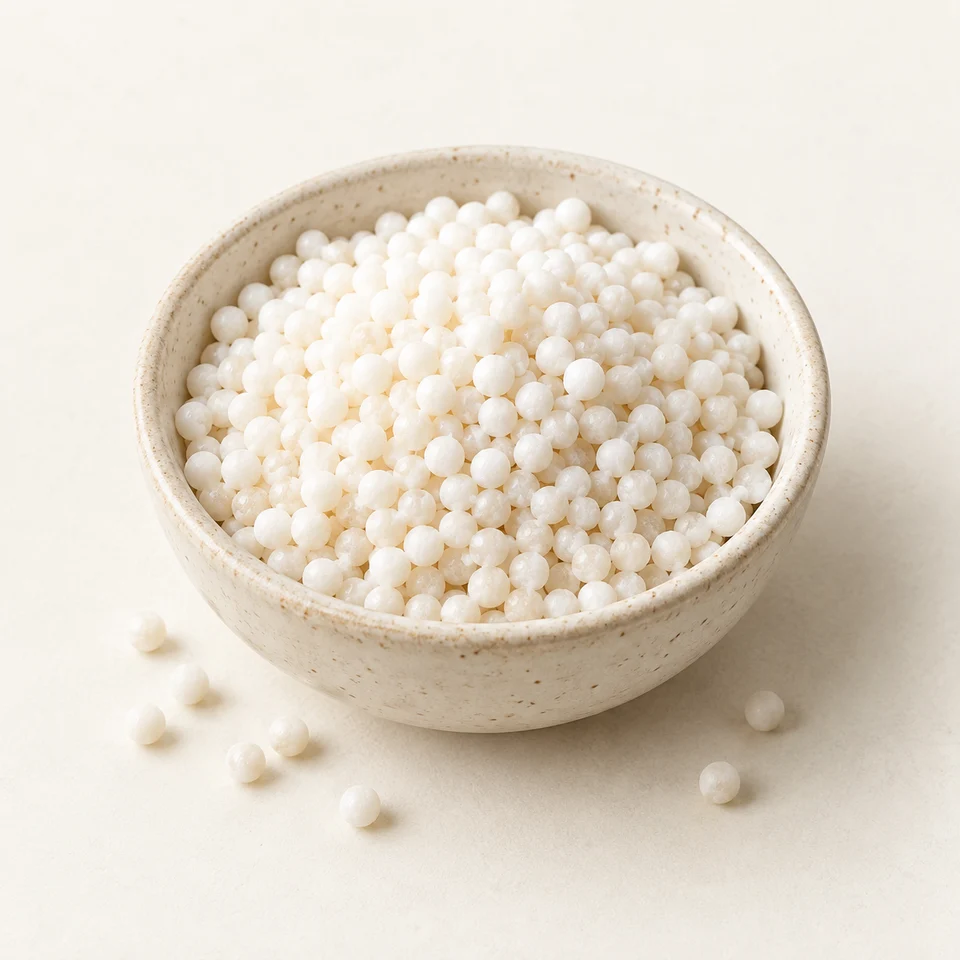
Tapioca pearls are rounded pieces formed from cassava starch, usually dried before sale. They are used in sweet puddings, fruit-based desserts, and milk or tea drinks, including the chewy spheres served in bubble tea.
The pearls have a mild flavour. When cooked, they become soft, slippery, and chewy, with a translucent appearance. Cooking time and diameter strongly affect the final texture, so small, large, quick-cooking, and conventional products should not be assumed equivalent.
They range from small beads to large spheres and may be white, cream, or coloured. Some are sold as quick-cooking or pre-cooked products, while others require soaking or boiling. Hydration and heat swell and soften the dried pieces; syrups, dairy, tea, or other accompanying ingredients further alter the finished appearance and texture.
- Ingredient type
- derived ingredient
Forms & related ingredients
FOLLOW IT TO THE PLATE
Where will you meet it?
Explore the dishes that use this ingredient and their country and cuisine connections.
Explore linked dishesON A MENU OR LABEL
Find local names and written forms to help recognise this ingredient.
See local namesWhere tapioca pearls appears
4 linked foodsFind foods to recognise by country and type. Recipes and products vary; these are recorded ingredient connections.
Showing 1–4 of 4
Desserts


Salads

Avocat au tapioca ou au gari
Optional additionIngredient connections awaiting review · Coverage is still growing, including packaged snacks.
Name examples awaiting language review. Confirm the specific food or product.
Local names for tapioca pearls
Names and romanised forms to recognise on menus and labels.
Tapioca pearls
Boba
Pérolas de tapioca
Perles de tapioca
Perlas de tapioca
Tapiokaperlen
Perle di tapioca
Tapiocaparels
タピオカパール
Tapioka pāru
타피오카 펄
Tap’ioka peol
珍珠
Zhēnzhū
Mutiara tapioka
ไข่มุกมันสำปะหลัง
Khai muk man sam-palang
Tapioka pāru
Romanised form
dry tapioca pearls
Search alias · Not a confirmed translation
Tapioca ou perles du Japon, cru
Search alias · Not a confirmed translation
Tapioca, pearl or seed style, boiled, no added fat or salt
Search alias · Not a confirmed translation
Tapioca, pearl or seed style, uncooked
Search alias · Not a confirmed translation
Tapioca, pearl, dry
Search alias · Not a confirmed translation
Tap’ioka peol
Romanised form
Zhēnzhū
Romanised form
Khai muk man sam-palang
Romanised form
Available names only. Languages may be spoken in other countries; a name alone does not identify every ingredient in a dish.
Name not available yet.
A name in English has not been added for tapioca pearls. Choose another language to see its available names.
Tapioca Pearls nutrition & diet
Tapioca Pearls nutritional value
Tapioca, pearl, dry
Per 100 g of the edible portion in the recorded food form.
- Calories
- 358kcal
- Protein
- 0.2g
- Carbs
- 88.7g
- Fat
- 0.0g
Reference values for the specific food form shown. Other varieties, brands and preparations can differ.
Portions & preparation
Treat tapioca pearls as a concentrated starch component and consider the serving alongside the beverage or dessert base. Cooking changes firmness and water content; sweetened, colored, filled, or flavored pearls require their own ingredient review. Drain thoroughly after cooking when used in drinks or puddings.
Compare the right form: Match references to cooked tapioca pearls as served, or specify dry uncooked pearls; include size, color, filling, coating, and preparation.
Diet considerations
Tapioca pearls originate from cassava and are plant-derived, but prepared products may include sugar syrups, dairy drinks, gelatin, colorings, or other additions. Compatibility therefore depends on the complete recipe, processing aids, coatings, and the carbohydrate contribution of the portion served.
AI-authored reading notes · Awaiting editorial review. Measured values, where available, have a separate source above.
Dietary compatibility
- VeganNot established
- VegetarianNot established
- PescatarianNot established
- KetoNot established
- PaleoNot established
- Low-carbNot established
- HalalNot established
- KosherNot established
What these diet assessments mean
- Vegan · Not established
- The available profile does not establish the full composition or processing for this dietary pattern.
- Vegetarian · Not established
- The available profile does not establish the full composition or processing for this dietary pattern.
- Pescatarian · Not established
- The available profile does not establish the full composition or processing for this dietary pattern.
- Keto · Not established
- A defined serving and sourced carbohydrate data are needed before assessing this dietary pattern.
- Paleo · Not established
- The ingredient form and processing have not been assessed against this dietary pattern.
- Low-carb · Not established
- A defined serving and sourced carbohydrate data are needed before assessing this dietary pattern.
- Halal · Not established
- Sourcing, processing and any applicable certification have not been verified. A food name alone does not establish halal status.
- Kosher · Not established
- Sourcing, processing and any applicable certification have not been verified. A food name alone does not establish kosher status.
For the plain ingredient · Awaiting review. Diet compatibility is not allergy suitability or halal/kosher certification. Keto and low-carb depend on the portion.
AI-generated illustration for visual context. It does not identify a particular product or establish allergen content.
Sources & review
Nutrition reference: USDA FoodData Central — Tapioca, pearl, dry ↗. Values are scaled from 100 g of the recorded edible form. Individual portions have no assumed fixed weight.
Expanded overview, name examples and nutrition notes are database drafts awaiting editorial review. Numeric nutrition values, where shown, have their own source and food-form reference.
The ingredient description and dish connections come from the draft catalogue and may change after review.
Last recorded verification: .