
Corn on the Cob
Corn on the cob is an intact ear of corn with its kernels attached, commonly boiled, steamed, grilled, or roasted.
About Corn on the Cob
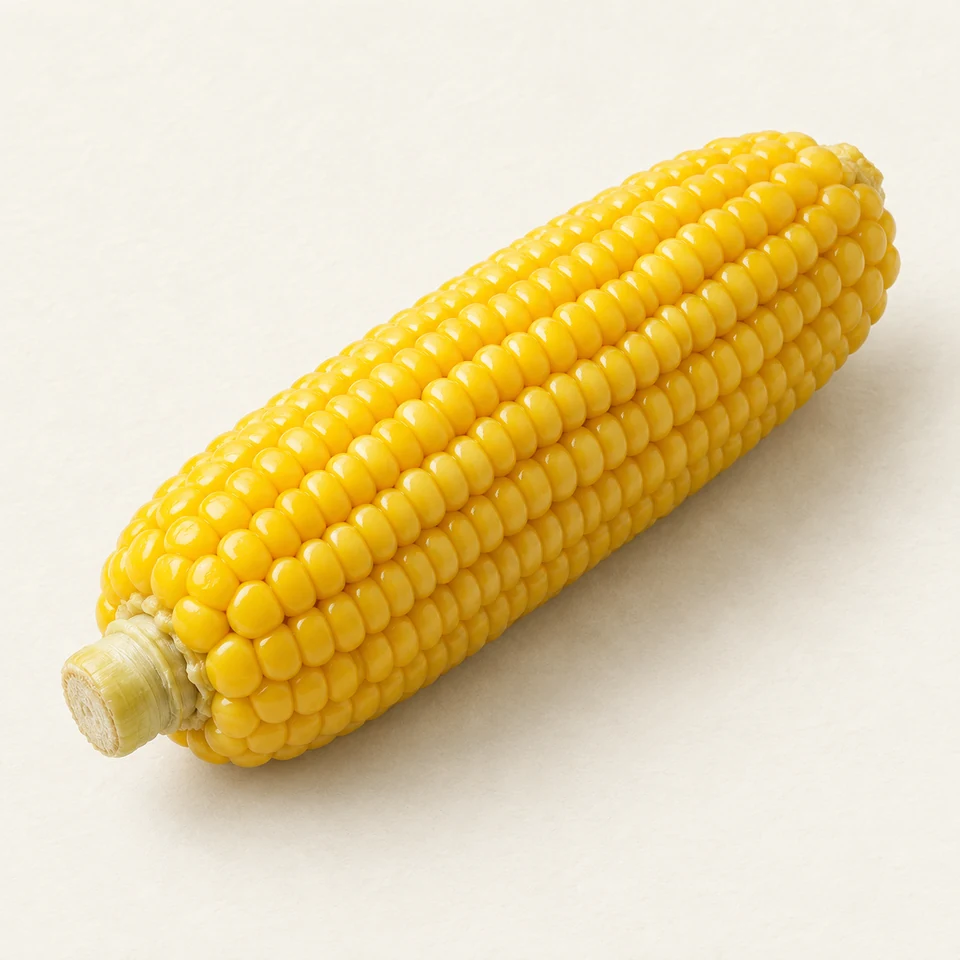
Corn on the cob is an intact ear of corn with the kernels attached to the central cob and usually covered by husks before preparation. The kernels may be yellow, white, or multicoloured, and range from tender and juicy to firmer and starchier according to maturity and variety. The cob gives the ear its characteristic elongated shape and makes it suitable for hand-held eating.
It is commonly boiled, steamed, grilled, roasted, or cooked over a fire, then eaten directly from the cob or served with seasonings and other accompaniments. It may be sold fresh with husks on or removed.
Cooking changes the kernels’ tenderness, moisture, aroma, and surface colour, while the cob remains inedible or is discarded after eating. Fresh ears are generally handled whole, although the kernels may be cut away after cooking for use in other dishes.
- Ingredient type
- whole food
FOLLOW IT TO THE PLATE
Where will you meet it?
Explore the dishes that use this ingredient and their country and cuisine connections.
Explore linked dishesON A MENU OR LABEL
Find local names and written forms to help recognise this ingredient.
See local namesWhere corn on the cob appears
5 linked foodsFind foods to recognise by country and type. Recipes and products vary; these are recorded ingredient connections.
Showing 1–5 of 5
Main dishes
Soups

Sancocho de Cola
Optional additionSancocho de Guandú
Optional additionSancocho de Pescado
Optional additionIngredient connections awaiting review · Coverage is still growing, including packaged snacks.
Name examples awaiting language review. Confirm the specific food or product.
Local names for corn on the cob
Names and romanised forms to recognise on menus and labels.
mazorca de maíz
épi de maïs
Corn on the Cob
corn on the cob
Maiskolben
pannocchia di mais
espiga de milho
panotxa de blat de moro
maïskolf
kolba kukurydzy
kukuřičný klas
kukuricový klas
kukoricacső
știulete de porumb
початок кукурузы
pochatok kukuruzy
качан кукурудзи
kachan kukurudzy
царевичен кочан
tsarevichen kochan
καλαμπόκι στο στάχυ
kalampóki sto stáchi
koçan mısır
كوز الذرة
kūz adh-dhurra
بلال
bolāl
קלח תירס
kelaḥ tiras
玉米棒
yùmǐ bàng
とうもろこしの穂
tōmorokoshi no ho
옥수수 이삭
oksusu isak
भुट्टा
bhuṭṭā
ভুট্টার মোচা
bhuṭṭār mocā
சோளக்கதிர்
cōḷakkatir
మొక్కజొన్న కంకి
mokkajonna kaṅki
ಜೋಳದ ತೆನೆ
jōḷada tene
jagung tongkol
jagung bertongkol
bắp ngô nguyên trái
ข้าวโพดทั้งฝัก
khâao-phôt tháng fàk
mahindi kwenye gunzi
kalampóki sto stáchi
Romanised form
jōḷada tene
Romanised form
tōmorokoshi no ho
Romanised form
cōḷakkatir
Romanised form
kūz adh-dhurra
Romanised form
kachan kukurudzy
Romanised form
oksusu isak
Romanised form
bhuṭṭār mocā
Romanised form
yùmǐ bàng
Romanised form
bhuṭṭā
Romanised form
pochatok kukuruzy
Romanised form
tsarevichen kochan
Romanised form
kelaḥ tiras
Romanised form
bolāl
Romanised form
khâao-phôt tháng fàk
Romanised form
mokkajonna kaṅki
Romanised form
Available names only. Languages may be spoken in other countries; a name alone does not identify every ingredient in a dish.
Name not available yet.
A name in English has not been added for corn on the cob. Choose another language to see its available names.
Corn on the Cob nutrition & diet
Corn on the Cob nutritional value
Corn, fresh on cob, raw
Per 100 g of the edible portion in the stated food form.
- Calories
- 88.2kcal
- Protein
- 3.6g
- Carbs
- 12.5g
- Fat
- 1.8g
Reference values apply to the named food form, not every preparation, variety or brand. © Food Standards Australia New Zealand. AFCD Release 3, food F003209. Available carbohydrate excludes sugar alcohols; energy converted from kJ to kcal (÷4.184). Australian data may not be appropriate for use in other countries. There are limitations associated with food composition databases. Food composition data used in the database or databases may represent an average of the nutrient content of a particular sample of foods and ingredients, determined at a particular time. The nutrient composition of foods and ingredients can vary substantially between batches and brands because of a number of factors, including changes in season, processing practices and ingredient source, and methods of calculation. Data licensed under the FSANZ Data User Licence Agreement, based on CC BY-SA 3.0 AU: https://www.foodstandards.gov.au/science-data/monitoringnutrients/afcd/datauserlicenceagreement.
Portions & preparation
Reference the edible kernels, not the cob, husk, or silk, and state whether the ear is raw, boiled, steamed, grilled, or roasted. Record butter, oil, cheese, salt, or sauces separately. Ear size and kernel removal affect the comparable edible portion.
Compare the right form: Match an intact maize ear in the same raw or cooked state; calculate the edible kernels separately from cob, husk, silk, and toppings.
Diet considerations
Corn on the cob is plant-derived when it is simply maize. Butter, cheese, meat-based seasonings, sauces, or coatings change compatibility. The kernels provide a whole-cereal carbohydrate pattern, with practical interpretation varying by ear size, kernel yield, preparation, and portion.
AI-authored reading notes · Awaiting editorial review. Measured values, where available, have a separate source above.
Dietary compatibility
- VeganTypically compatible
- VegetarianTypically compatible
- PescatarianTypically compatible
- KetoDepends on the version
- PaleoTypically incompatible
- Low-carbDepends on the version
- HalalNot established
- KosherNot established
What these diet assessments mean
- Vegan · Typically compatible
- The plain ingredient profile is plant, fungal or mineral based. Added ingredients in a prepared product need a separate check.
- Vegetarian · Typically compatible
- The plain ingredient profile is plant, fungal or mineral based. Added ingredients in a prepared product need a separate check.
- Pescatarian · Typically compatible
- The plain ingredient profile is plant, fungal or mineral based. Added ingredients in a prepared product need a separate check.
- Keto · Depends on the version
- Compatibility depends on the portion and preparation. A sourced carbohydrate amount for a defined serving is not available.
- Paleo · Typically incompatible
- This profile falls outside the conventional paleo pattern used here (grains and pseudograins, legumes, dairy or refined sugar).
- Low-carb · Depends on the version
- Compatibility depends on the portion and preparation. A sourced carbohydrate amount for a defined serving is not available.
- Halal · Not established
- Sourcing, processing and any applicable certification have not been verified. A food name alone does not establish halal status.
- Kosher · Not established
- Sourcing, processing and any applicable certification have not been verified. A food name alone does not establish kosher status.
For the plain ingredient · Awaiting review. Diet compatibility is not allergy suitability or halal/kosher certification. Keto and low-carb depend on the portion.
AI-generated illustration for visual context. It does not identify a particular product or establish allergen content.
Sources & review
Nutrition reference: Australian Food Composition Database, Release 3, 2025 — Corn, fresh on cob, raw ↗. Values are scaled from 100 g of the recorded edible form. Individual portions have no assumed fixed weight.
Expanded overview, name examples and nutrition notes are database drafts awaiting editorial review. Numeric nutrition values, where shown, have their own source and food-form reference.
The ingredient description and dish connections come from the draft catalogue and may change after review.
Last recorded verification: .