
Jackfruit
Jackfruit is a large tropical fruit eaten ripe as a sweet fruit or unripe as a savory cooking ingredient.
About Jackfruit
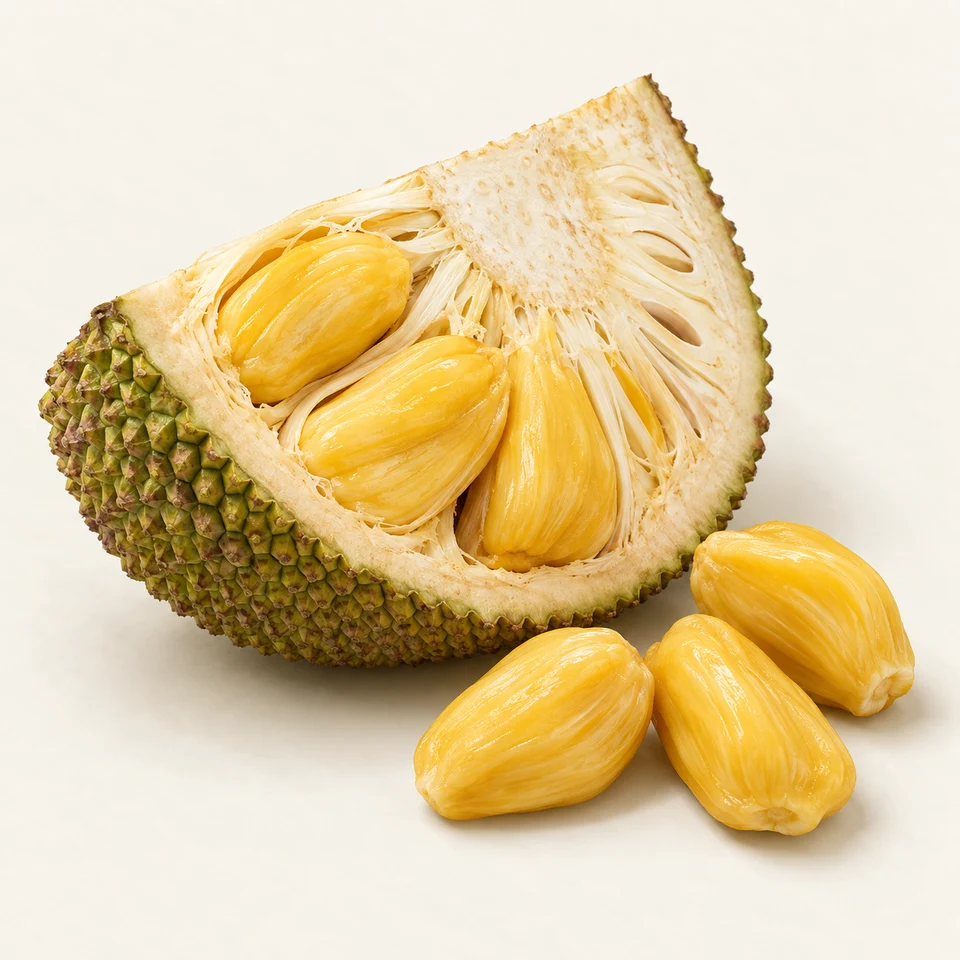
Jackfruit is the large fruit of a tropical tree, with a green to yellow-brown rind covered in blunt spines. Inside are clusters of sweet, fragrant yellow-orange bulbs surrounding seeds. Ripe bulbs are soft and fibrous, while young, unripe flesh is paler, firmer, and much less sweet.
Ripe jackfruit is eaten fresh or used in desserts, drinks, and preserves. Young jackfruit is used as a savoury ingredient in curries, braises, stir-fries, and other spiced dishes. Its flavour therefore ranges from sweet and aromatic when ripe to mild and vegetal when unripe.
It is sold as a whole fruit, prepared bulbs, canned pieces, frozen portions, or packaged young flesh. Ripening changes the colour, sweetness, and softness of the fruit. Cooking young flesh makes it tender and separates it into strands; the seeds may also be cooked separately.
- Ingredient type
- whole food
FOLLOW IT TO THE PLATE
Where will you meet it?
Explore the dishes that use this ingredient and their country and cuisine connections.
Explore linked dishesON A MENU OR LABEL
Find local names and written forms to help recognise this ingredient.
See local namesWhere jackfruit appears
6 linked foodsFind foods to recognise by country and type. Recipes and products vary; these are recorded ingredient connections.
Showing 1–6 of 6
Main dishes
Desserts
Turon
Optional additionSoups

Rice dishes
Ingredient connections awaiting review · Coverage is still growing, including packaged snacks.
Name examples awaiting language review. Confirm the specific food or product.
Local names for jackfruit
Names and romanised forms to recognise on menus and labels.
Nangka
nangka
कटहल
kaṭhal
কাঁঠাল
kāṭhāl
பலாப்பழம்
palāppaḻam
Jackfruit
jackfruit
nangka
nangka
nangka
nangka
nangka
ಹಲಸು
halasu
ചക്ക
cakka
කොස්
kos
పనసపండు
panasapaṇḍu
ફણસ
phaṇasa
फणस
phaṇasa
ਕਟਹਲ
kaṭahal
कटहर
kaṭahar
کٹھل
kaṭhal
菠萝蜜
bōluómì
ジャックフルーツ
jakkufurūtsu
잭프루트
jaekpeuruteu
ขนุน
khanun
ខ្នុរ
khnŏr
mít
fenesi
جاك فروت
jāk frūt
جکفروت
jakforut
jackfruit
джекфрут
dzhekfrut
jackfruit
Jackfrucht
jackfruit
fruit du jacquier
jaca
jaca
jackfruit
kaṭahar
Romanised form
halasu
Romanised form
jakkufurūtsu
Romanised form
jackfruit (raw)
Search alias · Not a confirmed translation
Jackfruit, Canned, Syrup
Search alias · Not a confirmed translation
Jackfruit, peeled, raw
Search alias · Not a confirmed translation
khnŏr
Romanised form
palāppaḻam
Romanised form
jāk frūt
Romanised form
jaekpeuruteu
Romanised form
kāṭhāl
Romanised form
kos
Romanised form
bōluómì
Romanised form
kaṭhal
Romanised form
cakka
Romanised form
kaṭhal
Romanised form
dzhekfrut
Romanised form
jakforut
Romanised form
phaṇasa
Romanised form
phaṇasa
Romanised form
khanun
Romanised form
kaṭahal
Romanised form
panasapaṇḍu
Romanised form
Available names only. Languages may be spoken in other countries; a name alone does not identify every ingredient in a dish.
Name not available yet.
A name in English has not been added for jackfruit. Choose another language to see its available names.
Jackfruit nutrition & diet
Jackfruit nutritional value
Jackfruit, raw
Per 100 g of the edible portion in the recorded food form.
- Calories
- 95kcal
- Protein
- 1.7g
- Carbs
- 23.3g
- Fat
- 0.6g
Reference values for the specific food form shown. Other varieties, brands and preparations can differ.
Portions & preparation
Separate ripe fruit flesh from unripe cooking jackfruit, since maturity changes texture, preparation, and how the ingredient is used. Match references to the edible bulbs after removing rind, core, and seeds. Canned, sweetened, brined, or cooked versions require their own preparation and liquid assumptions.
Compare the right form: Match ripe or unripe jackfruit flesh, with edible bulbs separated from rind, core, and seeds; distinguish fresh, canned, brined, and cooked forms.
Diet considerations
Jackfruit is a plant-derived fruit. Ripe flesh is commonly used as a sweet food, while unripe flesh is used in savory preparations. Compatibility changes with syrup, brine, sauces, batter, or accompanying meat and dairy. Portion and maturity affect carbohydrate patterns and culinary role.
AI-authored reading notes · Awaiting editorial review. Measured values, where available, have a separate source above.
Dietary compatibility
- VeganTypically compatible
- VegetarianTypically compatible
- PescatarianTypically compatible
- KetoDepends on the version
- PaleoTypically compatible
- Low-carbDepends on the version
- HalalNot established
- KosherNot established
What these diet assessments mean
- Vegan · Typically compatible
- The plain ingredient profile is plant, fungal or mineral based. Added ingredients in a prepared product need a separate check.
- Vegetarian · Typically compatible
- The plain ingredient profile is plant, fungal or mineral based. Added ingredients in a prepared product need a separate check.
- Pescatarian · Typically compatible
- The plain ingredient profile is plant, fungal or mineral based. Added ingredients in a prepared product need a separate check.
- Keto · Depends on the version
- Compatibility depends on the portion and preparation. A sourced carbohydrate amount for a defined serving is not available.
- Paleo · Typically compatible
- The plain form fits the conventional paleo food groups. Added ingredients and individual interpretations can differ.
- Low-carb · Depends on the version
- Compatibility depends on the portion and preparation. A sourced carbohydrate amount for a defined serving is not available.
- Halal · Not established
- Sourcing, processing and any applicable certification have not been verified. A food name alone does not establish halal status.
- Kosher · Not established
- Sourcing, processing and any applicable certification have not been verified. A food name alone does not establish kosher status.
For the plain ingredient · Awaiting review. Diet compatibility is not allergy suitability or halal/kosher certification. Keto and low-carb depend on the portion.
AI-generated illustration for visual context. It does not identify a particular product or establish allergen content.
Sources & review
Nutrition reference: USDA FoodData Central — Jackfruit, raw ↗. Values are scaled from 100 g of the recorded edible form. Individual portions have no assumed fixed weight.
Expanded overview, name examples and nutrition notes are database drafts awaiting editorial review. Numeric nutrition values, where shown, have their own source and food-form reference.
The ingredient description and dish connections come from the draft catalogue and may change after review.
Last recorded verification: .