
Rice noodles
Rice noodles are tender noodles commonly served in soups, salads, stir-fries, and other Asian dishes.
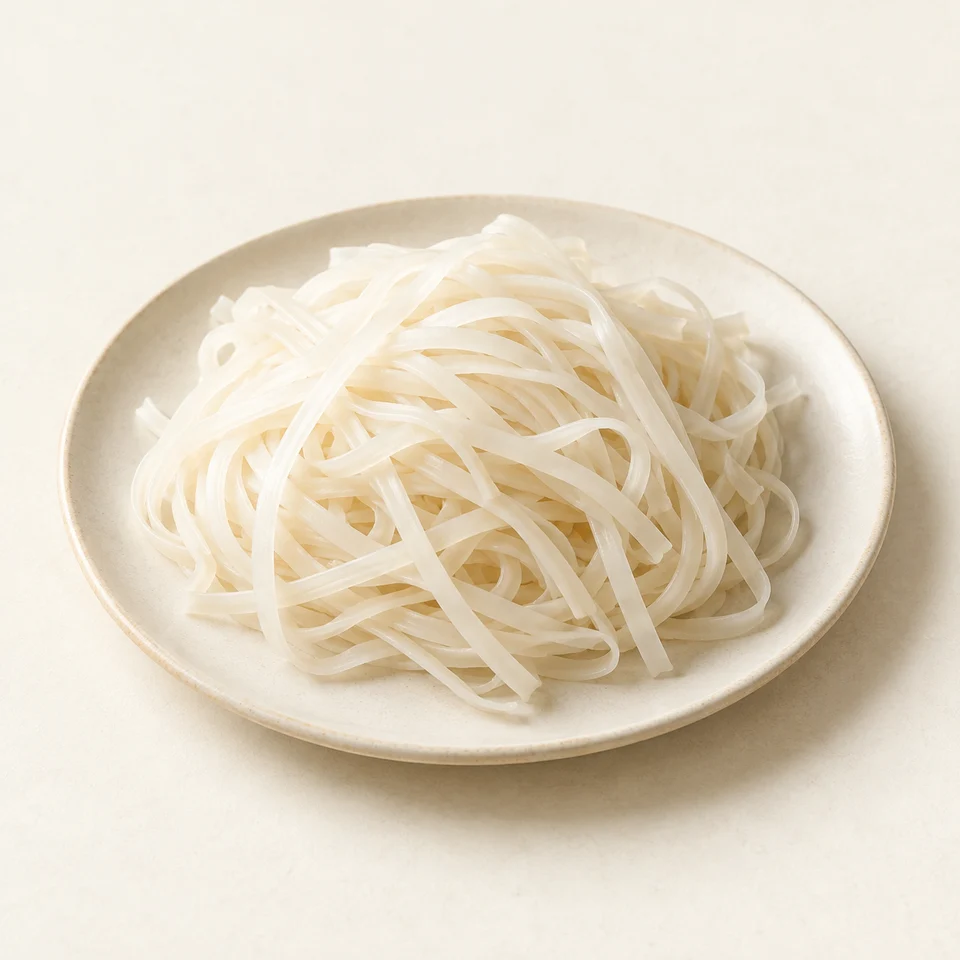
About Rice noodles
Rice noodles are noodles made primarily from rice flour and water, sometimes with additional ingredients that affect firmness or elasticity. They may be thin or wide, round or flat, and fresh, dried, steamed, or partially cooked. Their colour is generally white to translucent, with a mild flavour and a tender, slippery, or lightly springy texture.
They are used in soups, salads, stir-fries, rolls, and other dishes in which they absorb sauces and broths. Dried noodles are usually soaked or boiled before use, while fresh noodles may be added directly or briefly reheated. Thickness, shape, and processing determine whether the cooked noodle is delicate, chewy, or more resistant to breaking.
Rice noodles are sold as loose strands, bundles, sheets, or packaged portions. They may look white, cream, or slightly translucent before or after cooking. Soaking, boiling, steaming, or stir-frying softens them and changes their flexibility, surface slipperiness, and resistance to breaking.
- Ingredient type
- whole food
FOLLOW IT TO THE PLATE
Where will you meet it?
Explore the dishes that use this ingredient and their country and cuisine connections.
Explore linked dishesON A MENU OR LABEL
Find local names and written forms to help recognise this ingredient.
See local namesWhere rice noodles appears
35 linked foodsFind foods to recognise by country and type. Recipes and products vary; these are recorded ingredient connections.
Showing 1–12 of 35
Soups


Noodle dishes


Ingredient connections awaiting review · Coverage is still growing, including packaged snacks.
Name examples awaiting language review. Confirm the specific food or product.
Local names for rice noodles
Names and romanised forms to recognise on menus and labels.
米粉
mǐfěn
เส้นก๋วยเตี๋ยว
sen kuai tiao
Bún
Rice noodles
Nouilles de riz
Reisnudeln
Fideos de arroz
Macarrão de arroz
Tagliatelle di riso
Rijstnoedels
Makaron ryżowy
Рисовая лапша
risovaya lapsha
Рисова локшина
rysova lokshyna
Pirinç eriştesi
Νουντλς ρυζιού
nountls ryzioú
米粉
mǐfěn
米麺
beimen
쌀국수
ssalguksu
Mì gạo
Mi beras
Mi beras
चावल के नूडल्स
chāval ke nūḍals
nountls ryzioú
Romanised form
beimen
Romanised form
dry rice noodles
Search alias · Not a confirmed translation
Rice noodles, cooked
Search alias · Not a confirmed translation
Rice noodles, dry
Search alias · Not a confirmed translation
rysova lokshyna
Romanised form
ssalguksu
Romanised form
mǐfěn
Romanised form
chāval ke nūḍals
Romanised form
risovaya lapsha
Romanised form
sen kuai tiao
Romanised form
Available names only. Languages may be spoken in other countries; a name alone does not identify every ingredient in a dish.
Name not available yet.
A name in English has not been added for rice noodles. Choose another language to see its available names.
Rice noodles nutrition & diet
Rice noodles nutritional value
Rice noodles, dry
Per 100 g of the edible portion in the recorded food form.
- Calories
- 364kcal
- Protein
- 6.0g
- Carbs
- 80.2g
- Fat
- 0.6g
Reference values for the specific food form shown. Other varieties, brands and preparations can differ.
Portions & preparation
Use a reference for cooked or dry rice noodles that matches the catalogue entry, since water absorption changes the serving form. Distinguish plain noodles from seasoned, fried, stuffed, or instant products. Preparation with oil, broth, sauces, vegetables, meat, seafood, or eggs changes the dish substantially.
Compare the right form: Reference plain rice noodles in the stated dry or cooked form, with noodle thickness and any seasoning, coating, or added ingredients identified.
Diet considerations
Plain rice noodles are plant-derived from rice, but packaged or prepared versions may include wheat or other cereals, egg, seafood, meat, or dairy-based sauces. Soup, salad, and stir-fry combinations change compatibility and portion-dependent carbohydrate patterns. Coatings and flavor packets require separate ingredient review.
AI-authored reading notes · Awaiting editorial review. Measured values, where available, have a separate source above.
Dietary compatibility
- VeganNot established
- VegetarianNot established
- PescatarianNot established
- KetoDepends on the version
- PaleoTypically incompatible
- Low-carbDepends on the version
- HalalNot established
- KosherNot established
What these diet assessments mean
- Vegan · Not established
- The available profile does not establish the full composition or processing for this dietary pattern.
- Vegetarian · Not established
- The available profile does not establish the full composition or processing for this dietary pattern.
- Pescatarian · Not established
- The available profile does not establish the full composition or processing for this dietary pattern.
- Keto · Depends on the version
- Compatibility depends on the portion and preparation. A sourced carbohydrate amount for a defined serving is not available.
- Paleo · Typically incompatible
- This profile falls outside the conventional paleo pattern used here (grains and pseudograins, legumes, dairy or refined sugar).
- Low-carb · Depends on the version
- Compatibility depends on the portion and preparation. A sourced carbohydrate amount for a defined serving is not available.
- Halal · Not established
- Sourcing, processing and any applicable certification have not been verified. A food name alone does not establish halal status.
- Kosher · Not established
- Sourcing, processing and any applicable certification have not been verified. A food name alone does not establish kosher status.
For the plain ingredient · Awaiting review. Diet compatibility is not allergy suitability or halal/kosher certification. Keto and low-carb depend on the portion.
AI-generated illustration for visual context. It does not identify a particular product or establish allergen content.
Sources & review
Nutrition reference: USDA FoodData Central — Rice noodles, dry ↗. Values are scaled from 100 g of the recorded edible form. Individual portions have no assumed fixed weight.
Expanded overview, name examples and nutrition notes are database drafts awaiting editorial review. Numeric nutrition values, where shown, have their own source and food-form reference.
The ingredient description and dish connections come from the draft catalogue and may change after review.
Last recorded verification: .