
Baking Powder
Baking powder is a chemical leavening mixture used to make batters and doughs rise.
About Baking Powder
Baking powder is a dry chemical leavening mixture that releases carbon dioxide when moistened and heated. It is incorporated into cakes, biscuits, muffins, pancakes, quick breads, and other batters or doughs that do not rely on yeast fermentation.
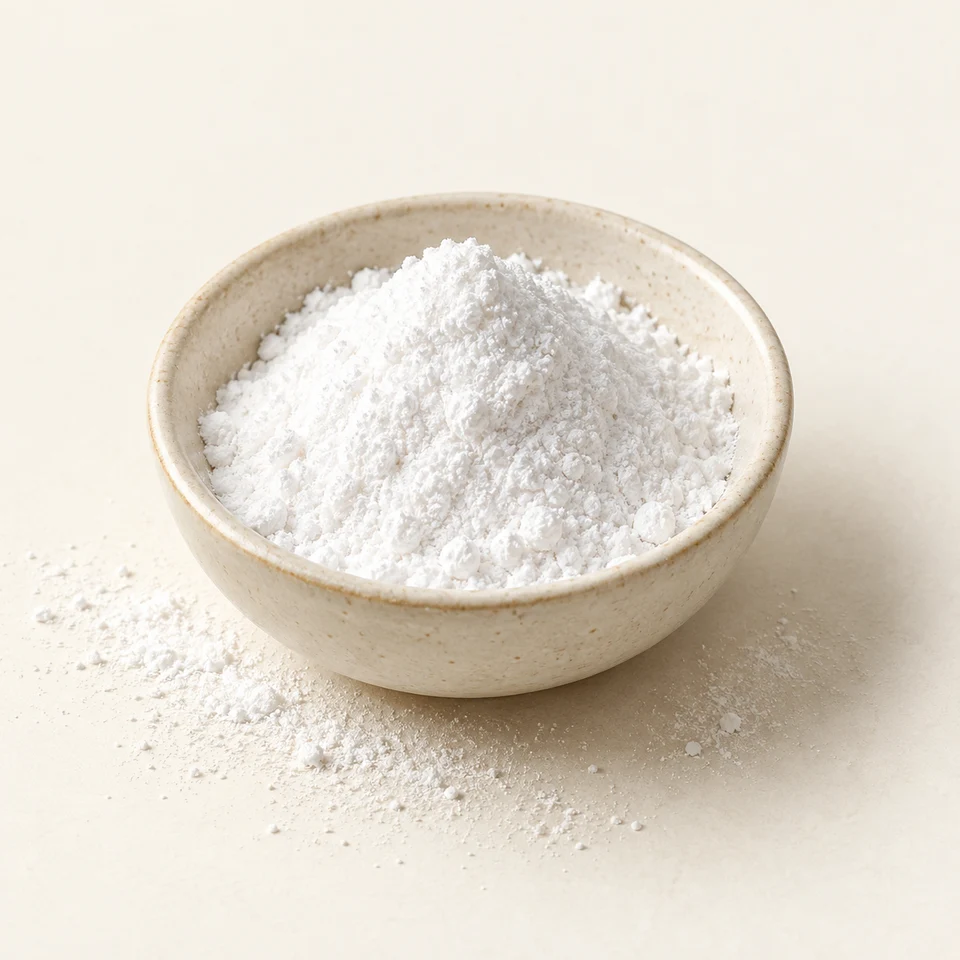
It generally combines a bicarbonate with one or more powdered acids and a starch or similar drying agent. The result is a fine white powder; its flavour is not otherwise specified, though excess or formulation differences can affect the finished baked food.
Single-acting and double-acting products differ in when gas is released. Baking powder may be sold as a standard, low-sodium, or specially balanced blend, and the dry powder becomes dispersed through the batter or dough during mixing before heating develops its leavening effect.
- Ingredient type
- additive
Forms & related ingredients
FOLLOW IT TO THE PLATE
Where will you meet it?
Explore the dishes that use this ingredient and their country and cuisine connections.
Explore linked dishesON A MENU OR LABEL
Find local names and written forms to help recognise this ingredient.
See local namesWhere baking powder appears
52 linked foodsFind foods to recognise by country and type. Recipes and products vary; these are recorded ingredient connections.
Showing 13–24 of 52
Desserts


Kruidnoten
Optional addition

Marquesote
Optional additionNew Mexico biscochitos
Optional additionPouding Chomeur
Optional additionSata Andagi
Optional additionIngredient connections awaiting review · Coverage is still growing, including packaged snacks.
Name examples awaiting language review. Confirm the specific food or product.
Local names for baking powder
Names and romanised forms to recognise on menus and labels.
baking powder
levure chimique
Backpulver
levure chimique
polvo de hornear
lievito in polvere
fermento em pó
bakpoeder
proszek do pieczenia
разрыхлитель теста
razrykhитель testa
розпушувач тіста
rozpushuvach tista
kabartma tozu
ベーキングパウダー
bēkingu paudā
泡打粉
pào dǎ fěn
베이킹파우더
beikingpaudeo
bēkingu paudā
Romanised form
Baking powder, dry powder
Search alias · Not a confirmed translation
rozpushuvach tista
Romanised form
beikingpaudeo
Romanised form
pào dǎ fěn
Romanised form
razrykhитель testa
Romanised form
Available names only. Languages may be spoken in other countries; a name alone does not identify every ingredient in a dish.
Name not available yet.
A name in English has not been added for baking powder. Choose another language to see its available names.
Baking Powder nutrition & diet
Baking Powder nutritional value
Baking powder
Per 100 g of the edible portion in the stated food form.
- Calories
- 163kcal
- Protein
- 5.2g
- Carbs
- 37.8g
- Fat
- 0.0g
Reference values apply to the named food form, not every preparation, variety or brand. CoFID 2021 food code 17-355. Carbohydrate follows the dataset’s available-carbohydrate convention. Contains public sector information licensed under the Open Government Licence v3.0: https://www.nationalarchives.gov.uk/doc/open-government-licence/version/3/.
Portions & preparation
Use the quantity incorporated into the batter or dough and identify single-acting or double-acting baking powder when possible. The surrounding recipe usually contributes most of the food’s composition. Consider whether the powder is mixed into a dry blend, prepared batter, or finished baked item before comparing references.
Compare the right form: Match a reference to commercial baking powder in its dry leavening form, with the specific formulation and serving context identified.
Diet considerations
Baking powder is a formulated additive rather than a plant or animal food. Compatibility depends on the recipe: cereal flours, dairy, eggs, fats, sugars, coatings, and fillings may accompany it. Commercial blends can include different acids, starches, or flavoring ingredients, so brand and recipe details matter.
AI-authored reading notes · Awaiting editorial review. Measured values, where available, have a separate source above.
Dietary compatibility
- VeganMay be compatible
- VegetarianMay be compatible
- PescatarianMay be compatible
- KetoNot established
- PaleoDepends on the version
- Low-carbNot established
- HalalNot established
- KosherNot established
What these diet assessments mean
- Vegan · May be compatible
- The recorded ingredients may fit this pattern. This is not a complete recipe or manufacturing specification; check additions and preparation.
- Vegetarian · May be compatible
- The recorded ingredients may fit this pattern. This is not a complete recipe or manufacturing specification; check additions and preparation.
- Pescatarian · May be compatible
- The recorded ingredients may fit this pattern. This is not a complete recipe or manufacturing specification; check additions and preparation.
- Keto · Not established
- A defined serving and sourced carbohydrate data are needed before assessing this dietary pattern.
- Paleo · Depends on the version
- Optional or variable recorded ingredients: Corn starch. This profile falls outside the conventional paleo pattern used here (grains and pseudograins, legumes, dairy or refined sugar). Recipes and products can differ.
- Low-carb · Not established
- A defined serving and sourced carbohydrate data are needed before assessing this dietary pattern.
- Halal · Not established
- Sourcing, processing and any applicable certification have not been verified. A food name alone does not establish halal status.
- Kosher · Not established
- Sourcing, processing and any applicable certification have not been verified. A food name alone does not establish kosher status.
For the plain ingredient · Awaiting review. Diet compatibility is not allergy suitability or halal/kosher certification. Keto and low-carb depend on the portion.
AI-generated illustration for visual context. It does not identify a particular product or establish allergen content.
Sources & review
Nutrition reference: UK Composition of Foods Integrated Dataset (CoFID), 2021 — Baking powder ↗. Values are scaled from 100 g of the recorded edible form. Individual portions have no assumed fixed weight.
Expanded overview, name examples and nutrition notes are database drafts awaiting editorial review. Numeric nutrition values, where shown, have their own source and food-form reference.
The ingredient description and dish connections come from the draft catalogue and may change after review.
Last recorded verification: .