
Cassava Starch
Cassava starch is a purified starch used to thicken foods and provide elasticity in doughs and noodles.
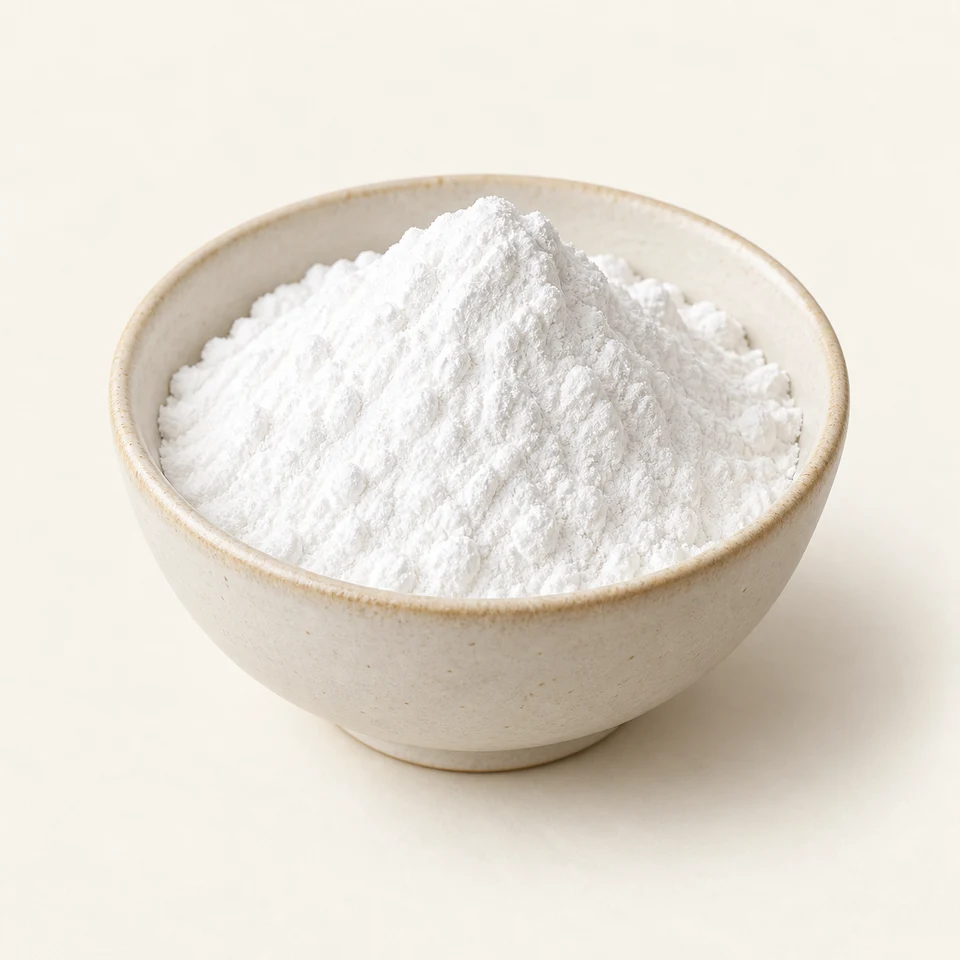
About Cassava Starch
Manioc starch is the purified starch separated from cassava roots and dried into a fine, generally white powder. It is distinct from cassava flour, which is made from more of the processed root. The powder is used as a thickener, binder, and texture modifier in sauces, soups, batters, doughs, puddings, and other preparations.
Manioc starch has little flavour. When heated with liquid, it can form a smooth paste or gel, with the final thickness, elasticity, or translucency determined by hydration and heating. Its sensory contribution is therefore primarily textural rather than aromatic, although the surrounding recipe supplies the dominant flavour.
It may be sold as ordinary starch or in a granulated or pregelatinized form. As a dry powder it is fine and generally white; hydration turns it into a paste or gel, while cooking determines the finished texture. The intended product should be distinguished from cassava flour or a prepared tapioca product.
- Ingredient type
- flour
FOLLOW IT TO THE PLATE
Where will you meet it?
Explore the dishes that use this ingredient and their country and cuisine connections.
Explore linked dishesON A MENU OR LABEL
Find local names and written forms to help recognise this ingredient.
See local namesWhere cassava starch appears
13 linked foodsFind foods to recognise by country and type. Recipes and products vary; these are recorded ingredient connections.
Showing 1–12 of 13
Sides
Snacks

Soups
Breads


Ingredient connections awaiting review · Coverage is still growing, including packaged snacks.
Name examples awaiting language review. Confirm the specific food or product.
Local names for cassava starch
Names and romanised forms to recognise on menus and labels.
fécula de mandioca
almidón de mandioca
Manioc starch
cassava starch
amidon de manioc
amido di manioca
Maniokstärke
maniokzetmeel
skrobia maniokowa
木薯淀粉
mùshǔ diànfěn
キャッサバ澱粉
kyassaba denpun
แป้งมันสำปะหลัง
paeng man sampalang
tinh bột sắn
wanga wa muhogo
kyassaba denpun
Romanised form
maravaḷḷikkiḻaṅku māvu
Romanised form
மரவள்ளிக்கிழங்கு மாவு
midó de mandioca
nashā al-kassāfā
Romanised form
نشا الكسافا
krokhmal manioku
Romanised form
крохмаль маніоку
kasaba jeonbun
Romanised form
카사바 전분
ṭyāpio̯kā sṭārch
Romanised form
ট্যাপিওকা স্টার্চ
mùshǔ diànfěn
Romanised form
ṭaipioka sṭārch
Romanised form
टैपिओका स्टार्च
fécule de manioc
kappappoṭi
Romanised form
കപ്പപ്പൊടി
kanji ubi kayu
manyok nişastası
krakhmal manioka
Romanised form
крахмал маниока
cassavezetmeel
tepung tapioka
neshāste-ye kāsāvā
Romanised form
نشاسته کاساوا
almidón de yuca
paeng man sam-palang
Romanised form
paeng man sampalang
Romanised form
Manioc starch
Search alias · Not a confirmed translation
Manioc Starch
Search alias · Not a confirmed translation
Available names only. Languages may be spoken in other countries; a name alone does not identify every ingredient in a dish.
Name not available yet.
A name in English has not been added for cassava starch. Choose another language to see its available names.
Cassava Starch nutrition & diet
Cassava Starch nutritional value
Starch, cassava starch — MEXT 02028
Per 100 g of the edible portion in the explicitly named reference form.
- Calories
- 354kcal
- Protein
- 0.1g
- Carbs
- 85.3g
- Fat
- 0.2g
Per 100 g edible portion. Values use MEXT 2023 with March 2026 corrections; the English food name is matched by food code from the official English edition. Carbohydrate is total carbohydrate by difference. Values in parentheses in the source are estimates reported by MEXT. This reference does not cover other preparations or brands.
Portions & preparation
Record manioc starch as the dry extracted powder or as a prepared gel, dough, coating, or baked product. Its role as thickener or binder changes the amount used and the surrounding recipe. Document hydration, heating, added fats, sweeteners, and other ingredients rather than treating all uses alike.
Compare the right form: Match a reference to dry cassava-derived manioc starch or the exact cooked, baked, coated, or blended food in which it is used.
Diet considerations
Manioc starch is plant-derived and processed from cassava. Compatibility changes when blended with wheat or other cereal flours, milk, egg, meat, or coatings. As a concentrated starch ingredient, its carbohydrate pattern depends strongly on recipe quantity and serving size; a finished product should be assessed as a recipe.
AI-authored reading notes · Awaiting editorial review. Measured values, where available, have a separate source above.
Dietary compatibility
- VeganNot established
- VegetarianNot established
- PescatarianNot established
- KetoNot established
- PaleoNot established
- Low-carbNot established
- HalalNot established
- KosherNot established
What these diet assessments mean
- Vegan · Not established
- The available profile does not establish the full composition or processing for this dietary pattern.
- Vegetarian · Not established
- The available profile does not establish the full composition or processing for this dietary pattern.
- Pescatarian · Not established
- The available profile does not establish the full composition or processing for this dietary pattern.
- Keto · Not established
- A defined serving and sourced carbohydrate data are needed before assessing this dietary pattern.
- Paleo · Not established
- The ingredient form and processing have not been assessed against this dietary pattern.
- Low-carb · Not established
- A defined serving and sourced carbohydrate data are needed before assessing this dietary pattern.
- Halal · Not established
- Sourcing, processing and any applicable certification have not been verified. A food name alone does not establish halal status.
- Kosher · Not established
- Sourcing, processing and any applicable certification have not been verified. A food name alone does not establish kosher status.
For the plain ingredient · Awaiting review. Diet compatibility is not allergy suitability or halal/kosher certification. Keto and low-carb depend on the portion.
AI-generated illustration for visual context. It does not identify a particular product or establish allergen content.
Sources & review
Nutrition reference: MEXT Standard Tables of Food Composition in Japan, 2023 supplement, corrected March 2026 ↗. Values are scaled from 100 g of the recorded edible form. Individual portions have no assumed fixed weight.
Expanded overview, name examples and nutrition notes are database drafts awaiting editorial review. Numeric nutrition values, where shown, have their own source and food-form reference.
The ingredient description and dish connections come from the draft catalogue and may change after review.
Last recorded verification: .