
Dijon Mustard
Dijon mustard is a pungent prepared mustard used as a condiment, dressing ingredient, and sauce component.
About Dijon Mustard
Dijon mustard is a prepared mustard associated with the Dijon style. It is made from ground mustard seed and an acidic or wine-based liquid, commonly vinegar, wine, or verjuice, with salt and other permitted ingredients. It is used at the table and in vinaigrettes, dressings, mayonnaise, marinades, sandwiches, and pan sauces.
Its flavour is pungent, tart, savoury, and sometimes slightly bitter, with heat that can vary by seed and processing. Most versions are smooth, though some retain fine seed particles. Acidity, saltiness, sweetness, and sharpness differ among formulations and may soften when the mustard is cooked or blended.
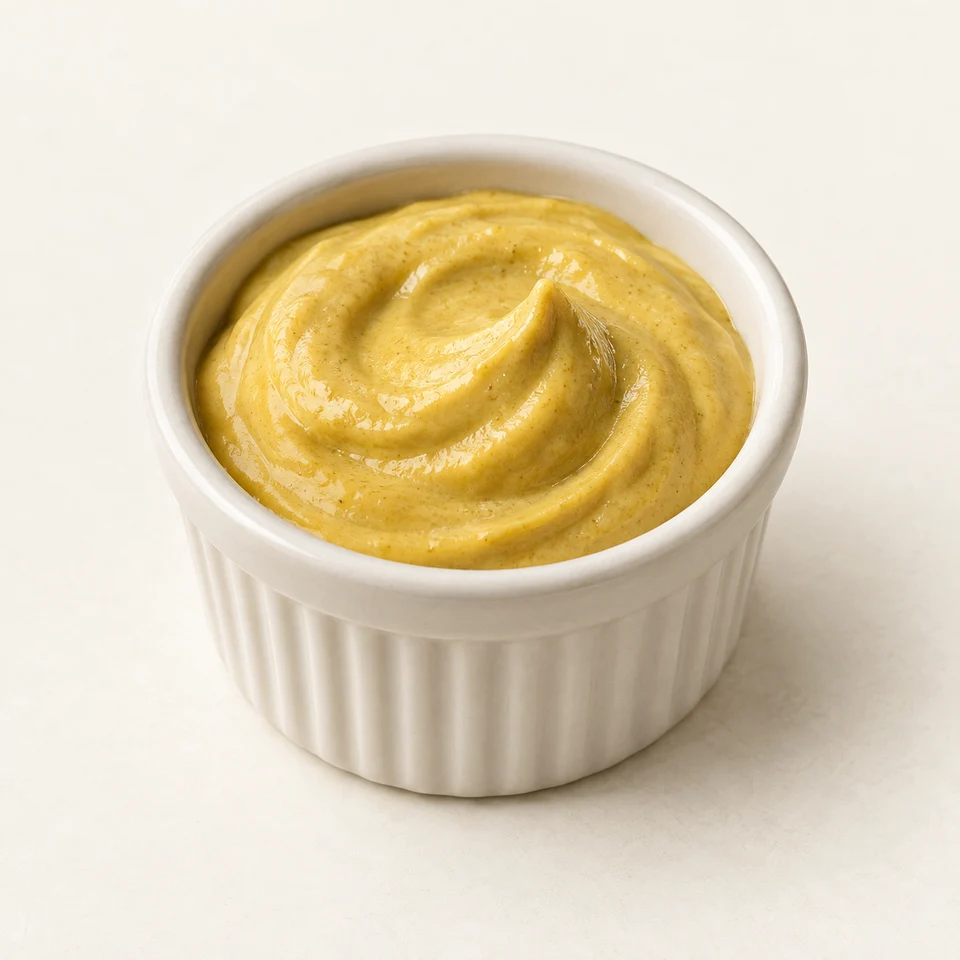
Dijon mustard is usually pale yellow to beige and sold as a thick prepared condiment in jars or similar containers. It may be smooth or mildly grainy. Stirring loosens it, while mixing with oil, cream, mayonnaise, or pan juices produces a thinner sauce and spreads its flavour through the dish.
- Ingredient type
- sauce
Forms & related ingredients
FOLLOW IT TO THE PLATE
Where will you meet it?
Explore the dishes that use this ingredient and their country and cuisine connections.
Explore linked dishesON A MENU OR LABEL
Find local names and written forms to help recognise this ingredient.
See local namesWhere dijon mustard appears
9 linked foodsFind foods to recognise by country and type. Recipes and products vary; these are recorded ingredient connections.
Showing 1–9 of 9
Main dishes


Salads
Schwäbischer Kartoffelsalat
Optional additionIngredient connections awaiting review · Coverage is still growing, including packaged snacks.
Name examples awaiting language review. Confirm the specific food or product.
Local names for dijon mustard
Names and romanised forms to recognise on menus and labels.
moutarde de Dijon
Dijon Mustard
Dijon mustard
Dijon-Senf
Dijonmosterd
mostaza de Dijon
mostassa de Dijon
senape di Digione
mostarda de Dijon
muștar de Dijon
musztarda Dijon
dijonská hořčice
dijonská horčica
dijoni mustár
Dijon hardalı
дижонская горчица
dižonskaja gorchica
діжонська гірчиця
dizhonska hirchytsia
μουστάρδα Ντιζόν
moustárda Nტizón
ディジョンマスタード
dijon masutādo
디종 머스터드
dijong meoseuteodeu
第戎芥末
Dìróng jièmò
חרדל דיז'ון
khardal Dijon
moustárda Nტizón
Romanised form
dijon masutādo
Romanised form
dizhonska hirchytsia
Romanised form
dijong meoseuteodeu
Romanised form
Dìróng jièmò
Romanised form
dižonskaja gorchica
Romanised form
khardal Dijon
Romanised form
Available names only. Languages may be spoken in other countries; a name alone does not identify every ingredient in a dish.
Name not available yet.
A name in English has not been added for dijon mustard. Choose another language to see its available names.
Dijon Mustard nutrition & diet
Dijon Mustard nutritional value
Product example: DIJON MUSTARD (Kraft Heinz Foods Company)
Per 100 g of this specific product as recorded by USDA, per 100 g.
- Calories
- 100kcal
- Protein
- 0.0g
- Carbs
- 0.0g
- Fat
- 0.0g
A product-specific label example, not a generic average. Formulations can change; use the nutrition label on the product being eaten.
Portions & preparation
Use the prepared condiment as sold rather than dry mustard powder, and distinguish smooth from seeded styles. Portion is usually recipe- or condiment-based. Check whether it is diluted in a dressing or sauce, because accompanying oil, sweetener, dairy, or other ingredients belong to the finished preparation.
Compare the right form: Reference prepared Dijon mustard in its exact smooth or whole-seed form, including recipe and brand, rather than mustard seed or dry powder.
Diet considerations
Mustard is plant-derived, but Dijon formulations may include wine, vinegar, sweeteners, dairy, egg, or other culinary additives. Compatibility therefore depends on the label and finished recipe. When used in a dressing or sauce, the surrounding oil, cereal ingredients, animal additions, and serving portion change the dietary interpretation.
AI-authored reading notes · Awaiting editorial review. Measured values, where available, have a separate source above.
Dietary compatibility
- VeganDepends on the version
- VegetarianDepends on the version
- PescatarianDepends on the version
- KetoNot established
- PaleoNot established
- Low-carbNot established
- HalalDepends on the version
- KosherNot established
What these diet assessments mean
- Vegan · Depends on the version
- Check the version or source of: White Wine. Production can involve animal-derived fining agents or other additions; check the producer and formulation.
- Vegetarian · Depends on the version
- Check the version or source of: White Wine. Production can involve animal-derived fining agents or other additions; check the producer and formulation.
- Pescatarian · Depends on the version
- Check the version or source of: White Wine. Production can involve animal-derived fining agents or other additions; check the producer and formulation.
- Keto · Not established
- A defined serving and sourced carbohydrate data are needed before assessing this dietary pattern.
- Paleo · Not established
- The ingredient form and processing have not been assessed against this dietary pattern.
- Low-carb · Not established
- A defined serving and sourced carbohydrate data are needed before assessing this dietary pattern.
- Halal · Depends on the version
- Optional or variable recorded ingredients: White Wine. This profile identifies an alcoholic ingredient. Check the actual formulation and preparation against your halal requirements. Recipes and products can differ.
- Kosher · Not established
- Sourcing, processing and any applicable certification have not been verified. A food name alone does not establish kosher status.
For the plain ingredient · Awaiting review. Diet compatibility is not allergy suitability or halal/kosher certification. Keto and low-carb depend on the portion.
AI-generated illustration for visual context. It does not identify a particular product or establish allergen content.
Sources & review
Nutrition reference: USDA FoodData Central branded product — DIJON MUSTARD ↗. Values are scaled from 100 g of the recorded edible form. Individual portions have no assumed fixed weight.
Expanded overview, name examples and nutrition notes are database drafts awaiting editorial review. Numeric nutrition values, where shown, have their own source and food-form reference.
The ingredient description and dish connections come from the draft catalogue and may change after review.
Last recorded verification: .