
Dried Chiles
Dried chiles are preserved chile peppers used whole, ground, or rehydrated in sauces, stews, and spice mixtures.
About Dried Chiles
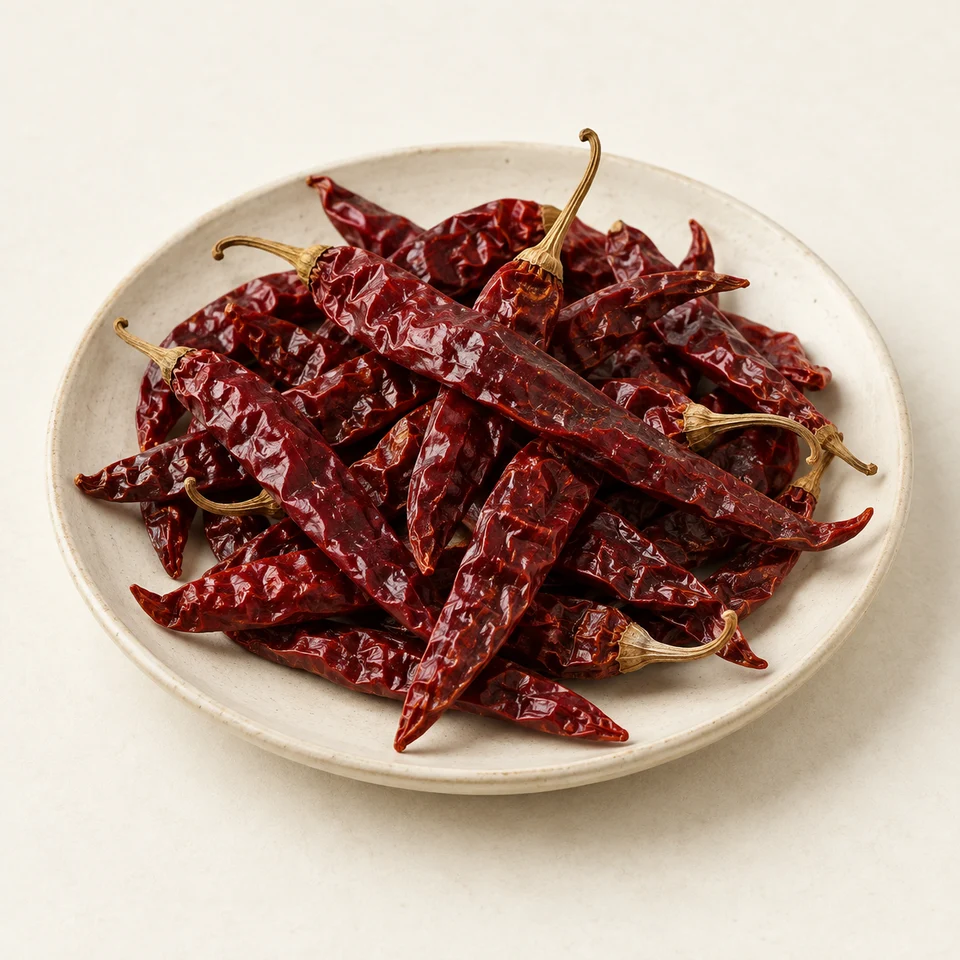
Dried chiles are chile peppers preserved by drying, treated here as a broad plural ingredient category rather than one specific variety. They are used whole, crushed, ground, or rehydrated for sauces, stews, braises, marinades, and spice mixtures, rather than representing one fixed product.
They may be small or large, mild or pungent, and red, brown, orange, or nearly black. Depending on the peppers and preparation, they can contribute heat, colour, fruitiness, smokiness, earthiness, or a deeper roasted flavour. Their textures range from leathery to brittle after drying.
Whole pods can be softened and blended, while flakes and powders are added directly as seasoning. Drying makes the surfaces wrinkled; rehydrating softens them, and grinding changes them into a dispersible form. The final sensory character depends on the unspecified variety, blend, size, and drying method.
- Ingredient type
- whole food
Forms & related ingredients
FOLLOW IT TO THE PLATE
Where will you meet it?
Explore the dishes that use this ingredient and their country and cuisine connections.
Explore linked dishesON A MENU OR LABEL
Find local names and written forms to help recognise this ingredient.
See local namesWhere dried chiles appears
2 linked foodsFind foods to recognise by country and type. Recipes and products vary; these are recorded ingredient connections.
Showing 1–2 of 2
Sauces


Ingredient connections awaiting review · Coverage is still growing, including packaged snacks.
Name examples awaiting language review. Confirm the specific food or product.
Local names for dried chiles
Names and romanised forms to recognise on menus and labels.
chiles secos
Dried Chiles
dried chiles
chiles secos
piments séchés
getrocknete Chilis
peperoncini secchi
乾燥唐辛子
kansō tōgarashi
말린 고추
mallin gochu
干辣椒
gān làjiāo
सूखी मिर्च
sūkhī mirc
শুকনো লঙ্কা
shukno lonka
فلفل حار مجفف
filfil ḥārr mujaffaf
kuru acı biberler
cabai kering
cili kering
kansō tōgarashi
Romanised form
filfil ḥārr mujaffaf
Romanised form
mallin gochu
Romanised form
shukno lonka
Romanised form
gān làjiāo
Romanised form
sūkhī mirc
Romanised form
Available names only. Languages may be spoken in other countries; a name alone does not identify every ingredient in a dish.
Name not available yet.
A name in English has not been added for dried chiles. Choose another language to see its available names.
Dried Chiles nutrition & diet
Dried Chiles nutritional value
Peppers, hot chile, sun-dried
Per 100 g of the edible portion in the recorded food form.
- Calories
- 324kcal
- Protein
- 10.6g
- Carbs
- 69.9g
- Fat
- 5.8g
Reference values for the specific food form shown. Other varieties, brands and preparations can differ.
Portions & preparation
Identify the varieties included and use the edible dried pods, flakes, or ground material that the recipe specifies. Remove stems and decide how seeds are handled. Rehydrating, roasting, frying, or blending changes the preparation, and added oil, salt, or other ingredients should be recorded separately.
Compare the right form: Match references to the exact dried chile varieties and form—whole, ground, flaked, or rehydrated—rather than a generic pepper entry.
Diet considerations
Dried chiles are plant-derived when they contain only dehydrated peppers. Mixed or prepared products may include salt, sugar, oil, flour, or animal ingredients, changing compatibility. Portion depends on use as seasoning or sauce, while tortillas, rice, noodles, and other cereal foods alter carbohydrate patterns.
AI-authored reading notes · Awaiting editorial review. Measured values, where available, have a separate source above.
Dietary compatibility
- VeganTypically compatible
- VegetarianTypically compatible
- PescatarianTypically compatible
- KetoDepends on the version
- PaleoTypically compatible
- Low-carbDepends on the version
- HalalNot established
- KosherNot established
What these diet assessments mean
- Vegan · Typically compatible
- The plain ingredient profile is plant, fungal or mineral based. Added ingredients in a prepared product need a separate check.
- Vegetarian · Typically compatible
- The plain ingredient profile is plant, fungal or mineral based. Added ingredients in a prepared product need a separate check.
- Pescatarian · Typically compatible
- The plain ingredient profile is plant, fungal or mineral based. Added ingredients in a prepared product need a separate check.
- Keto · Depends on the version
- Compatibility depends on the portion and preparation. A sourced carbohydrate amount for a defined serving is not available.
- Paleo · Typically compatible
- The plain form fits the conventional paleo food groups. Added ingredients and individual interpretations can differ.
- Low-carb · Depends on the version
- Compatibility depends on the portion and preparation. A sourced carbohydrate amount for a defined serving is not available.
- Halal · Not established
- Sourcing, processing and any applicable certification have not been verified. A food name alone does not establish halal status.
- Kosher · Not established
- Sourcing, processing and any applicable certification have not been verified. A food name alone does not establish kosher status.
For the plain ingredient · Awaiting review. Diet compatibility is not allergy suitability or halal/kosher certification. Keto and low-carb depend on the portion.
AI-generated illustration for visual context. It does not identify a particular product or establish allergen content.
Sources & review
Nutrition reference: USDA FoodData Central — Peppers, hot chile, sun-dried ↗. Values are scaled from 100 g of the recorded edible form. Individual portions have no assumed fixed weight.
Expanded overview, name examples and nutrition notes are database drafts awaiting editorial review. Numeric nutrition values, where shown, have their own source and food-form reference.
The ingredient description and dish connections come from the draft catalogue and may change after review.
Last recorded verification: .