
Lime
Lime is a small acidic citrus fruit used for juice, zest, garnishes, sauces, and drinks.
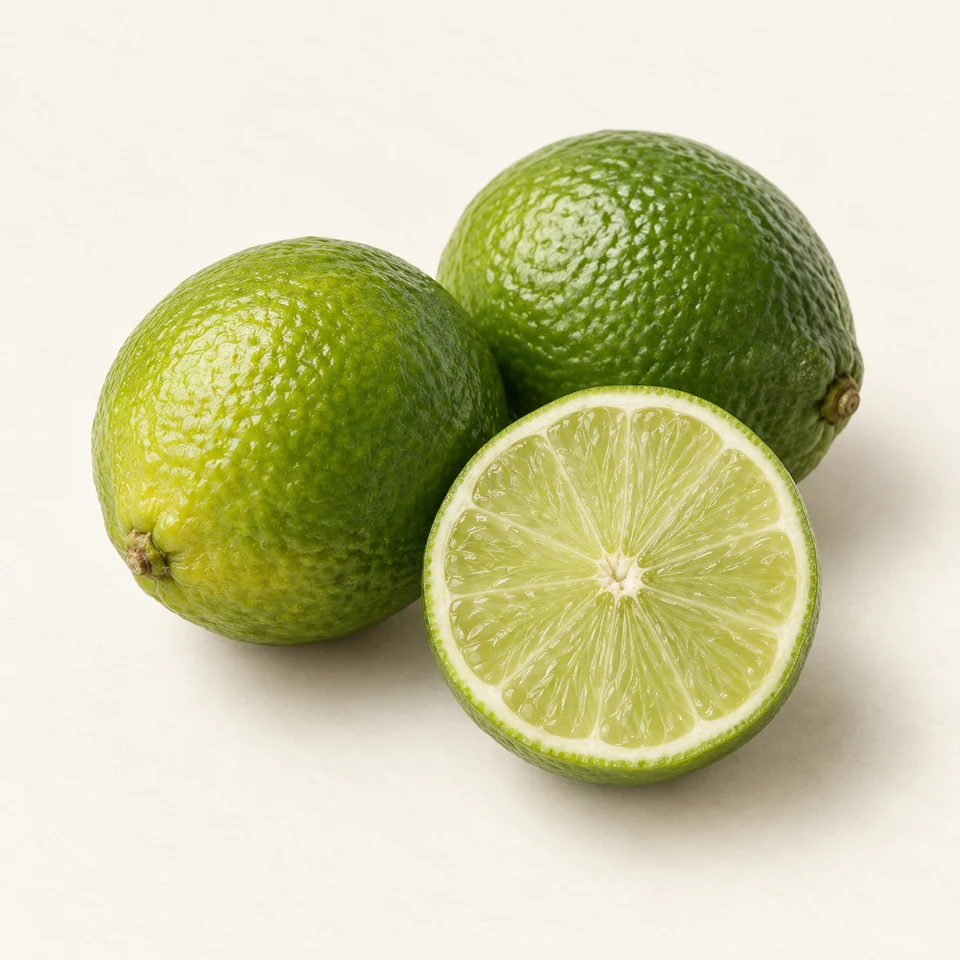
About Lime
Lime is the whole fruit of several small, acidic citrus types, used for juice, zest, garnishes, sauces, drinks, dressings, marinades, desserts and condiments. It may also be cut into wedges for garnishing or used in preserved preparations.
Its juicy segments have a sharp sour flavour and fresh aroma, while the peel supplies fragrant zest. The flesh may contain seeds, and colour, size and acidity vary among types. Culinary lime therefore does not have a uniform flavour or texture across markets.
Limes are sold fresh, as whole fruit, wedges, juice or zest, and after drying, preserving or other processing. Squeezing separates the juice from the peel and flesh; grating releases zest, while drying or preserving changes moisture, firmness and flavour. The citrus type is unspecified.
- Ingredient type
- whole food
Forms & related ingredients
FOLLOW IT TO THE PLATE
Where will you meet it?
Explore the dishes that use this ingredient and their country and cuisine connections.
Explore linked dishesON A MENU OR LABEL
Find local names and written forms to help recognise this ingredient.
See local namesWhere lime appears
86 linked foodsFind foods to recognise by country and type. Recipes and products vary; these are recorded ingredient connections.
Showing 1–12 of 86
Main dishes


Bistec de Palomilla
Optional addition
Camarones al Ajillo
Optional addition

Causa Limeña
Optional addition


Ceviche Ecuatoriano
Optional addition

Ingredient connections awaiting review · Coverage is still growing, including packaged snacks.
Name examples awaiting language review. Confirm the specific food or product.
Local names for lime
Names and romanised forms to recognise on menus and labels.
lime
citron vert
lima
ライム
raimu
lima
lime
Limette
limoen
llima
lime
lime
lime
limetti
limonka
лайм
laym
misket limonu
ليمون أخضر
laymūn akhḍar
नींबू
nīmbū
পাতিলেবু
pātilebu
라임
raim
青柠
qīngníng
มะนาว
manāo
chanh xanh
jeruk nipis
limau nipis
raimu
Romanised form
Citron vert ou lime, chair sans peau, sans pépins, cru
Search alias · Not a confirmed translation
Lime, peeled, raw
Search alias · Not a confirmed translation
Limes, flesh only
Search alias · Not a confirmed translation
Limes, flesh only, weighed with peel and pips
Search alias · Not a confirmed translation
Limettenschale
Search alias · Not a confirmed translation
raw lime
Search alias · Not a confirmed translation
raw lime pulp
Search alias · Not a confirmed translation
laymūn akhḍar
Romanised form
raim
Romanised form
pātilebu
Romanised form
qīngníng
Romanised form
nīmbū
Romanised form
laym
Romanised form
manāo
Romanised form
Available names only. Languages may be spoken in other countries; a name alone does not identify every ingredient in a dish.
Name not available yet.
A name in English has not been added for lime. Choose another language to see its available names.
Lime nutrition & diet
Lime nutritional value
Limes, raw
Per 100 g of the edible portion in the recorded food form.
- Calories
- 30kcal
- Protein
- 0.7g
- Carbs
- 10.5g
- Fat
- 0.2g
Reference values for the specific food form shown. Other varieties, brands and preparations can differ.
Portions & preparation
Identify the lime species or local variety when relevant, and distinguish whole fruit, peeled segments, juice, zest, and expressed peel oils. Use only the intended edible portion. Preparation with sugar, salt, syrups, preserves, or mixed drinks should be captured separately because it changes the catalogue item.
Compare the right form: Match the reference to the same lime variety and edible form—whole, peeled flesh, juice, zest, or peel—used in the serving.
Diet considerations
Lime is plant-derived. Plain fruit, zest, and juice differ from preparations containing sugar, syrups, dairy, egg, alcohol, or animal-derived garnishes. Lime-based sauces and drinks may include cereal-derived thickeners or sweetened mixers. Portion and the surrounding recipe determine the carbohydrate pattern more than the garnish alone.
AI-authored reading notes · Awaiting editorial review. Measured values, where available, have a separate source above.
Dietary compatibility
- VeganTypically compatible
- VegetarianTypically compatible
- PescatarianTypically compatible
- KetoDepends on the version
- PaleoTypically compatible
- Low-carbDepends on the version
- HalalNot established
- KosherNot established
What these diet assessments mean
- Vegan · Typically compatible
- The plain ingredient profile is plant, fungal or mineral based. Added ingredients in a prepared product need a separate check.
- Vegetarian · Typically compatible
- The plain ingredient profile is plant, fungal or mineral based. Added ingredients in a prepared product need a separate check.
- Pescatarian · Typically compatible
- The plain ingredient profile is plant, fungal or mineral based. Added ingredients in a prepared product need a separate check.
- Keto · Depends on the version
- Compatibility depends on the portion and preparation. A sourced carbohydrate amount for a defined serving is not available.
- Paleo · Typically compatible
- The plain form fits the conventional paleo food groups. Added ingredients and individual interpretations can differ.
- Low-carb · Depends on the version
- Compatibility depends on the portion and preparation. A sourced carbohydrate amount for a defined serving is not available.
- Halal · Not established
- Sourcing, processing and any applicable certification have not been verified. A food name alone does not establish halal status.
- Kosher · Not established
- Sourcing, processing and any applicable certification have not been verified. A food name alone does not establish kosher status.
For the plain ingredient · Awaiting review. Diet compatibility is not allergy suitability or halal/kosher certification. Keto and low-carb depend on the portion.
AI-generated illustration for visual context. It does not identify a particular product or establish allergen content.
Sources & review
Nutrition reference: USDA FoodData Central — Limes, raw ↗. Values are scaled from 100 g of the recorded edible form. Individual portions have no assumed fixed weight.
Expanded overview, name examples and nutrition notes are database drafts awaiting editorial review. Numeric nutrition values, where shown, have their own source and food-form reference.
The ingredient description and dish connections come from the draft catalogue and may change after review.
Last recorded verification: .