
Basil
Basil is an aromatic herb used fresh or dried in sauces, salads, soups, and other savory dishes.
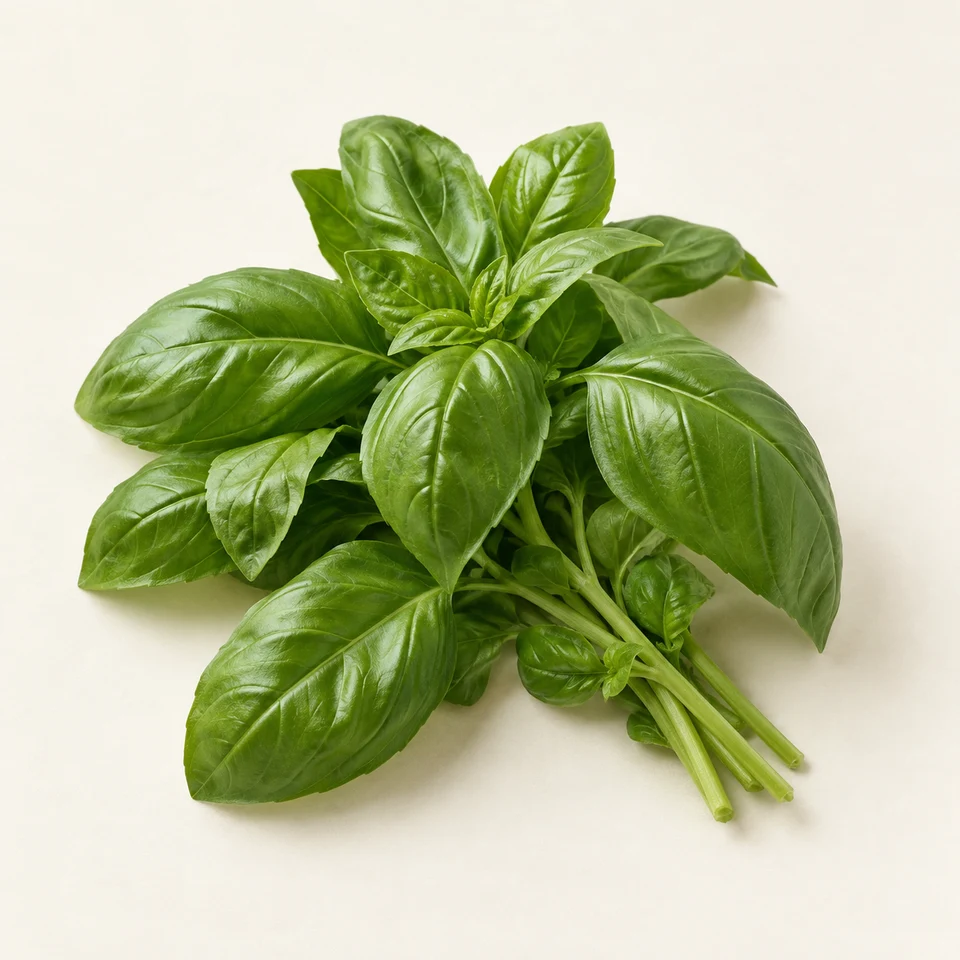
About Basil
Basil is a fragrant culinary herb harvested mainly for its tender leaves and sometimes its young stems. Fresh basil has smooth or slightly textured green leaves, a soft leafy texture, and a sweet, peppery, clove-like, or anise-like aroma that varies by type. It is used in sauces, salads, soups, vegetable dishes, and other savoury foods.
Fresh leaves are commonly torn or chopped into prepared dishes, while dried basil is added during cooking or used in blended seasonings. The specific cultivar is not identified here, so flavour and leaf shape can vary.
Basil may be sold as whole fresh sprigs, loose leaves, dried flakes, or other dried forms. Fresh leaves are soft and leafy; drying makes them darker and lighter in texture, while dried basil can provide a more concentrated seasoning effect. The plant type and cultivar remain unspecified.
- Ingredient type
- whole food
Forms & related ingredients
FOLLOW IT TO THE PLATE
Where will you meet it?
Explore the dishes that use this ingredient and their country and cuisine connections.
Explore linked dishesON A MENU OR LABEL
Find local names and written forms to help recognise this ingredient.
See local namesWhere basil appears
37 linked foodsFind foods to recognise by country and type. Recipes and products vary; these are recorded ingredient connections.
Showing 25–36 of 37
Salads
Salade Niçoise
Optional additionNoodle dishes

Rice dishes

Sauces
Street food
Pizza Fritta
Optional additionIngredient connections awaiting review · Coverage is still growing, including packaged snacks.
Name examples awaiting language review. Confirm the specific food or product.
Local names for basil
Names and romanised forms to recognise on menus and labels.
Basil
Basilic
Basilico
Albahaca
Basilikum
Basilicum
Manjericão
Alfàbrega
βασιλικός
vasilikós
Fesleğen
ريحان
Rayḥān
Базилик
Bazilik
Базилік
Bazylik
Bazylia
Bazalka
Bazalka
Bazsalikom
Busuioc
Босилек
Bosilek
Босиљак
Bosiljak
Bosiljak
Bazilika
Basilika
Basilikum
Basilikum
Basilika
Basiilik
Baziliks
Bazilikas
Basilíka
Basil
Basil
Albaka
Alfabaca
Basiliekruid
Mrihani
Kemangi
Selasih
Kêmangi
Kamangian
Húng quế
โหระพา
Horapha
ໃບກະເພົາ
Bai kaphao
ជីរនាងវង
Chi neang vong
ပင်စိမ်း
Pinsiim
罗勒
Luólè
バジル
Bajiru
바질
Bajil
तुलसी
Tulsī
তুলসী
Tulasī
तुळस
Tuḷasa
તુલસી
Tulasī
துளசி
Tuḷaci
తులసి
Tulasi
ತುಳಸಿ
Tuḷasi
തുളസി
Tuḷasi
මදුරුතලා
Maduwutalā
तुलसी
Tulasī
ریحان
Reyhān
تلسی
Tulsī
Tulasī
Romanised form
vasilikós
Romanised form
Tuḷasi
Romanised form
Bajiru
Romanised form
basil leaf (dried)
Search alias · Not a confirmed translation
basil leaf (raw)
Search alias · Not a confirmed translation
basil leaf (whole or pieces)
Search alias · Not a confirmed translation
basil sprig
Search alias · Not a confirmed translation
Basil, dried, ground
Search alias · Not a confirmed translation
Basil, fresh
Search alias · Not a confirmed translation
Basil, green, fresh, raw
Search alias · Not a confirmed translation
Basil, Leaf, Blanched
Search alias · Not a confirmed translation
Basil, raw
Search alias · Not a confirmed translation
basilic en poudre
Search alias · Not a confirmed translation
Basilic, frais
Search alias · Not a confirmed translation
Basilic, séché
Search alias · Not a confirmed translation
dried basil
Search alias · Not a confirmed translation
Fresh basil
Search alias · Not a confirmed translation
fresh basil leaf
Search alias · Not a confirmed translation
Chi neang vong
Romanised form
Tuḷaci
Romanised form
Bai kaphao
Romanised form
Rayḥān
Romanised form
Bazylik
Romanised form
Bajil
Romanised form
Tulasī
Romanised form
Maduwutalā
Romanised form
Luólè
Romanised form
Tulsī
Romanised form
Tuḷasi
Romanised form
Tulsī
Romanised form
Bazilik
Romanised form
Pinsiim
Romanised form
Bosilek
Romanised form
Reyhān
Romanised form
Bosiljak
Romanised form
Tulasī
Romanised form
Tuḷasa
Romanised form
Horapha
Romanised form
Tulasi
Romanised form
Available names only. Languages may be spoken in other countries; a name alone does not identify every ingredient in a dish.
Name not available yet.
A name in English has not been added for basil. Choose another language to see its available names.
Basil nutrition & diet
Basil nutritional value
Basil, fresh
Per 100 g of the edible portion in the recorded food form.
- Calories
- 23kcal
- Protein
- 3.1g
- Carbs
- 2.6g
- Fat
- 0.6g
Reference values for the specific food form shown. Other varieties, brands and preparations can differ.
Portions & preparation
Distinguish fresh basil leaves from dried basil, stems, pesto, or seasoned products before comparing portions. Use the edible leaves as served, and account for oil, nuts, cheese, salt, and other ingredients in pesto or cooked dishes rather than attributing the whole preparation to basil.
Compare the right form: Match references to the identified basil species or culinary type and to fresh leaves, dried leaves, or a prepared product, with stems excluded when appropriate.
Diet considerations
Basil leaves are plant-derived. Compatibility changes when basil is supplied as pesto, seasoning, infused oil, or a prepared sauce containing dairy, nuts, animal products, cereal ingredients, or coatings. The herb’s own portion is usually recipe-dependent, while accompanying ingredients determine the dish’s carbohydrate pattern.
AI-authored reading notes · Awaiting editorial review. Measured values, where available, have a separate source above.
Dietary compatibility
- VeganNot established
- VegetarianNot established
- PescatarianNot established
- KetoNot established
- PaleoNot established
- Low-carbNot established
- HalalNot established
- KosherNot established
What these diet assessments mean
- Vegan · Not established
- The available profile does not establish the full composition or processing for this dietary pattern.
- Vegetarian · Not established
- The available profile does not establish the full composition or processing for this dietary pattern.
- Pescatarian · Not established
- The available profile does not establish the full composition or processing for this dietary pattern.
- Keto · Not established
- A defined serving and sourced carbohydrate data are needed before assessing this dietary pattern.
- Paleo · Not established
- The ingredient form and processing have not been assessed against this dietary pattern.
- Low-carb · Not established
- A defined serving and sourced carbohydrate data are needed before assessing this dietary pattern.
- Halal · Not established
- Sourcing, processing and any applicable certification have not been verified. A food name alone does not establish halal status.
- Kosher · Not established
- Sourcing, processing and any applicable certification have not been verified. A food name alone does not establish kosher status.
For the plain ingredient · Awaiting review. Diet compatibility is not allergy suitability or halal/kosher certification. Keto and low-carb depend on the portion.
AI-generated illustration for visual context. It does not identify a particular product or establish allergen content.
Sources & review
Nutrition reference: USDA FoodData Central — Basil, fresh ↗. Values are scaled from 100 g of the recorded edible form. Individual portions have no assumed fixed weight.
Expanded overview, name examples and nutrition notes are database drafts awaiting editorial review. Numeric nutrition values, where shown, have their own source and food-form reference.
The ingredient description and dish connections come from the draft catalogue and may change after review.
Last recorded verification: .