
Bay Leaf
Bay leaf is an aromatic leaf used to season soups, stews, sauces, rice dishes, and braises.
About Bay Leaf
Bay leaf is a whole aromatic leaf used to infuse flavour into food during cooking and usually removed before serving. Its aroma is herbal, woody, and resinous, with a flavour that becomes noticeable during simmering rather than through direct eating.
Bay leaf is added to soups, stews, sauces, braises, stocks, rice dishes, and bean or meat preparations. It is sold as whole dried leaves, fresh leaves, broken pieces, or ground seasoning, depending on the product.
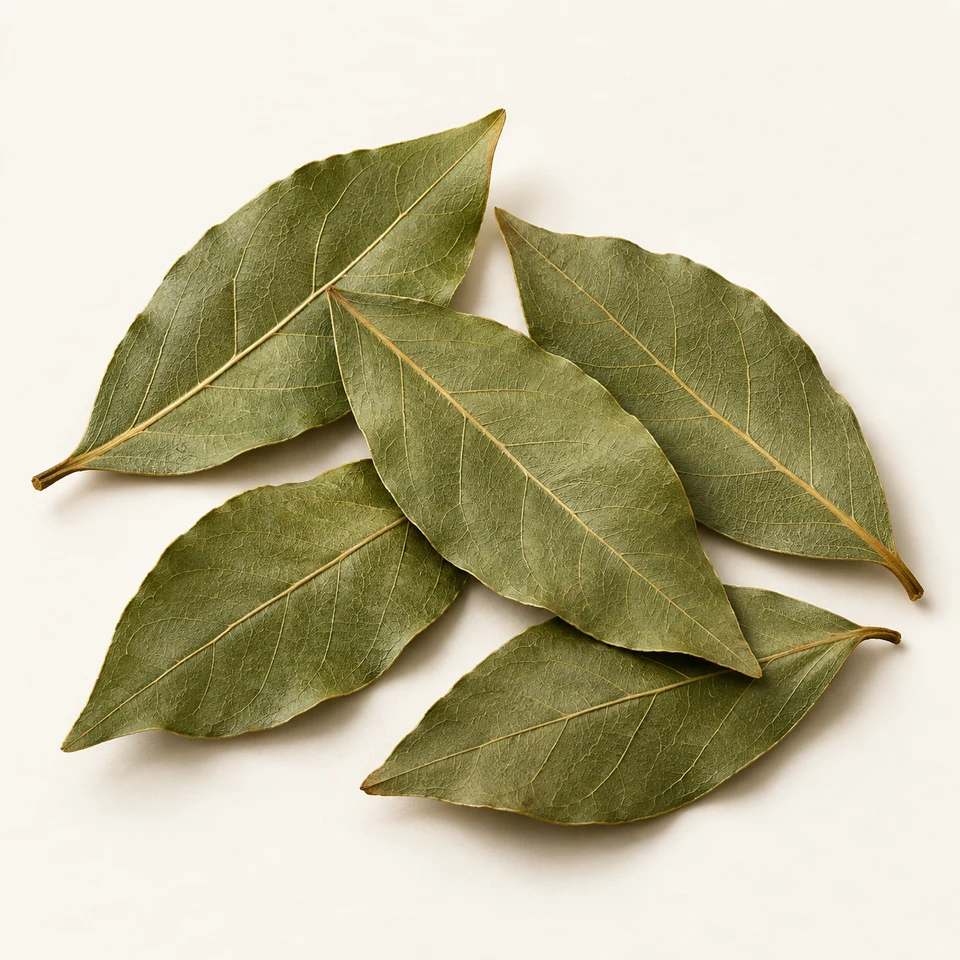
Dried leaves are commonly olive green to brown, firm, and brittle, while fresh leaves are more flexible and darker green. Broken or ground forms change how the leaf is incorporated and whether it can be removed. The name covers leaves from different culinary bay traditions, so appearance and intensity can differ.
- Ingredient type
- seasoning
Forms & related ingredients
FOLLOW IT TO THE PLATE
Where will you meet it?
Explore the dishes that use this ingredient and their country and cuisine connections.
Explore linked dishesON A MENU OR LABEL
Find local names and written forms to help recognise this ingredient.
See local namesWhere bay leaf appears
20 linked foodsFind foods to recognise by country and type. Recipes and products vary; these are recorded ingredient connections.
Showing 13–20 of 20
Main dishes
Sides
Snacks

Asturian chorizo in cider
Optional additionSoups
Rice dishes
Ingredient connections awaiting review · Coverage is still growing, including packaged snacks.
Name examples awaiting language review. Confirm the specific food or product.
Local names for bay leaf
Names and romanised forms to recognise on menus and labels.
Bay leaf
Feuille de laurier
Hoja de laurel
Foglia di alloro
Folha de louro
Lorbeerblatt
Laurierblad
Fulla de llorer
φύλλο δάφνης
fýllo dáfnīs
Defne yaprağı
ورق الغار
Waraq al-ghār
برگ بو
Barg-e bū
Лавровый лист
Lavrovyy list
Лавровий лист
Lavrovyi lyst
Liść laurowy
Bobkový list
Bobkový list
Babérlevél
Frunză de dafin
Дафинов лист
Dafinov list
Ловоров лист
Lovorov list
Lovorov list
Lovorjev list
lagerblad
lagerblad
Laurbærblad
Laurbærblad
Laakerinlehti
Loorberileht
Lauru lapa
Lauro lapas
Lárviðarlauf
Duilleog labhrais
Deilen llawryf
lourierblaar
lourierblaar
Jani la mrujuani
Daun salam
Daun bay
Lá nguyệt quế
月桂叶
Yuèguì yè
ローリエ
Rōrie
월계수 잎
Wolgye-su ip
fýllo dáfnīs
Romanised form
Rōrie
Romanised form
bay leaf (dried)
Search alias · Not a confirmed translation
Waraq al-ghār
Romanised form
Lavrovyi lyst
Romanised form
Wolgye-su ip
Romanised form
Yuèguì yè
Romanised form
Lavrovyy list
Romanised form
Dafinov list
Romanised form
lagerblad
Barg-e bū
Romanised form
Lovorov list
Romanised form
lourierblaar
Available names only. Languages may be spoken in other countries; a name alone does not identify every ingredient in a dish.
Name not available yet.
A name in English has not been added for bay leaf. Choose another language to see its available names.
Bay Leaf nutrition & diet
Bay Leaf nutritional value
Spices, bay leaf
Per 100 g of the edible portion in the recorded food form.
- Calories
- 313kcal
- Protein
- 7.6g
- Carbs
- 75.0g
- Fat
- 8.4g
Reference values for the specific food form shown. Other varieties, brands and preparations can differ.
Portions & preparation
Use bay leaf primarily as a flavoring and remove whole leaves before serving. Compare fresh and dried forms separately, since preparation changes weight, intensity, and the amount actually consumed in a dish.
Compare the right form: Match references to dried or fresh bay leaves, whole or ground, and distinguish the discarded leaf from the infused edible portion.
Diet considerations
Bay leaf is plant-derived. Compatibility usually depends on the surrounding recipe, including animal stock, dairy, sauces, or cereal-based ingredients. Whole leaves are commonly removed, while ground bay leaf remains in the portion and may alter the dish’s carbohydrate pattern only minimally.
AI-authored reading notes · Awaiting editorial review. Measured values, where available, have a separate source above.
Dietary compatibility
- VeganTypically compatible
- VegetarianTypically compatible
- PescatarianTypically compatible
- KetoNot established
- PaleoMay be compatible
- Low-carbNot established
- HalalNot established
- KosherNot established
What these diet assessments mean
- Vegan · Typically compatible
- The plain ingredient profile is plant, fungal or mineral based. Added ingredients in a prepared product need a separate check.
- Vegetarian · Typically compatible
- The plain ingredient profile is plant, fungal or mineral based. Added ingredients in a prepared product need a separate check.
- Pescatarian · Typically compatible
- The plain ingredient profile is plant, fungal or mineral based. Added ingredients in a prepared product need a separate check.
- Keto · Not established
- A defined serving and sourced carbohydrate data are needed before assessing this dietary pattern.
- Paleo · May be compatible
- May fit a paleo pattern, depending on the cut or form, processing and added ingredients.
- Low-carb · Not established
- A defined serving and sourced carbohydrate data are needed before assessing this dietary pattern.
- Halal · Not established
- Sourcing, processing and any applicable certification have not been verified. A food name alone does not establish halal status.
- Kosher · Not established
- Sourcing, processing and any applicable certification have not been verified. A food name alone does not establish kosher status.
For the plain ingredient · Awaiting review. Diet compatibility is not allergy suitability or halal/kosher certification. Keto and low-carb depend on the portion.
AI-generated illustration for visual context. It does not identify a particular product or establish allergen content.
Sources & review
Nutrition reference: USDA FoodData Central — Spices, bay leaf ↗. Values are scaled from 100 g of the recorded edible form. Individual portions have no assumed fixed weight.
Expanded overview, name examples and nutrition notes are database drafts awaiting editorial review. Numeric nutrition values, where shown, have their own source and food-form reference.
The ingredient description and dish connections come from the draft catalogue and may change after review.
Last recorded verification: .