
Desiccated coconut
Desiccated coconut is dried, finely grated coconut used in sweets, baked goods, curries, and coatings.
About Desiccated coconut
Desiccated coconut is coconut flesh that has been grated or shredded and dried to remove much of its moisture. It is commonly sold as fine, medium, or coarse particles, and may be unsweetened or, in some products, combined with added sugar or other ingredients. It is used in sweets, baked goods, curries, and coatings.
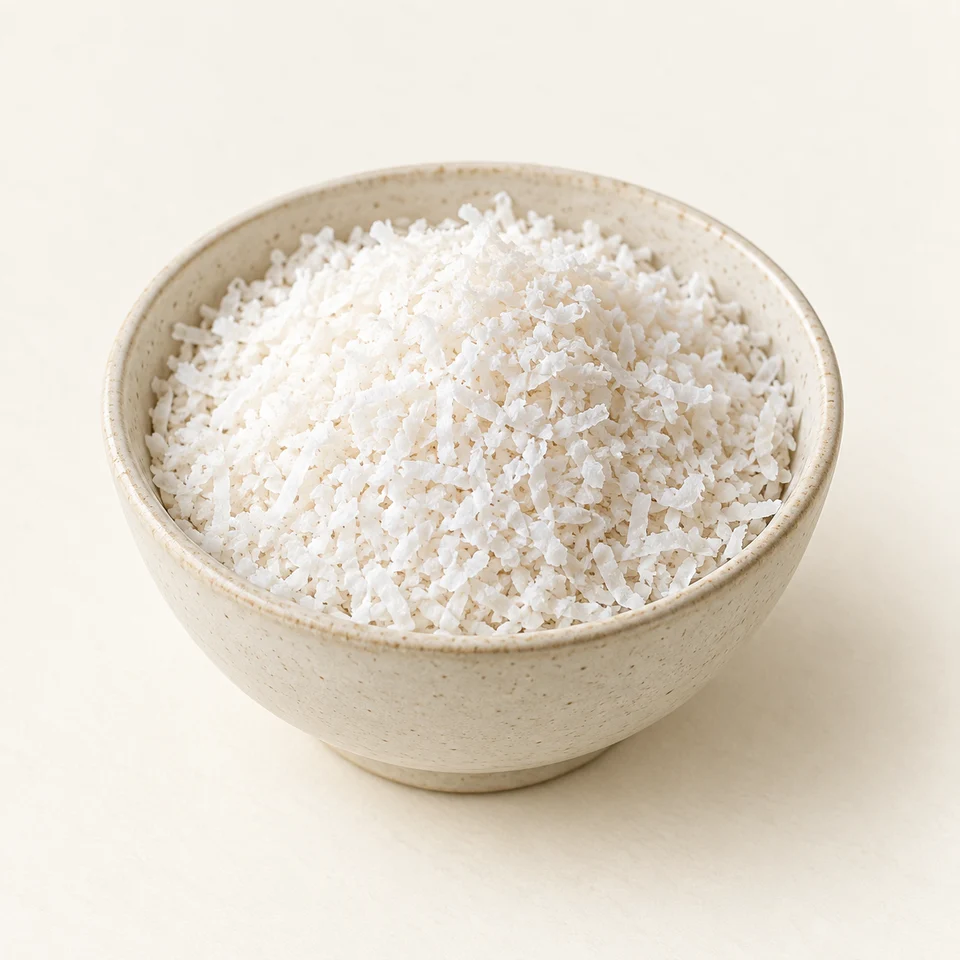
It is white to cream coloured, dry, and crumbly, with a pronounced coconut aroma. The particles become tender or chewy when moistened, while the dry product remains loose and granular. Particle size affects how noticeable the coconut is in a mixture and how quickly it softens.
Desiccated coconut is sold loose or packaged in fine, medium, or coarse shreds or granules. It is used in sweets, cakes, biscuits, pastries, curries, breadings, toppings, and coatings. Rehydrating, soaking, toasting, or incorporating it into batters and fillings changes its texture, moisture, and flavour.
- Ingredient type
- whole food
FOLLOW IT TO THE PLATE
Where will you meet it?
Explore the dishes that use this ingredient and their country and cuisine connections.
Explore linked dishesON A MENU OR LABEL
Find local names and written forms to help recognise this ingredient.
See local namesWhere desiccated coconut appears
72 linked foodsFind foods to recognise by country and type. Recipes and products vary; these are recorded ingredient connections.
Showing 25–36 of 72
Desserts


Ingredient connections awaiting review · Coverage is still growing, including packaged snacks.
Name examples awaiting language review. Confirm the specific food or product.
Local names for desiccated coconut
Names and romanised forms to recognise on menus and labels.
Desiccated coconut
desiccated coconut
noix de coco râpée séchée
coco rallado deshidratado
coco ratllat dessecat
coco ralado desidratado
cocco grattugiato essiccato
Kokosraspeln
gedroogde geraspte kokos
wiórki kokosowe
кокосовая стружка
kokosovaja stružka
kurutulmuş rendelenmiş hindistan cevizi
सूखा कसा हुआ नारियल
sūkhā kasā huā nāriyāl
শুকনো নারকেল কুচি
śukno nārikel kuči
உலர்ந்த துருவிய தேங்காய்
ularnta turuviya tēṅkāy
乾燥ココナッツ
kansō kokonattsu
椰蓉
yēróng
kelapa parut kering
kelapa parut kering
kansō kokonattsu
Romanised form
ularnta turuviya tēṅkāy
Romanised form
śukno nārikel kuči
Romanised form
yēróng
Romanised form
sūkhā kasā huā nāriyāl
Romanised form
kokosovaja stružka
Romanised form
Available names only. Languages may be spoken in other countries; a name alone does not identify every ingredient in a dish.
Name not available yet.
A name in English has not been added for desiccated coconut. Choose another language to see its available names.
Desiccated coconut nutrition & diet
Desiccated coconut nutritional value
Nuts, coconut meat, dried (desiccated), not sweetened
Per 100 g of the edible portion in the recorded food form.
- Calories
- 660kcal
- Protein
- 6.9g
- Carbs
- 23.6g
- Fat
- 64.5g
Reference values for the specific food form shown. Other varieties, brands and preparations can differ.
Portions & preparation
Match the portion to the recipe because desiccated coconut is concentrated by drying. Specify fine or coarse texture, sweetened or unsweetened preparation, and whether it is toasted. Rehydrating it changes texture and serving weight, while coconut used as a coating may be consumed unevenly across portions.
Compare the right form: Reference unsweetened or sweetened desiccated coconut, finely or coarsely grated, and toasted or untoasted; match the edible coconut portion.
Diet considerations
Desiccated coconut is plant-derived, but compatibility changes with added sugar, dairy ingredients, or cereal-based coatings in prepared products. Plain coconut does not establish suitability for every dietary pattern. Recipe use can also affect portion-dependent carbohydrate exposure when combined with sweet fillings, batters, or coatings.
AI-authored reading notes · Awaiting editorial review. Measured values, where available, have a separate source above.
Dietary compatibility
- VeganTypically compatible
- VegetarianTypically compatible
- PescatarianTypically compatible
- KetoDepends on the version
- PaleoTypically compatible
- Low-carbDepends on the version
- HalalNot established
- KosherNot established
What these diet assessments mean
- Vegan · Typically compatible
- The plain ingredient profile is plant, fungal or mineral based. Added ingredients in a prepared product need a separate check.
- Vegetarian · Typically compatible
- The plain ingredient profile is plant, fungal or mineral based. Added ingredients in a prepared product need a separate check.
- Pescatarian · Typically compatible
- The plain ingredient profile is plant, fungal or mineral based. Added ingredients in a prepared product need a separate check.
- Keto · Depends on the version
- Compatibility depends on the portion and preparation. A sourced carbohydrate amount for a defined serving is not available.
- Paleo · Typically compatible
- The plain form fits the conventional paleo food groups. Added ingredients and individual interpretations can differ.
- Low-carb · Depends on the version
- Compatibility depends on the portion and preparation. A sourced carbohydrate amount for a defined serving is not available.
- Halal · Not established
- Sourcing, processing and any applicable certification have not been verified. A food name alone does not establish halal status.
- Kosher · Not established
- Sourcing, processing and any applicable certification have not been verified. A food name alone does not establish kosher status.
For the plain ingredient · Awaiting review. Diet compatibility is not allergy suitability or halal/kosher certification. Keto and low-carb depend on the portion.
AI-generated illustration for visual context. It does not identify a particular product or establish allergen content.
Sources & review
Nutrition reference: USDA FoodData Central — Nuts, coconut meat, dried (desiccated), not sweetened ↗. Values are scaled from 100 g of the recorded edible form. Individual portions have no assumed fixed weight.
Expanded overview, name examples and nutrition notes are database drafts awaiting editorial review. Numeric nutrition values, where shown, have their own source and food-form reference.
The ingredient description and dish connections come from the draft catalogue and may change after review.
Last recorded verification: .