
Fermented Milk
Fermented milk is milk cultured to produce a tangy flavor and a thicker or lightly effervescent texture.
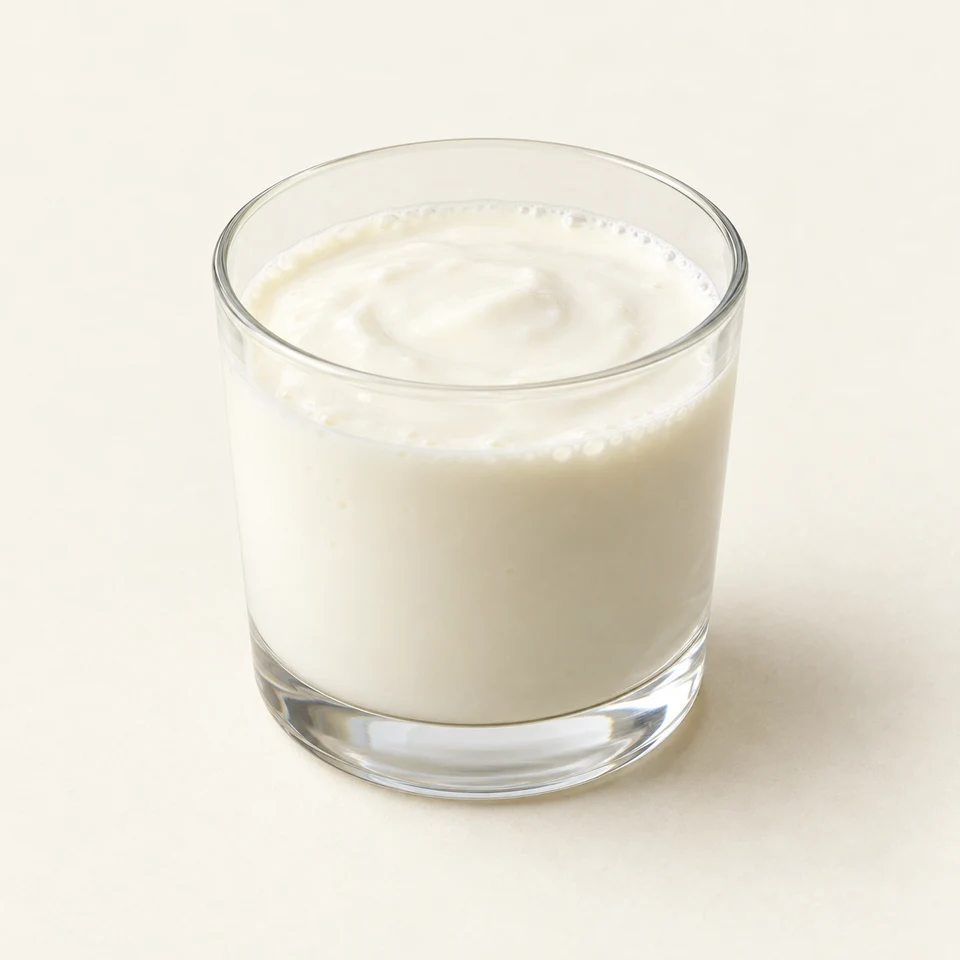
About Fermented Milk
Fermented milk is milk cultured with microorganisms that convert some milk sugars and produce a tangy taste. It is used as a drink, a base for sauces and soups, a tenderizing or marinating liquid, and an ingredient in batters and other cooked dishes.
Depending on the culture and handling, it may remain pourable, become spoon-thick, or develop slight effervescence. Its flavour is tangy, while consistency ranges from fluid to thick; exact acidity varies with fermentation time and concentration.
The appearance is generally white to cream-coloured. It may be sold or prepared plain, salted, sweetened, strained, or flavoured; straining or concentration makes it thicker, while added ingredients alter its colour, flavour, and texture.
- Ingredient type
- compound ingredient
Forms & related ingredients
FOLLOW IT TO THE PLATE
Where will you meet it?
Explore the dishes that use this ingredient and their country and cuisine connections.
Explore linked dishesON A MENU OR LABEL
Find local names and written forms to help recognise this ingredient.
See local namesWhere fermented milk appears
9 linked foodsFind foods to recognise by country and type. Recipes and products vary; these are recorded ingredient connections.
Showing 1–9 of 9
Snacks
Desserts

Soups
Drinks

Breakfasts
Ingredient connections awaiting review · Coverage is still growing, including packaged snacks.
Name examples awaiting language review. Confirm the specific food or product.
Local names for fermented milk
Names and romanised forms to recognise on menus and labels.
Fermented Milk
fermented milk
lait fermenté
fermentierte Milch
leche fermentada
leite fermentado
latte fermentato
gefermenteerde melk
mleko fermentowane
fermente süt
ζυμωμένο γάλα
zymoméno gála
ферментированное молоко
fermentirovannoye moloko
ферментоване молоко
fermentovane moloko
発酵乳
hakkōnyū
발효유
balhyo-yu
发酵乳
fājiào rǔ
حليب مُخمَّر
ḥalīb mukhammar
किण्वित दूध
kiṇvit dūdh
গাঁজানো দুধ
gā̃jāno dudh
นมหมัก
nom mak
sữa lên men
zymoméno gála
Romanised form
hakkōnyū
Romanised form
ḥalīb mukhammar
Romanised form
fermentovane moloko
Romanised form
balhyo-yu
Romanised form
gā̃jāno dudh
Romanised form
fājiào rǔ
Romanised form
kiṇvit dūdh
Romanised form
fermentirovannoye moloko
Romanised form
nom mak
Romanised form
Available names only. Languages may be spoken in other countries; a name alone does not identify every ingredient in a dish.
Name not available yet.
A name in English has not been added for fermented milk. Choose another language to see its available names.
Fermented Milk nutrition & diet
Fermented Milk nutritional value
Reference: Fermented milk plain 4.2% fat e.g. filmjölk
Per 100 g of 100 g edible portion in the named official reference form.
- Calories
- 68kcal
- Protein
- 3.5g
- Carbs
- 4.2g
- Fat
- 4.1g
Official national food-composition reference. The displayed food form is part of the estimate; cultivar, recipe, brand, processing and preparation can change values.
Portions & preparation
This term requires identification of the animal milk, culture, texture, and degree of processing before reference matching. Distinguish plain cultured milk from strained, carbonated, sweetened, flavored, or fortified products. Record the edible portion and additions such as fruit, cereal, sugar, or oil rather than treating all fermented milk alike.
Compare the right form: Match the exact animal milk and cultured form, distinguishing drinkable, thickened, strained, carbonated, sweetened, and flavored products.
Diet considerations
Fermented milk is animal-derived, but the source animal and recipe are unspecified. Compatibility changes with gelatin, egg, cereal, fruit preparations, sugar, or other animal ingredients. Culturing does not make it plant-based; texture, straining, processing, and portion determine how its carbohydrate pattern fits the surrounding meal.
AI-authored reading notes · Awaiting editorial review. Measured values, where available, have a separate source above.
Dietary compatibility
- VeganTypically incompatible
- VegetarianTypically compatible
- PescatarianTypically compatible
- KetoDepends on the version
- PaleoTypically incompatible
- Low-carbDepends on the version
- HalalNot established
- KosherNot established
What these diet assessments mean
- Vegan · Typically incompatible
- The ingredient profile identifies an animal-derived food or derivative.
- Vegetarian · Typically compatible
- Permitted by the lacto-ovo vegetarian pattern used here, in its plain form.
- Pescatarian · Typically compatible
- Permitted by the pescatarian pattern used here, in its plain form.
- Keto · Depends on the version
- Compatibility depends on the portion and preparation. A sourced carbohydrate amount for a defined serving is not available.
- Paleo · Typically incompatible
- This profile falls outside the conventional paleo pattern used here (grains and pseudograins, legumes, dairy or refined sugar).
- Low-carb · Depends on the version
- Compatibility depends on the portion and preparation. A sourced carbohydrate amount for a defined serving is not available.
- Halal · Not established
- Sourcing, processing and any applicable certification have not been verified. A food name alone does not establish halal status.
- Kosher · Not established
- Sourcing, processing and any applicable certification have not been verified. A food name alone does not establish kosher status.
For the plain ingredient · Awaiting review. Diet compatibility is not allergy suitability or halal/kosher certification. Keto and low-carb depend on the portion.
AI-generated illustration for visual context. It does not identify a particular product or establish allergen content.
Sources & review
Nutrition reference: Swedish Food Agency Food Database, 2026-07-01 — 2048 ↗. Values are scaled from 100 g of the recorded edible form. Individual portions have no assumed fixed weight.
Expanded overview, name examples and nutrition notes are database drafts awaiting editorial review. Numeric nutrition values, where shown, have their own source and food-form reference.
The ingredient description and dish connections come from the draft catalogue and may change after review.
Last recorded verification: .