
Vegetables
Vegetables are edible plant parts commonly used fresh, cooked, or preserved in a wide range of dishes.
About Vegetables
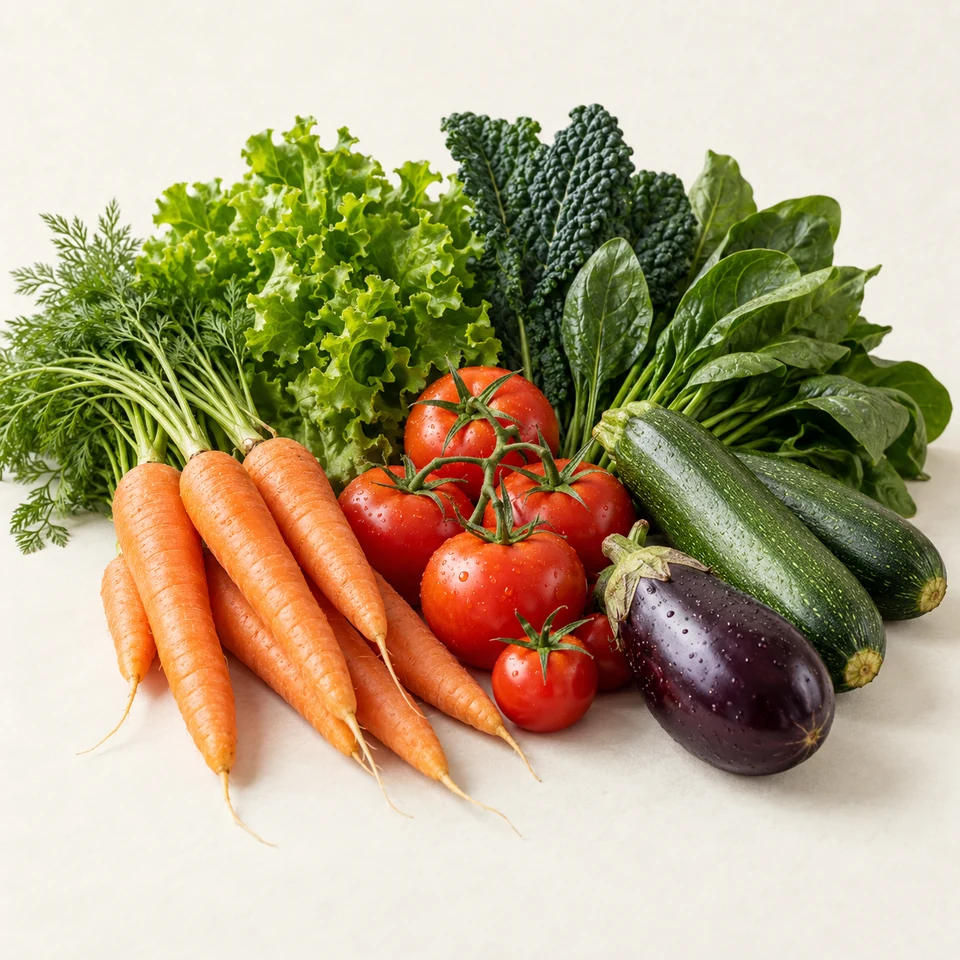
Vegetables are edible plant parts used as food, including roots, tubers, bulbs, stems, leaves, flowers, fruits, and seeds. The broad category can describe a single vegetable or a mixture, so culinary use depends on the particular plant part and variety.
Appearance, flavour, texture, and water content vary widely, from crisp and fresh to starchy, tender, fibrous, or creamy after cooking. Vegetables are used across a wide range of dishes, either alone or with other ingredients.
They may be eaten raw, boiled, steamed, roasted, fried, fermented, pickled, dried, frozen, or canned. Fresh vegetables may be whole, trimmed, sliced, grated, or otherwise prepared, and these forms alter their texture and appearance.
- Ingredient type
- whole food
Forms & related ingredients
FOLLOW IT TO THE PLATE
Where will you meet it?
Explore the dishes that use this ingredient and their country and cuisine connections.
Explore linked dishesON A MENU OR LABEL
Find local names and written forms to help recognise this ingredient.
See local namesWhere vegetables appears
192 linked foodsFind foods to recognise by country and type. Recipes and products vary; these are recorded ingredient connections.
Showing 1–12 of 192
Main dishes


Ingredient connections awaiting review · Coverage is still growing, including packaged snacks.
Name examples awaiting language review. Confirm the specific food or product.
Local names for vegetables
Names and romanised forms to recognise on menus and labels.
vegetables
légumes
verduras
Gemüse
verdure
legumes
verdures
groenten
grönsaker
grøntsager
grønnsaker
vihannekset
köögiviljad
dārzeņi
daržovės
warzywa
zelenina
zelenina
zelenjava
povrće
povrće
поврће
povrće
овощи
ovoshchi
овочі
ovoči
зеленчуци
zelenchutsi
зеленчук
zelenčuk
λαχανικά
lachaniká
sebzeler
خضروات
khuḍrawāt
سبزیجات
sabzijāt
ירקות
yerakot
सब्ज़ियाँ
sabziyan
तरकारीहरू
tarkārīharū
শাকসবজি
shākshobji
শাক-পাচলি
xāk-pāchali
भाज्या
bhājyā
શાકભાજી
śākabhājī
காய்கறிகள்
kāykaṟikaḷ
కూరగాయలు
kūragāyalu
ತರಕಾರಿಗಳು
tarakārigaḷu
പച്ചക്കറികൾ
paccakkaṟikaḷ
එළවළු
eḷavaḷu
سبزیاں
sabziyān
蔬菜
shūcài
野菜
yasai
채소
chaeso
ผัก
phak
rau củ
sayuran
sayur-sayuran
mga gulay
mboga
groente
አትክልቶች
ātikiltotč
khudaar
kayan lambu
ẹfọ́
akwụkwọ nri
imifino
imifuno
tarkārīharū
Romanised form
lachaniká
Romanised form
tarakārigaḷu
Romanised form
yasai
Romanised form
vegetable (smoked)
Search alias · Not a confirmed translation
vegetable (sodium-free, artificially sweetened)
Search alias · Not a confirmed translation
vegetable (steamed)
Search alias · Not a confirmed translation
vegetable (unprocessed, deep-frozen)
Search alias · Not a confirmed translation
vegetable (unprocessed, frozen)
Search alias · Not a confirmed translation
vegetable (waxed)
Search alias · Not a confirmed translation
vegetable (white, deep-frozen)
Search alias · Not a confirmed translation
vegetable (white, dried)
Search alias · Not a confirmed translation
vegetable (white, frozen)
Search alias · Not a confirmed translation
vegetable (whole or pieces)
Search alias · Not a confirmed translation
vegetable white (processed)
Search alias · Not a confirmed translation
kāykaṟikaḷ
Romanised form
xāk-pāchali
Romanised form
ātikiltotč
Romanised form
zelenčuk
Romanised form
khuḍrawāt
Romanised form
ovoči
Romanised form
chaeso
Romanised form
shākshobji
Romanised form
eḷavaḷu
Romanised form
shūcài
Romanised form
sabziyan
Romanised form
paccakkaṟikaḷ
Romanised form
sabziyān
Romanised form
ovoshchi
Romanised form
zelenchutsi
Romanised form
yerakot
Romanised form
sabzijāt
Romanised form
povrće
Romanised form
śākabhājī
Romanised form
bhājyā
Romanised form
phak
Romanised form
kūragāyalu
Romanised form
Available names only. Languages may be spoken in other countries; a name alone does not identify every ingredient in a dish.
Name not available yet.
A name in English has not been added for vegetables. Choose another language to see its available names.
Vegetables nutrition & diet
Vegetables nutritional value
Reference: Vegetables (average), raw
Per 100 g of 100 g edible portion in the named official reference form.
- Calories
- 29kcal
- Protein
- 1.3g
- Carbs
- 4.3g
- Fat
- 0.3g
Official national food-composition reference. The displayed food form is part of the estimate; cultivar, recipe, brand, processing and preparation can change values.
Portions & preparation
“Vegetables” is a broad category, so identify the species, plant part, variety, maturity, and preparation before using a reference. Fresh, frozen, canned, dried, fermented, roasted, and fried forms differ in edible portion and added ingredients. Cooking water, oil, sauces, and retained solids should be recorded separately.
Compare the right form: Match references to the exact vegetable species, edible plant part, variety, raw or cooked state, preservation method, and drained or undrained portion.
Diet considerations
Vegetables are plant-derived, but the category includes many species with different preparation characteristics. Animal additions, dairy sauces, coatings, and cereal-based batters change compatibility. Fresh or plain cooked portions differ from pickled, creamed, fried, or stuffed versions, and starchy vegetables create different portion-dependent carbohydrate patterns.
AI-authored reading notes · Awaiting editorial review. Measured values, where available, have a separate source above.
Dietary compatibility
- VeganTypically compatible
- VegetarianTypically compatible
- PescatarianTypically compatible
- KetoDepends on the version
- PaleoTypically compatible
- Low-carbDepends on the version
- HalalNot established
- KosherNot established
What these diet assessments mean
- Vegan · Typically compatible
- The plain ingredient profile is plant, fungal or mineral based. Added ingredients in a prepared product need a separate check.
- Vegetarian · Typically compatible
- The plain ingredient profile is plant, fungal or mineral based. Added ingredients in a prepared product need a separate check.
- Pescatarian · Typically compatible
- The plain ingredient profile is plant, fungal or mineral based. Added ingredients in a prepared product need a separate check.
- Keto · Depends on the version
- Compatibility depends on the portion and preparation. A sourced carbohydrate amount for a defined serving is not available.
- Paleo · Typically compatible
- The plain form fits the conventional paleo food groups. Added ingredients and individual interpretations can differ.
- Low-carb · Depends on the version
- Compatibility depends on the portion and preparation. A sourced carbohydrate amount for a defined serving is not available.
- Halal · Not established
- Sourcing, processing and any applicable certification have not been verified. A food name alone does not establish halal status.
- Kosher · Not established
- Sourcing, processing and any applicable certification have not been verified. A food name alone does not establish kosher status.
For the plain ingredient · Awaiting review. Diet compatibility is not allergy suitability or halal/kosher certification. Keto and low-carb depend on the portion.
AI-generated illustration for visual context. It does not identify a particular product or establish allergen content.
Sources & review
Nutrition reference: Swiss Food Composition Database 7.1 (2026) — 1152 ↗. Values are scaled from 100 g of the recorded edible form. Individual portions have no assumed fixed weight.
Expanded overview, name examples and nutrition notes are database drafts awaiting editorial review. Numeric nutrition values, where shown, have their own source and food-form reference.
The ingredient description and dish connections come from the draft catalogue and may change after review.
Last recorded verification: .