
Beef Offal
Beef offal refers to edible organ meats and other non-muscle parts of cattle, used in soups, stews, and specialty dishes.
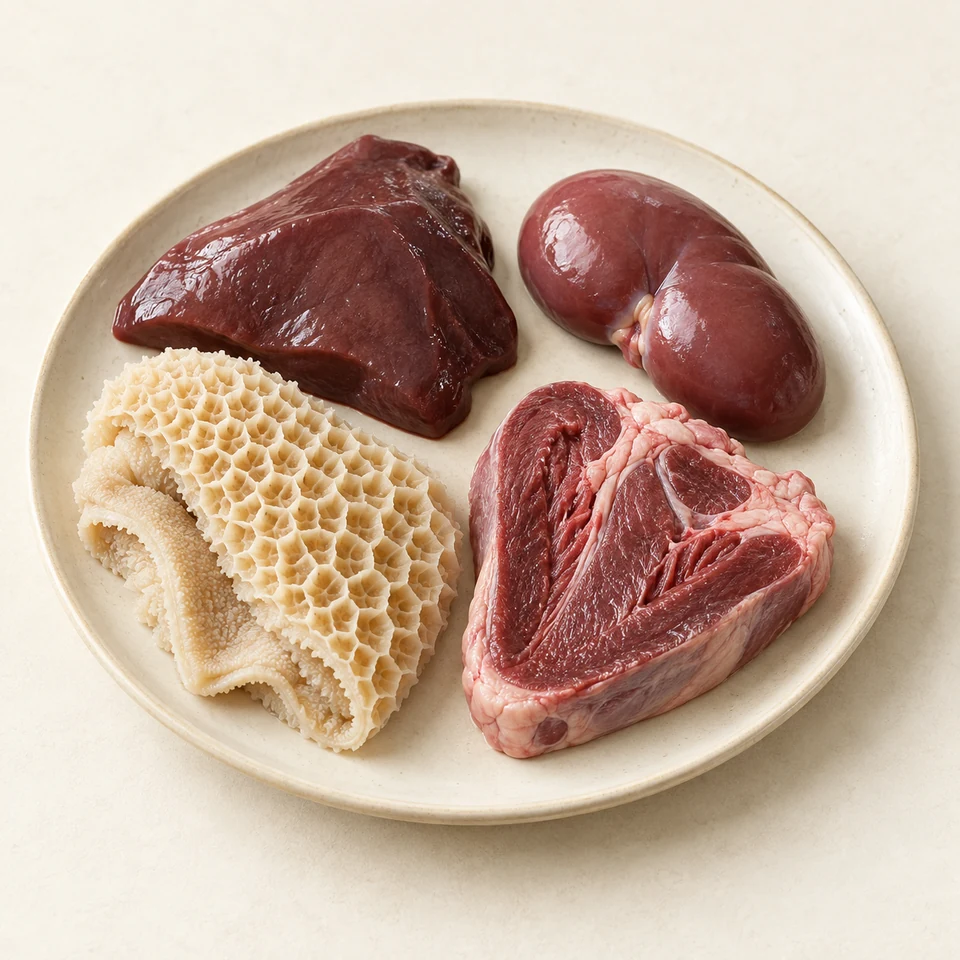
About Beef Offal
Beef offal is a collective culinary term for edible non-muscle parts of cattle, including organs and selected other tissues. It is a category rather than one anatomical ingredient, so its contents may include liver, kidney, heart, tongue, tripe, intestines, or other parts depending on the seller and culinary context.
Offal is used in soups, stews, braises, grilled dishes, sausages, pâtés, and specialty preparations. Flavour and texture vary widely: liver is dense, tripe is firm and honeycombed, and heart is lean and muscular. Because the category includes different parts, no single sensory description applies to every assortment.
It may be sold as a single part, a mixed assortment, fresh, frozen, or cooked. Appearance and preparation therefore depend on the tissue: tripe may show a honeycombed surface, while liver, heart, tongue, and intestines have distinct forms. Cooking changes firmness, moisture, and surface appearance.
- Ingredient type
- whole food
FOLLOW IT TO THE PLATE
Where will you meet it?
Explore the dishes that use this ingredient and their country and cuisine connections.
Explore linked dishesON A MENU OR LABEL
Find local names and written forms to help recognise this ingredient.
See local namesWhere beef offal appears
19 linked foodsFind foods to recognise by country and type. Recipes and products vary; these are recorded ingredient connections.
Showing 1–12 of 19
Main dishes


Soups

Ingredient connections awaiting review · Coverage is still growing, including packaged snacks.
Name examples awaiting language review. Confirm the specific food or product.
Local names for beef offal
Names and romanised forms to recognise on menus and labels.
menudencias de res
vísceras de res
牛杂
niú zá
소내장
sona jang
Beef Offal
beef offal
牛杂
niú zá
abats de bœuf
Rinderinnereien
frattaglie di manzo
miudezas bovinas
runderafval
podroby wołowe
говяжьи субпродукты
govyazh'i subprodukty
sığır sakatatı
牛もつ
gyū motsu
lòng bò
jeroan sapi
organ dalaman lembu
เครื่องในวัว
khrueang nai wua
أحشاء البقر
aḥshāʾ al-baqar
gyū motsu
Romanised form
aḥshāʾ al-baqar
Romanised form
sona jang
Romanised form
niú zá
Romanised form
govyazh'i subprodukty
Romanised form
khrueang nai wua
Romanised form
Available names only. Languages may be spoken in other countries; a name alone does not identify every ingredient in a dish.
Name not available yet.
A name in English has not been added for beef offal. Choose another language to see its available names.
Beef Offal nutrition & diet
Beef Offal nutritional value
Reference: Beef, offal, not further specified
Per 100 g of 100 g edible portion in the named official reference form.
- Calories
- 170kcal
- Protein
- 16.4g
- Carbs
- 1.0g
- Fat
- 11.2g
Official national food-composition reference. The displayed food form is part of the estimate; cultivar, recipe, brand, processing and preparation can change values.
Portions & preparation
Establish the exact cattle offal identity before selecting a reference, such as liver, kidney, heart, intestine, feet, or another part. Each has a different edible tissue and preparation. Record cleaning, trimming, cooking, drying, stuffing, and discarded portions; a generic offal entry cannot represent all forms.
Compare the right form: Identify the specific cattle organ or non-muscle part, cleaning and processing, cooking method, and edible portion before using any nutrition reference.
Diet considerations
Beef offal is animal-derived cattle material, but the category includes distinct organs and tissues rather than one uniform food. Compatibility changes with stuffing, breading, cereals, sauces, mixed meats, and broths. Carbohydrate patterns generally arise from recipe additions; the exact part, processing, and portion must be established.
AI-authored reading notes · Awaiting editorial review. Measured values, where available, have a separate source above.
Dietary compatibility
- VeganTypically incompatible
- VegetarianTypically incompatible
- PescatarianTypically incompatible
- KetoMay be compatible
- PaleoMay be compatible
- Low-carbMay be compatible
- HalalNot established
- KosherNot established
What these diet assessments mean
- Vegan · Typically incompatible
- The ingredient profile identifies an animal-derived food or derivative.
- Vegetarian · Typically incompatible
- The profile identifies animal flesh, seafood or a derivative excluded by a vegetarian diet.
- Pescatarian · Typically incompatible
- The profile identifies land-animal meat or a derivative, which is excluded by this pescatarian definition.
- Keto · May be compatible
- The plain form may fit a carbohydrate-restricted diet. Check the portion, added sugar, coatings and sauces against the nutrition values above.
- Paleo · May be compatible
- May fit a paleo pattern, depending on the cut or form, processing and added ingredients.
- Low-carb · May be compatible
- The plain form may fit a carbohydrate-restricted diet. Check the portion, added sugar, coatings and sauces against the nutrition values above.
- Halal · Not established
- Sourcing, processing and any applicable certification have not been verified. A food name alone does not establish halal status.
- Kosher · Not established
- Sourcing, processing and any applicable certification have not been verified. A food name alone does not establish kosher status.
For the plain ingredient · Awaiting review. Diet compatibility is not allergy suitability or halal/kosher certification. Keto and low-carb depend on the portion.
AI-generated illustration for visual context. It does not identify a particular product or establish allergen content.
Sources & review
Nutrition reference: Pacific Nutrient Database 2020 — 01.1.2.4.0_95 ↗. Values are scaled from 100 g of the recorded edible form. Individual portions have no assumed fixed weight.
Expanded overview, name examples and nutrition notes are database drafts awaiting editorial review. Numeric nutrition values, where shown, have their own source and food-form reference.
The ingredient description and dish connections come from the draft catalogue and may change after review.
Last recorded verification: .