
Cassava Leaves
Cassava leaves are edible leafy greens that are cooked in stews and vegetable dishes in some cuisines.
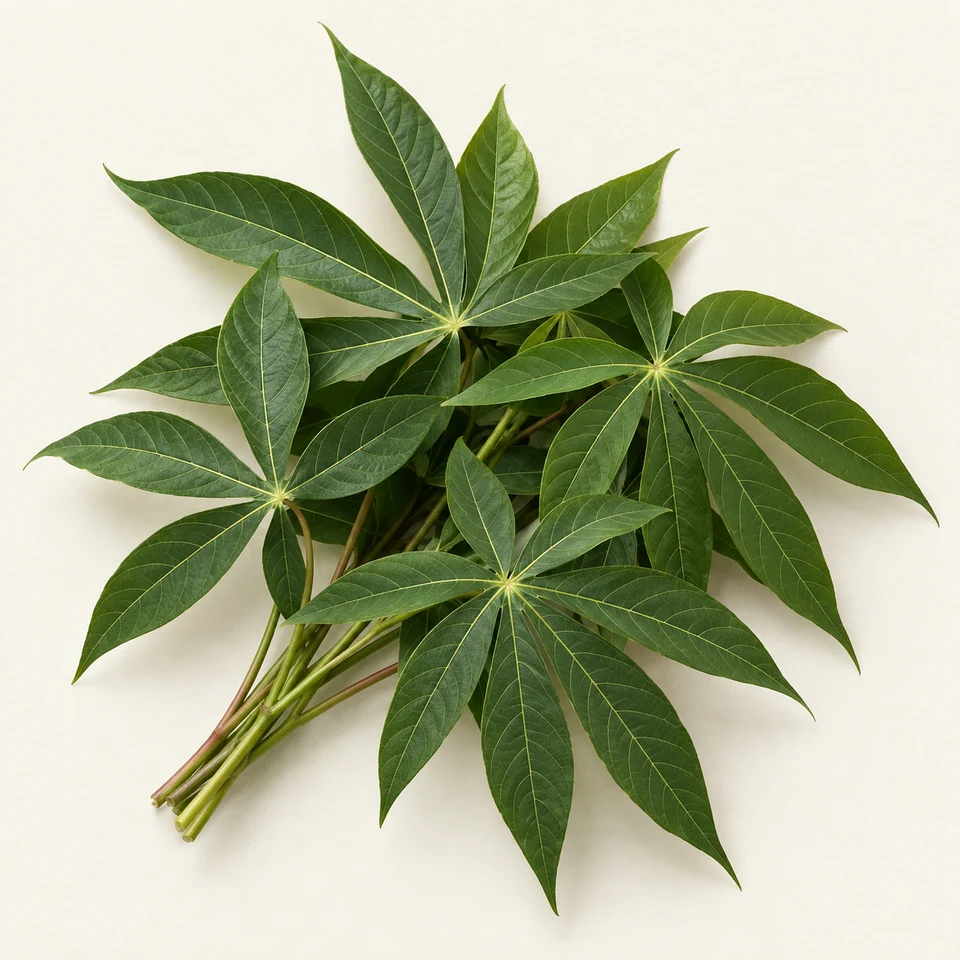
About Cassava Leaves
Manioc leaves are the foliage of the cassava plant, used as leafy greens rather than as the plant's starchy root. They are incorporated into stews, sauces, and other cooked dishes. Tender leaves and young shoots may be used differently from older, tougher foliage.
Raw leaves are green, fibrous, and firm, with an earthy, vegetal flavour that can be slightly bitter. Boiling or simmering softens them and mellows their character. Pounding breaks down the fibres and produces a finer, denser texture that blends well into sauces.
Manioc leaves are sold fresh, chopped, pounded, dried, or as a paste. They may be boiled before being simmered with other ingredients, or cooked directly in a stew according to the preparation. Stems and coarse portions are commonly removed before chopping.
- Ingredient type
- whole food
FOLLOW IT TO THE PLATE
Where will you meet it?
Explore the dishes that use this ingredient and their country and cuisine connections.
Explore linked dishesON A MENU OR LABEL
Find local names and written forms to help recognise this ingredient.
See local namesWhere cassava leaves appears
24 linked foodsFind foods to recognise by country and type. Recipes and products vary; these are recorded ingredient connections.
Showing 1–12 of 24
Main dishes


Ingredient connections awaiting review · Coverage is still growing, including packaged snacks.
Name examples awaiting language review. Confirm the specific food or product.
Local names for cassava leaves
Names and romanised forms to recognise on menus and labels.
feuilles de manioc
folhas de mandioca
Manioc leaves
cassava leaves
hojas de yuca
Maniokblätter
foglie di manioca
cassavebladeren
daun singkong
daun ubi kayu
majani ya muhogo
lá sắn
ใบมันสำปะหลัง
bai man sampalang
木薯叶
mùshǔ yè
キャッサバの葉
kyassaba no ha
카사바 잎
kasaba ip
कसावा के पत्ते
kasāvā ke patte
மரவள்ளிக்கிழங்கு இலைகள்
maravaḷḷikkiḻaṅku ilaikaḷ
കപ്പയില
kappayila
أوراق الكسافا
awrāq al-kasāfā
manyok yaprakları
листья маниока
list'ya manioka
amababi y'imyumbati
kyassaba no ha
Romanised form
maravaḷḷikkiḻaṅku ilaikaḷ
Romanised form
awrāq al-kasāfā
Romanised form
kasaba ip
Romanised form
mùshǔ yè
Romanised form
kasāvā ke patte
Romanised form
kappayila
Romanised form
list'ya manioka
Romanised form
hojas de mandioca
bai man sampalang
Romanised form
dahon ng kamoteng kahoy
Manioc leaves
Search alias · Not a confirmed translation
Manioc Leaves
Search alias · Not a confirmed translation
Available names only. Languages may be spoken in other countries; a name alone does not identify every ingredient in a dish.
Name not available yet.
A name in English has not been added for cassava leaves. Choose another language to see its available names.
Cassava Leaves nutrition & diet
Cassava Leaves nutritional value
Cassava, leaves, fresh, raw — WAFCT 04_008
Per 100 g of the edible portion in the named food form.
- Calories
- 93kcal
- Protein
- 7.6g
- Carbs
- 9.1g
- Fat
- 1.1g
Per 100 g edible portion. Source: Vincent et al., FAO/INFOODS Food Composition Table for Western Africa (2019). Carbohydrate is available carbohydrate calculated by difference; square-bracketed fat in the source uses continuous-extraction analysis. Values describe this reference form, not every recipe, cultivar or preparation.
Portions & preparation
Establish the exact manioc identity, cultivar, leaf maturity, and customary preparation before selecting a reference. Record washed and cooked edible leaves rather than assuming raw foliage is equivalent. Include oil, coconut milk, meat, fish, and other ingredients when the leaves are served in a prepared dish.
Compare the right form: Match an identified manioc species and cultivar with the customary cooked leaf form and edible portion; raw, dried, pounded, and dish-based forms differ.
Diet considerations
Manioc leaves are plant-derived foliage when the identity is confirmed. Compatibility changes when cooked with meat, fish, dairy, shellfish, or other animal-derived ingredients, and when mixed with cereal ingredients or heavily processed sauces. Because identity and preparation vary regionally, the complete recipe and portion should be recorded.
AI-authored reading notes · Awaiting editorial review. Measured values, where available, have a separate source above.
Dietary compatibility
- VeganTypically compatible
- VegetarianTypically compatible
- PescatarianTypically compatible
- KetoDepends on the version
- PaleoTypically compatible
- Low-carbDepends on the version
- HalalNot established
- KosherNot established
What these diet assessments mean
- Vegan · Typically compatible
- The plain ingredient profile is plant, fungal or mineral based. Added ingredients in a prepared product need a separate check.
- Vegetarian · Typically compatible
- The plain ingredient profile is plant, fungal or mineral based. Added ingredients in a prepared product need a separate check.
- Pescatarian · Typically compatible
- The plain ingredient profile is plant, fungal or mineral based. Added ingredients in a prepared product need a separate check.
- Keto · Depends on the version
- Compatibility depends on the portion and preparation. A sourced carbohydrate amount for a defined serving is not available.
- Paleo · Typically compatible
- The plain form fits the conventional paleo food groups. Added ingredients and individual interpretations can differ.
- Low-carb · Depends on the version
- Compatibility depends on the portion and preparation. A sourced carbohydrate amount for a defined serving is not available.
- Halal · Not established
- Sourcing, processing and any applicable certification have not been verified. A food name alone does not establish halal status.
- Kosher · Not established
- Sourcing, processing and any applicable certification have not been verified. A food name alone does not establish kosher status.
For the plain ingredient · Awaiting review. Diet compatibility is not allergy suitability or halal/kosher certification. Keto and low-carb depend on the portion.
AI-generated illustration for visual context. It does not identify a particular product or establish allergen content.
Sources & review
Nutrition reference: FAO/INFOODS Food Composition Table for Western Africa (2019) — 04_008 ↗. Values are scaled from 100 g of the recorded edible form. Individual portions have no assumed fixed weight.
Expanded overview, name examples and nutrition notes are database drafts awaiting editorial review. Numeric nutrition values, where shown, have their own source and food-form reference.
The ingredient description and dish connections come from the draft catalogue and may change after review.
Last recorded verification: .