
Cassia cinnamon
Cassia cinnamon is a strongly flavored spice used in sweet dishes, drinks, spice blends, and savory braises.
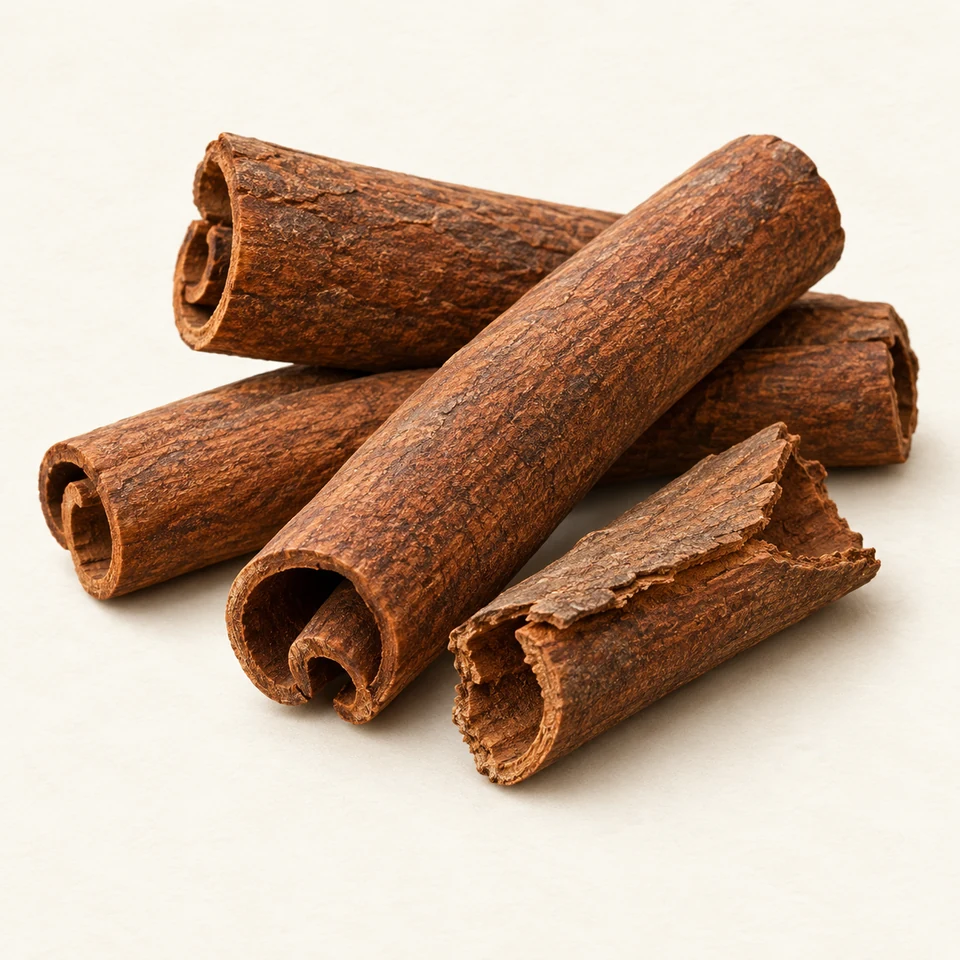
About Cassia cinnamon
Cassia cinnamon is the strongly aromatic dried bark sold as a cinnamon spice. It is used in sweet dishes, hot drinks, baked goods, spice blends, preserves, and savoury braises.
It has a warm, sweet-spicy flavour with pronounced woody notes. Dried bark is firm and brittle, while ground cassia disperses as a powder through a preparation and remains in the finished food.
It is sold in curled whole pieces or as ground powder, usually reddish brown to dark brown when ground. Whole pieces can infuse liquids or cooking dishes and be removed before serving; grinding changes the texture and keeps the spice throughout the food.
- Ingredient type
- seasoning
Forms & related ingredients
FOLLOW IT TO THE PLATE
Where will you meet it?
Explore the dishes that use this ingredient and their country and cuisine connections.
Explore linked dishesON A MENU OR LABEL
Find local names and written forms to help recognise this ingredient.
See local namesWhere cassia cinnamon appears
85 linked foodsFind foods to recognise by country and type. Recipes and products vary; these are recorded ingredient connections.
Showing 1–12 of 85
Main dishes


Dezhou braised chicken
Optional additionKasha Mangsho
Optional addition
Kukul Mas Curry
Optional additionMangshor Jhol
Optional additionMezbani Beef
Optional addition

Mutton Korma
Optional additionIngredient connections awaiting review · Coverage is still growing, including packaged snacks.
Name examples awaiting language review. Confirm the specific food or product.
Local names for cassia cinnamon
Names and romanised forms to recognise on menus and labels.
cassia
canela cassia
肉桂
ròu guì
canela-cássia
cannelle casse
Cassia-Zimt
cannella cassia
cassia-kaneel
canyella càssia
カシア
kashia
카시아
kasia
कैसिया दालचीनी
kaisiyā dālcīnī
ক্যাসিয়া দারুচিনি
kyāsiyā dārucini
காசியா இலவங்கப்பட்டை
kāciyā ilavaṅkappaṭṭai
قرفة كاسيا
qirfat kāsyā
кассия
kassiya
касія
kasiia
kasya tarçını
kayu manis cassia
kayu manis kasia
kashia
Romanised form
kāciyā ilavaṅkappaṭṭai
Romanised form
qirfat kāsyā
Romanised form
kasiia
Romanised form
kasia
Romanised form
kyāsiyā dārucini
Romanised form
ròu guì
Romanised form
kaisiyā dālcīnī
Romanised form
kassiya
Romanised form
Available names only. Languages may be spoken in other countries; a name alone does not identify every ingredient in a dish.
Name not available yet.
A name in English has not been added for cassia cinnamon. Choose another language to see its available names.
Cassia cinnamon nutrition & diet
Cassia cinnamon nutritional value
Reference: Cinnamon, Powder
Per 100 g of 100 g edible portion in the named official reference form.
- Calories
- 349kcal
- Protein
- 3.6g
- Carbs
- 80.9g
- Fat
- 1.1g
Official national food-composition reference. The displayed food form is part of the estimate; cultivar, recipe, brand, processing and preparation can change values.
Portions & preparation
Use the ground bark or quills as specified, because these forms are not interchangeable by volume in recipes. A small culinary portion may be dispersed through a dish, drink, or blend. Match references to cassia rather than another cinnamon species and account for added sugar or fat.
Compare the right form: Reference cassia cinnamon bark, ground powder, or brewed infusion as used; species and physical form should match the ingredient.
Diet considerations
Cassia cinnamon is plant-derived bark. Plain spice is compatible with plant-based patterns, but sweetened drinks, baked goods, braises, and commercial blends may add dairy, eggs, honey, meat stock, or cereal ingredients. The recipe, not the spice alone, determines dietary compatibility and carbohydrate context.
AI-authored reading notes · Awaiting editorial review. Measured values, where available, have a separate source above.
Dietary compatibility
- VeganTypically compatible
- VegetarianTypically compatible
- PescatarianTypically compatible
- KetoNot established
- PaleoMay be compatible
- Low-carbNot established
- HalalNot established
- KosherNot established
What these diet assessments mean
- Vegan · Typically compatible
- The plain ingredient profile is plant, fungal or mineral based. Added ingredients in a prepared product need a separate check.
- Vegetarian · Typically compatible
- The plain ingredient profile is plant, fungal or mineral based. Added ingredients in a prepared product need a separate check.
- Pescatarian · Typically compatible
- The plain ingredient profile is plant, fungal or mineral based. Added ingredients in a prepared product need a separate check.
- Keto · Not established
- A defined serving and sourced carbohydrate data are needed before assessing this dietary pattern.
- Paleo · May be compatible
- May fit a paleo pattern, depending on the cut or form, processing and added ingredients.
- Low-carb · Not established
- A defined serving and sourced carbohydrate data are needed before assessing this dietary pattern.
- Halal · Not established
- Sourcing, processing and any applicable certification have not been verified. A food name alone does not establish halal status.
- Kosher · Not established
- Sourcing, processing and any applicable certification have not been verified. A food name alone does not establish kosher status.
For the plain ingredient · Awaiting review. Diet compatibility is not allergy suitability or halal/kosher certification. Keto and low-carb depend on the portion.
AI-generated illustration for visual context. It does not identify a particular product or establish allergen content.
Sources & review
Nutrition reference: Korean Standard Food Composition Database 10.4 (2026) — R0030000005a ↗. Values are scaled from 100 g of the recorded edible form. Individual portions have no assumed fixed weight.
Expanded overview, name examples and nutrition notes are database drafts awaiting editorial review. Numeric nutrition values, where shown, have their own source and food-form reference.
The ingredient description and dish connections come from the draft catalogue and may change after review.
Last recorded verification: .