
Fresh herbs
Freshly harvested leafy herbs used to add aroma, flavor, or garnish to dishes.
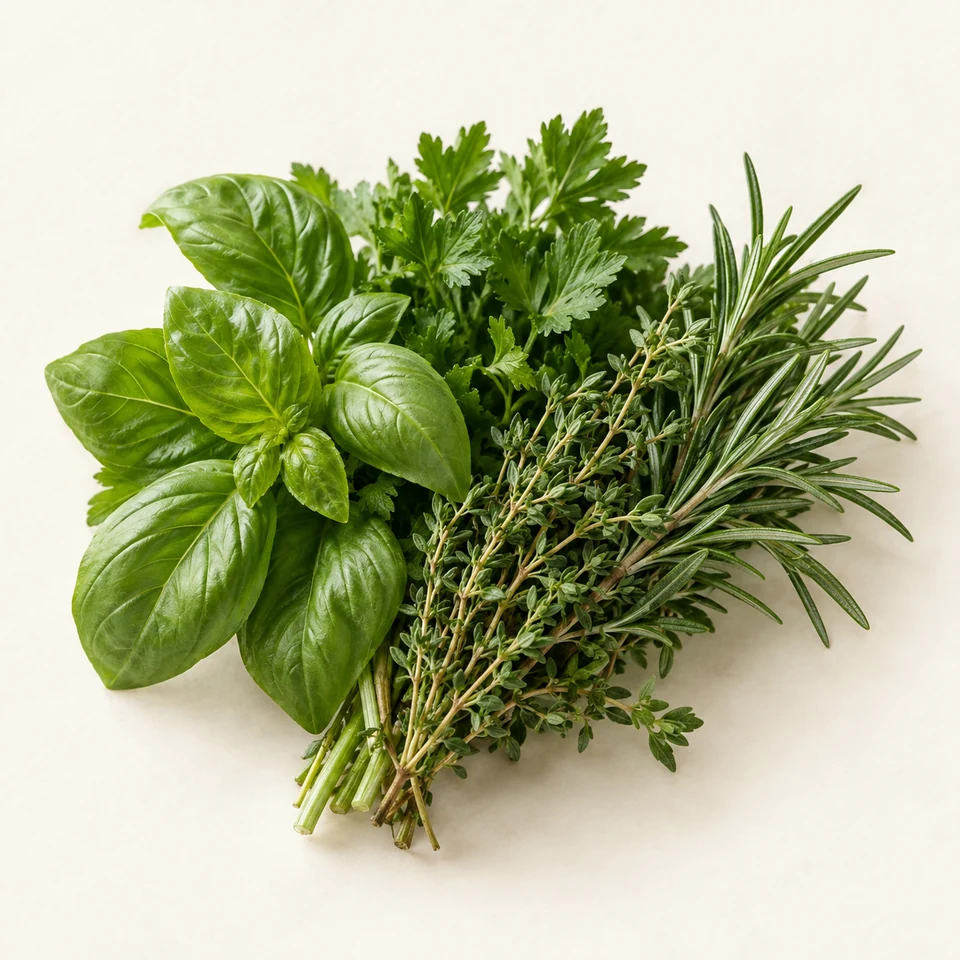
About Fresh herbs
Fresh herbs are recently harvested aromatic plant parts, usually leafy portions or tender stems, used to season or finish food. The label describes a category rather than a single ingredient, so appearance, texture, and flavour depend on the particular herb. They may be bright green, grey-green, or another natural leaf colour.
They are commonly used raw in salads, dressings, dips, sauces, soups, marinades, cooked dishes, and as garnishes. Flavours may be grassy, floral, citrusy, minty, peppery, resinous, or anise-like, and textures range from tender to fibrous. Some are added late to preserve delicate aroma, while sturdier herbs may be cooked for longer periods.
They may be sold as sprigs, bunches, loose leaves, or chopped material. Washing, trimming, stripping leaves, chopping, blending, and cooking change appearance and texture; the exact result depends on the unidentified herb, plant part, and preparation.
- Ingredient type
- whole food
Forms & related ingredients
FOLLOW IT TO THE PLATE
Where will you meet it?
Explore the dishes that use this ingredient and their country and cuisine connections.
Explore linked dishesON A MENU OR LABEL
Find local names and written forms to help recognise this ingredient.
See local namesWhere fresh herbs appears
84 linked foodsFind foods to recognise by country and type. Recipes and products vary; these are recorded ingredient connections.
Showing 13–24 of 84
Main dishes


Ingredient connections awaiting review · Coverage is still growing, including packaged snacks.
Name examples awaiting language review. Confirm the specific food or product.
Local names for fresh herbs
Names and romanised forms to recognise on menus and labels.
Fresh herbs
fresh herbs
herbes fraîches
hierbas frescas
ervas frescas
erbe fresche
frische Kräuter
verse kruiden
herbes fresques
ierburi proaspete
świeże zioła
čerstvé bylinky
čerstvé bylinky
svježe začinsko bilje
sveža zelišča
friss fűszernövények
taze otlar
φρέσκα μυρωδικά
freská myrodiká
свежая зелень
svezhaya zelen’
свіжа зелень
svizha zelen’
пресни подправки
presni podpravki
أعشاب طازجة
aʿshāb ṭāzija
سبزیهای معطر تازه
sabzihā-ye mo'attar-e tāzeh
ताज़ी जड़ी-बूटियाँ
tāzī jaṛī-būṭiyā̃
তাজা ভেষজ
tājā bheṣaj
புதிய மூலிகைகள்
puthiya mūlikaikaḷ
สมุนไพรสด
samunphrai sot
rau thơm tươi
herba segar
herba segar
新鲜香草
xīnxiān xiāngcǎo
生のハーブ
nama no hābu
생허브
saengheobeu
freská myrodiká
Romanised form
freská prásina myrodiká
Romanised form
φρέσκα πράσινα μυρωδικά
nama no hābu
Romanised form
shinsen na aoi hābu
Romanised form
新鮮な青いハーブ
puthiya mūlikaikaḷ
Romanised form
herbes verdes fresques
aʿshāb khaḍrāʾ ṭāzija
Romanised form
aʿshāb ṭāzija
Romanised form
أعشاب خضراء طازجة
svizha zelen’
Romanised form
saengheobeu
Romanised form
sinseonhan noksaek heobeu
Romanised form
신선한 녹색 허브
tājā bheṣaj
Romanised form
tājā sabuj bheṣaj
Romanised form
তাজা সবুজ ভেষজ
świeże zielone zioła
svježe zelene začinske biljke
xīnxiān lǜsè xiāngcǎo
Romanised form
xīnxiān xiāngcǎo
Romanised form
新鲜绿色香草
tāzī harī jaṛī-būṭiyā̃
Romanised form
tāzī jaṛī-būṭiyā̃
Romanised form
ताज़ी हरी जड़ी-बूटियाँ
herbes vertes fraîches
herba hijau segar
taze yeşil otlar
frische grüne Kräuter
svezhaya zelen’
Romanised form
presni podpravki
Romanised form
verse groene kruiden
ierburi verzi proaspete
erbe verdi fresche
herba hijau segar
sabzihā-ye mo'attar-e tāzeh
Romanised form
čerstvé zelené bylinky
rau thơm xanh tươi
ervas verdes frescas
hierbas verdes frescas
samunphrai si khiao sot
Romanised form
samunphrai sot
Romanised form
สมุนไพรสีเขียวสด
Available names only. Languages may be spoken in other countries; a name alone does not identify every ingredient in a dish.
Name not available yet.
A name in English has not been added for fresh herbs. Choose another language to see its available names.
Fresh herbs nutrition & diet
Fresh herbs nutritional value
Reference: HERB, FRESH, AVERAGE
Per 100 g of 100 g edible portion in the named official reference form.
- Calories
- 25.9kcal
- Protein
- 2.7g
- Carbs
- 0.9g
- Fat
- 0.5g
Official national food-composition reference. The displayed food form is part of the estimate; cultivar, recipe, brand, processing and preparation can change values.
Portions & preparation
Establish the exact herb species, edible leaves or stems, and preparation before using a reference. Raw leaves used as garnish differ from chopped, cooked, dried, frozen, preserved, or blended herbs. Herb butter, pesto, sauces, and seasoned mixes require assessment of their additional ingredients and actual serving portion.
Compare the right form: Reference the identified fresh herb species and edible leaves or stems in raw or cooked form; for blends, brand or recipe matters.
Diet considerations
Fresh herbs are generally plant-derived leafy ingredients, but this broad label does not identify a particular species or blend. Animal products, dairy, nuts, oil, salt, coatings, sauces, and cereal ingredients can enter during processing. Confirm the recipe and portion before assigning compatibility to a garnish, paste, or prepared mixture.
AI-authored reading notes · Awaiting editorial review. Measured values, where available, have a separate source above.
Dietary compatibility
- VeganTypically compatible
- VegetarianTypically compatible
- PescatarianTypically compatible
- KetoDepends on the version
- PaleoTypically compatible
- Low-carbDepends on the version
- HalalNot established
- KosherNot established
What these diet assessments mean
- Vegan · Typically compatible
- The plain ingredient profile is plant, fungal or mineral based. Added ingredients in a prepared product need a separate check.
- Vegetarian · Typically compatible
- The plain ingredient profile is plant, fungal or mineral based. Added ingredients in a prepared product need a separate check.
- Pescatarian · Typically compatible
- The plain ingredient profile is plant, fungal or mineral based. Added ingredients in a prepared product need a separate check.
- Keto · Depends on the version
- Compatibility depends on the portion and preparation. A sourced carbohydrate amount for a defined serving is not available.
- Paleo · Typically compatible
- The plain form fits the conventional paleo food groups. Added ingredients and individual interpretations can differ.
- Low-carb · Depends on the version
- Compatibility depends on the portion and preparation. A sourced carbohydrate amount for a defined serving is not available.
- Halal · Not established
- Sourcing, processing and any applicable certification have not been verified. A food name alone does not establish halal status.
- Kosher · Not established
- Sourcing, processing and any applicable certification have not been verified. A food name alone does not establish kosher status.
For the plain ingredient · Awaiting review. Diet compatibility is not allergy suitability or halal/kosher certification. Keto and low-carb depend on the portion.
AI-generated illustration for visual context. It does not identify a particular product or establish allergen content.
Sources & review
Nutrition reference: Fineli Finnish Food Composition Database, release 20.0 — 34865 ↗. Values are scaled from 100 g of the recorded edible form. Individual portions have no assumed fixed weight.
Expanded overview, name examples and nutrition notes are database drafts awaiting editorial review. Numeric nutrition values, where shown, have their own source and food-form reference.
The ingredient description and dish connections come from the draft catalogue and may change after review.
Last recorded verification: .