
Raisin
A raisin is a dried grape commonly used in baking, desserts, cereals, and savory dishes.
About Raisin
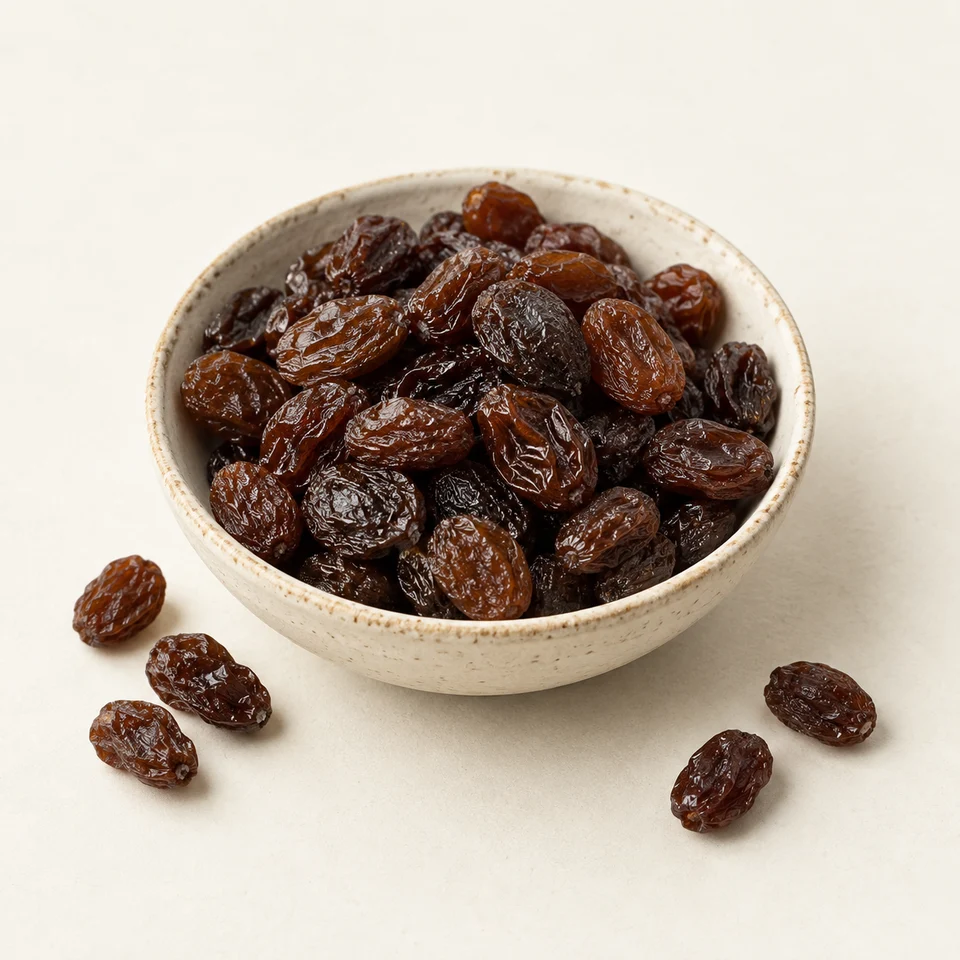
A raisin is a grape dried until its flesh becomes chewy, concentrated, and wrinkled. Raisins are used in breads, cakes, cookies, puddings, cereals, and trail-style mixtures, and they also bring sweetness to savoury rice dishes, stuffings, sauces, and stews.
Their flavour is intensely fruity and sweet, sometimes with caramel-like or wine-like notes. Colour ranges from golden and reddish-brown to deep brown, depending on the grape and drying method. Raisins may be seedless or contain seeds, and their texture can be soft and plump or distinctly leathery.
Raisins are sold whole, loose, packaged, or chopped. Soaking or cooking rehydrates and softens them, while chopping distributes their sweetness through a mixture. Golden raisins are often brighter and tangier, whereas dark raisins commonly have a deeper, more concentrated flavour.
- Ingredient type
- whole food
Forms & related ingredients
FOLLOW IT TO THE PLATE
Where will you meet it?
Explore the dishes that use this ingredient and their country and cuisine connections.
Explore linked dishesON A MENU OR LABEL
Find local names and written forms to help recognise this ingredient.
See local namesWhere raisin appears
45 linked foodsFind foods to recognise by country and type. Recipes and products vary; these are recorded ingredient connections.
Showing 37–45 of 45
Rice dishes
Breads


Sauces


Ingredient connections awaiting review · Coverage is still growing, including packaged snacks.
Name examples awaiting language review. Confirm the specific food or product.
Local names for raisin
Names and romanised forms to recognise on menus and labels.
raisin
raisin sec
pasa
uva passa
uva-passa
pansa
Rosine
rozijn
rosyntjie
rodzynka
rozinka
hrozienko
rozina
grožđica
grožđica
суво грожђе
suvo grožđe
изюм
izyum
родзинка
rodzynka
стафида
stafida
stafidă
mazsola
razina
rozīne
rosin
rusina
russin
rosin
rosin
σταφίδα
stafída
kuru üzüm
زبيب
zabīb
کشمش
keshmesh
צימוק
tsimuk
किशमिश
kishmish
কিশমিশ
kishmish
レーズン
rēzun
건포도
geonpodo
葡萄干
pútáogān
zabibu kavu
kismis
kismis
stafída
Romanised form
rēzun
Romanised form
California seedless raisin
Search alias · Not a confirmed translation
California Seedless Raisins
Search alias · Not a confirmed translation
California seedless Thompson raisin
Search alias · Not a confirmed translation
dark seedless raisin
Search alias · Not a confirmed translation
seeded raisin
Search alias · Not a confirmed translation
seedless golden raisin
Search alias · Not a confirmed translation
seedless raisin
Search alias · Not a confirmed translation
Sultana
Search alias · Not a confirmed translation
sultana raisin
Search alias · Not a confirmed translation
Sultana raisins
Search alias · Not a confirmed translation
Sultanas
Search alias · Not a confirmed translation
zabīb
Romanised form
rodzynka
Romanised form
geonpodo
Romanised form
kishmish
Romanised form
pútáogān
Romanised form
kishmish
Romanised form
izyum
Romanised form
stafida
Romanised form
tsimuk
Romanised form
keshmesh
Romanised form
suvo grožđe
Romanised form
Available names only. Languages may be spoken in other countries; a name alone does not identify every ingredient in a dish.
Name not available yet.
A name in English has not been added for raisin. Choose another language to see its available names.
Raisin nutrition & diet
Raisin nutritional value
Raisin
Per 100 g of the edible portion in the stated food form.
- Calories
- 306.4kcal
- Protein
- 2.1g
- Carbs
- 74.4g
- Fat
- 0.9g
Reference values apply to the named food form, not every preparation, variety or brand. © Food Standards Australia New Zealand. AFCD Release 3, food F007610. Available carbohydrate excludes sugar alcohols; energy converted from kJ to kcal (÷4.184). Australian data may not be appropriate for use in other countries. There are limitations associated with food composition databases. Food composition data used in the database or databases may represent an average of the nutrient content of a particular sample of foods and ingredients, determined at a particular time. The nutrient composition of foods and ingredients can vary substantially between batches and brands because of a number of factors, including changes in season, processing practices and ingredient source, and methods of calculation. Data licensed under the FSANZ Data User Licence Agreement, based on CC BY-SA 3.0 AU: https://www.foodstandards.gov.au/science-data/monitoringnutrients/afcd/datauserlicenceagreement.
Portions & preparation
Match the reference to dried grape pieces as sold or prepared, including whether they are seedless, oil-treated, sweetened, or rehydrated. Serving context matters because raisins may be eaten alone, mixed into cereal, baked into dough, or cooked into a dish with added fat or sugar.
Compare the right form: Reference should match dried grapes in the specified seedless or seeded form, with coatings, sweeteners, and rehydration status identified.
Diet considerations
Raisins are plant-derived dried grapes. Compatibility can change when they are coated, sweetened, mixed with dairy or animal fats, baked into cereal-based foods, or included in composite dishes. Their concentrated dried form also makes portion and recipe context important when considering carbohydrate patterns.
AI-authored reading notes · Awaiting editorial review. Measured values, where available, have a separate source above.
Dietary compatibility
- VeganTypically compatible
- VegetarianTypically compatible
- PescatarianTypically compatible
- KetoDepends on the version
- PaleoTypically compatible
- Low-carbDepends on the version
- HalalNot established
- KosherNot established
What these diet assessments mean
- Vegan · Typically compatible
- The plain ingredient profile is plant, fungal or mineral based. Added ingredients in a prepared product need a separate check.
- Vegetarian · Typically compatible
- The plain ingredient profile is plant, fungal or mineral based. Added ingredients in a prepared product need a separate check.
- Pescatarian · Typically compatible
- The plain ingredient profile is plant, fungal or mineral based. Added ingredients in a prepared product need a separate check.
- Keto · Depends on the version
- Compatibility depends on the portion and preparation. A sourced carbohydrate amount for a defined serving is not available.
- Paleo · Typically compatible
- The plain form fits the conventional paleo food groups. Added ingredients and individual interpretations can differ.
- Low-carb · Depends on the version
- Compatibility depends on the portion and preparation. A sourced carbohydrate amount for a defined serving is not available.
- Halal · Not established
- Sourcing, processing and any applicable certification have not been verified. A food name alone does not establish halal status.
- Kosher · Not established
- Sourcing, processing and any applicable certification have not been verified. A food name alone does not establish kosher status.
For the plain ingredient · Awaiting review. Diet compatibility is not allergy suitability or halal/kosher certification. Keto and low-carb depend on the portion.
AI-generated illustration for visual context. It does not identify a particular product or establish allergen content.
Sources & review
Nutrition reference: Australian Food Composition Database, Release 3, 2025 — Raisin ↗. Values are scaled from 100 g of the recorded edible form. Individual portions have no assumed fixed weight.
Expanded overview, name examples and nutrition notes are database drafts awaiting editorial review. Numeric nutrition values, where shown, have their own source and food-form reference.
The ingredient description and dish connections come from the draft catalogue and may change after review.
Last recorded verification: .