
Ricotta
Ricotta is a soft, mild Italian whey cheese used in fillings, desserts, pasta dishes, and spreads.
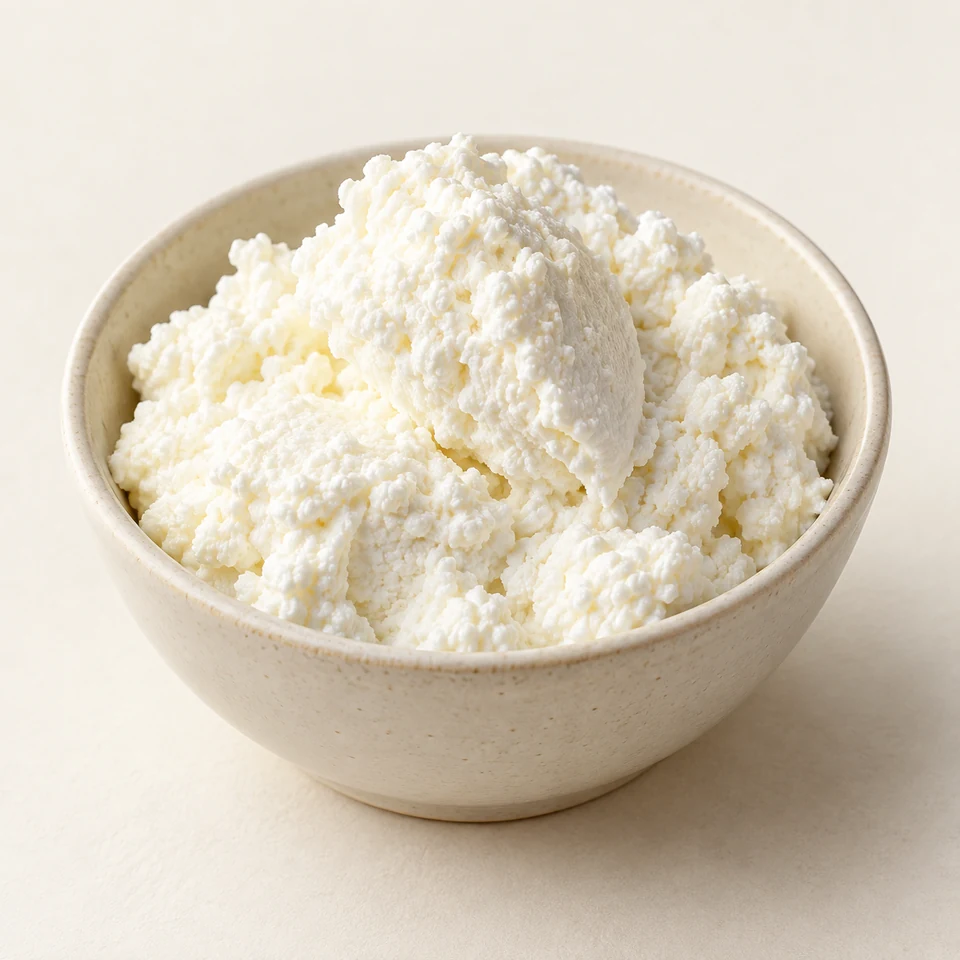
About Ricotta
Ricotta is a soft Italian dairy cheese traditionally made by reheating whey, sometimes with milk, so that fine curds form. It is used in lasagne, ravioli and other pasta fillings, baked dishes, cheesecakes, pastries, spreads, and savoury fillings. Fresh ricotta is perishable and is usually kept chilled.
Its flavour is mild, milky, and lightly sweet, with a moist texture that may be smooth, softly curded, or slightly grainy. Fresh ricotta is spoonable rather than firm. Draining removes whey and produces a denser cheese, while salt and baking make the flavour more pronounced and the texture firmer.
Ricotta is generally white to ivory and may be sold fresh, drained, salted, smoked, or baked. It can be stirred into mixtures, spread, layered, or stuffed into pasta and pastries. Milk source and processing influence its richness, moisture, curd size, and final consistency.
- Ingredient type
- whole food
FOLLOW IT TO THE PLATE
Where will you meet it?
Explore the dishes that use this ingredient and their country and cuisine connections.
Explore linked dishesON A MENU OR LABEL
Find local names and written forms to help recognise this ingredient.
See local namesWhere ricotta appears
13 linked foodsFind foods to recognise by country and type. Recipes and products vary; these are recorded ingredient connections.
Showing 1–12 of 13
Main dishes


Desserts


Noodle dishes
Street food

Ingredient connections awaiting review · Coverage is still growing, including packaged snacks.
Name examples awaiting language review. Confirm the specific food or product.
Local names for ricotta
Names and romanised forms to recognise on menus and labels.
ricotta
Ricotta
ricotta
ricotta
Ricotta
ricota
ricota
ricotta
ricotta
ricotta
ricotta
ricotta
ricotta
ricotta
рикота
rikota
рикота
rikota
рикотта
rikotta
рикота
rykota
ρικότα
rikóta
ricotta
ricotta
リコッタ
rikotta
리코타
rikota
瑞可塔奶酪
ruìkětǎ nǎilào
rikóta
Romanised form
rikotta
Romanised form
rykota
Romanised form
rikota
Romanised form
ruìkětǎ nǎilào
Romanised form
rikotta
Romanised form
rikota
Romanised form
rikota
Romanised form
Available names only. Languages may be spoken in other countries; a name alone does not identify every ingredient in a dish.
Name not available yet.
A name in English has not been added for ricotta. Choose another language to see its available names.
Ricotta nutrition & diet
Ricotta nutritional value
Cheese, Ricotta
Per 100 g of the edible portion in the stated food form.
- Calories
- 144kcal
- Protein
- 9.4g
- Carbs
- 2.0g
- Fat
- 11.0g
Reference values apply to the named food form, not every preparation, variety or brand. CoFID 2021 food code 12-176. Carbohydrate follows the dataset’s available-carbohydrate convention. Contains public sector information licensed under the Open Government Licence v3.0: https://www.nationalarchives.gov.uk/doc/open-government-licence/version/3/.
Portions & preparation
Match the reference to fresh, soft ricotta and identify whether it is made from whey, milk, or a stated combination. Whole, reduced-fat, whipped, salted, and flavored forms are not interchangeable. Consider the amount spread, stuffed, baked, or folded into a dish, plus accompanying pasta, pastry, sugar, or sauces.
Compare the right form: Reference fresh ricotta in the exact dairy base and fat style, noting salted, whipped, flavored, strained, or heat-treated form and edible portion.
Diet considerations
Ricotta is an animal-derived dairy cheese. Compatibility changes with milk source, added cream, flavorings, and recipes containing egg, meat, gelatin, or other animal ingredients. Pasta fillings, baked dishes, spreads, and desserts also differ in cereal, sugar, and portion-dependent carbohydrate patterns, so the complete preparation matters.
AI-authored reading notes · Awaiting editorial review. Measured values, where available, have a separate source above.
Dietary compatibility
- VeganTypically incompatible
- VegetarianDepends on the version
- PescatarianDepends on the version
- KetoDepends on the version
- PaleoTypically incompatible
- Low-carbDepends on the version
- HalalNot established
- KosherNot established
What these diet assessments mean
- Vegan · Typically incompatible
- The ingredient profile identifies an animal-derived food or derivative.
- Vegetarian · Depends on the version
- Check the coagulant or rennet source: animal rennet and vegetarian alternatives are both relevant to this category.
- Pescatarian · Depends on the version
- Check the coagulant or rennet source: animal rennet and vegetarian alternatives are both relevant to this category.
- Keto · Depends on the version
- Compatibility depends on the portion and preparation. A sourced carbohydrate amount for a defined serving is not available.
- Paleo · Typically incompatible
- This profile falls outside the conventional paleo pattern used here (grains and pseudograins, legumes, dairy or refined sugar).
- Low-carb · Depends on the version
- Compatibility depends on the portion and preparation. A sourced carbohydrate amount for a defined serving is not available.
- Halal · Not established
- Sourcing, processing and any applicable certification have not been verified. A food name alone does not establish halal status.
- Kosher · Not established
- Sourcing, processing and any applicable certification have not been verified. A food name alone does not establish kosher status.
For the plain ingredient · Awaiting review. Diet compatibility is not allergy suitability or halal/kosher certification. Keto and low-carb depend on the portion.
AI-generated illustration for visual context. It does not identify a particular product or establish allergen content.
Sources & review
Nutrition reference: UK Composition of Foods Integrated Dataset (CoFID), 2021 — Cheese, Ricotta ↗. Values are scaled from 100 g of the recorded edible form. Individual portions have no assumed fixed weight.
Expanded overview, name examples and nutrition notes are database drafts awaiting editorial review. Numeric nutrition values, where shown, have their own source and food-form reference.
The ingredient description and dish connections come from the draft catalogue and may change after review.
Last recorded verification: .