
Vegetable Oil
Generic vegetable cooking oil.
About Vegetable Oil
Vegetable oil is a general culinary term for oil pressed or extracted from plants, including seeds, grains, fruits, and nuts. It is used for frying, sautéing, roasting, baking, dressings, marinades, and processed foods. The term identifies a class of cooking oils rather than one fixed recipe or source.
Flavour may be almost neutral or distinctly characteristic, depending on the plant source and refining. Refined oils usually have a lighter aroma and flavour, while less-refined oils retain more colour and source-specific taste. Smoke behaviour, mouthfeel, and storage qualities likewise vary among oils and blends.
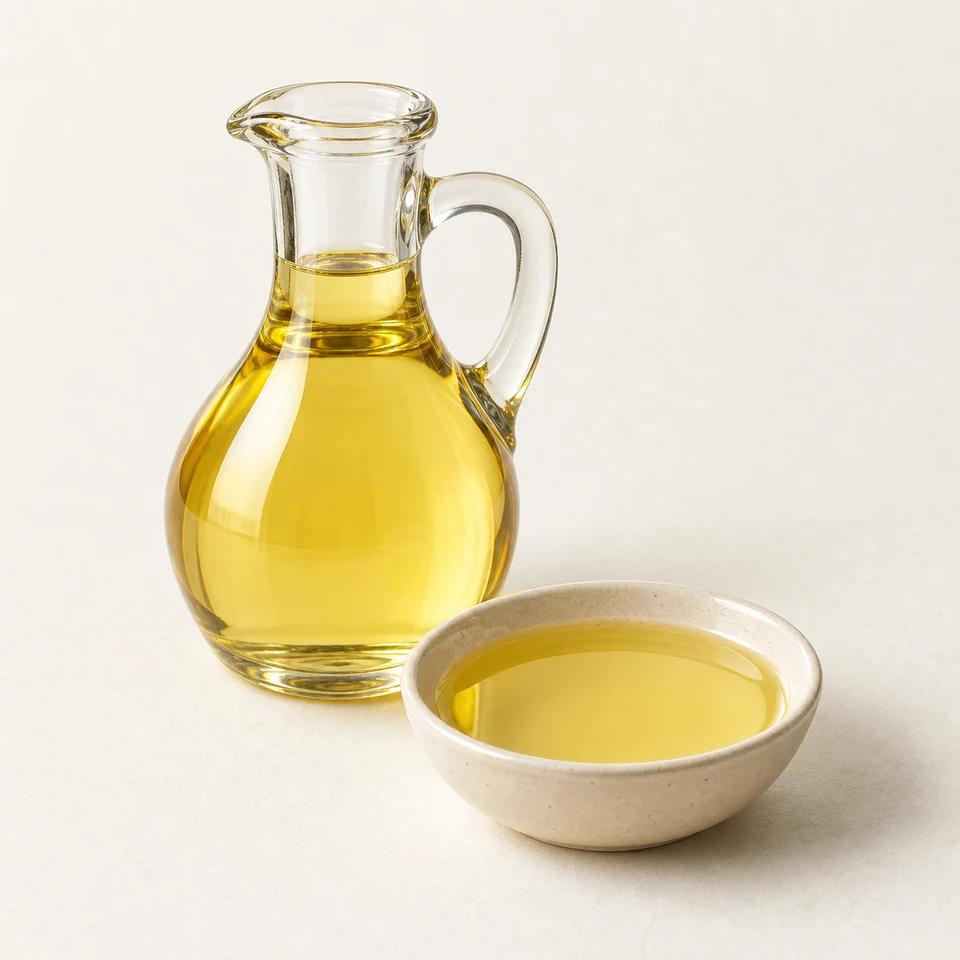
It is commonly sold as a clear pale-yellow to golden liquid, though some products are darker or become cloudy when chilled. Vegetable oil may be single-source or blended, refined or less refined, and liquid or partly solid. These forms are used differently in cooking and dressings.
- Ingredient type
- oil
- Form
- oil
Forms & related ingredients
FOLLOW IT TO THE PLATE
Where will you meet it?
Explore the dishes that use this ingredient and their country and cuisine connections.
Explore linked dishesON A MENU OR LABEL
Find local names and written forms to help recognise this ingredient.
See local namesWhere vegetable oil appears
2,390 linked foodsFind foods to recognise by country and type. Recipes and products vary; these are recorded ingredient connections.
Showing 61–72 of 2,390
Main dishes


Ingredient connections awaiting review · Coverage is still growing, including packaged snacks.
Name examples awaiting language review. Confirm the specific food or product.
Local names for vegetable oil
Names and romanised forms to recognise on menus and labels.
huile végétale
olio vegetale
Pflanzenöl
aceite vegetal
Vegetable Oil
vegetable oil
óleo vegetal
plantaardige olie
olej roślinny
rostlinný olej
растительное масло
rastitel'noye maslo
φυτικό λάδι
fytikó ládi
bitkisel yağ
زيت نباتي
zayt nabātī
植物油
shokubutsu-yu
식용유
sigyongyu
植物油
zhíwùyóu
वनस्पति तेल
vanaspati tel
fytikó ládi
Romanised form
shokubutsu-yu
Romanised form
huile végétale raffinée
Search alias · Not a confirmed translation
In vegetable oil
Search alias · Not a confirmed translation
vegetable oil (artificially butter-flavor)
Search alias · Not a confirmed translation
vegetable oil (cold-pressed)
Search alias · Not a confirmed translation
vegetable oil (fully hydrogenated)
Search alias · Not a confirmed translation
vegetable oil (heat-processed)
Search alias · Not a confirmed translation
vegetable oil (hydrogenated)
Search alias · Not a confirmed translation
vegetable oil (partially hydrogenated)
Search alias · Not a confirmed translation
Vegetable oil, Blended
Search alias · Not a confirmed translation
zayt nabātī
Romanised form
sigyongyu
Romanised form
zhíwùyóu
Romanised form
vanaspati tel
Romanised form
rastitel'noye maslo
Romanised form
Available names only. Languages may be spoken in other countries; a name alone does not identify every ingredient in a dish.
Name not available yet.
A name in English has not been added for vegetable oil. Choose another language to see its available names.
Vegetable Oil nutrition & diet
Vegetable Oil nutritional value
Reference: Oil, vegetable
Per 100 g of the edible portion of the stated reference food.
- Calories
- 884.3kcal
- Protein
- 0.0g
- Carbs
- 0.0g
- Fat
- 100.0g
Reference example for the named food and preparation, per 100 g edible portion. This is not a universal value for every recipe or brand; packaged products should be compared with their own label. © Food Standards Australia New Zealand. AFCD Release 3, food F006191. Available carbohydrate excludes sugar alcohols; energy converted from kJ to kcal (÷4.184). Australian data may not be appropriate for use in other countries. There are limitations associated with food composition databases. Food composition data used in the database or databases may represent an average of the nutrient content of a particular sample of foods and ingredients, determined at a particular time. The nutrient composition of foods and ingredients can vary substantially between batches and brands because of a number of factors, including changes in season, processing practices and ingredient source, and methods of calculation. Data licensed under the FSANZ Data User Licence Agreement, based on CC BY-SA 3.0 AU: https://www.foodstandards.gov.au/science-data/monitoringnutrients/afcd/datauserlicenceagreement.
Portions & preparation
Identify the source oil and use the amount actually added, distinguishing liquid oil from spray, infused oil, or an oil-containing dressing. Frying may leave some oil in food and some in the pan. Blended products and repeated-use cooking oils should not be treated as the same form for reference purposes.
Compare the right form: Match references to the named vegetable oil or blend, refined or unrefined, and to liquid, spray, infused, or used-in-cooking form.
Diet considerations
Vegetable oil is plant-derived, but “vegetable” does not identify the source or processing. Blends, flavorings, and shared preparations may add animal ingredients or cereal-containing coatings. Plain oil contains no inherent cereal portion, whereas fried foods, batters, dressings, and pastry can introduce portion-dependent carbohydrate patterns.
AI-authored reading notes · Awaiting editorial review. Measured values, where available, have a separate source above.
Dietary compatibility
- VeganTypically compatible
- VegetarianTypically compatible
- PescatarianTypically compatible
- KetoMay be compatible
- PaleoMay be compatible
- Low-carbMay be compatible
- HalalNot established
- KosherNot established
What these diet assessments mean
- Vegan · Typically compatible
- The plain ingredient profile is plant, fungal or mineral based. Added ingredients in a prepared product need a separate check.
- Vegetarian · Typically compatible
- The plain ingredient profile is plant, fungal or mineral based. Added ingredients in a prepared product need a separate check.
- Pescatarian · Typically compatible
- The plain ingredient profile is plant, fungal or mineral based. Added ingredients in a prepared product need a separate check.
- Keto · May be compatible
- The plain form may fit a carbohydrate-restricted diet. Check the portion, added sugar, coatings and sauces against the nutrition values above.
- Paleo · May be compatible
- May fit a paleo pattern, depending on the cut or form, processing and added ingredients.
- Low-carb · May be compatible
- The plain form may fit a carbohydrate-restricted diet. Check the portion, added sugar, coatings and sauces against the nutrition values above.
- Halal · Not established
- Sourcing, processing and any applicable certification have not been verified. A food name alone does not establish halal status.
- Kosher · Not established
- Sourcing, processing and any applicable certification have not been verified. A food name alone does not establish kosher status.
For the plain ingredient · Awaiting review. Diet compatibility is not allergy suitability or halal/kosher certification. Keto and low-carb depend on the portion.
AI-generated illustration for visual context. It does not identify a particular product or establish allergen content.
Sources & review
Nutrition reference: Australian Food Composition Database, Release 3, 2025 — Oil, vegetable ↗. Values are scaled from 100 g of the recorded edible form. Individual portions have no assumed fixed weight.
Expanded overview, name examples and nutrition notes are database drafts awaiting editorial review. Numeric nutrition values, where shown, have their own source and food-form reference.
The ingredient description and dish connections come from the draft catalogue and may change after review.
Last recorded verification: .