
Grape Leaves
Grape leaves are tender leaves used fresh or preserved, especially for wrapping fillings and serving in savory dishes.
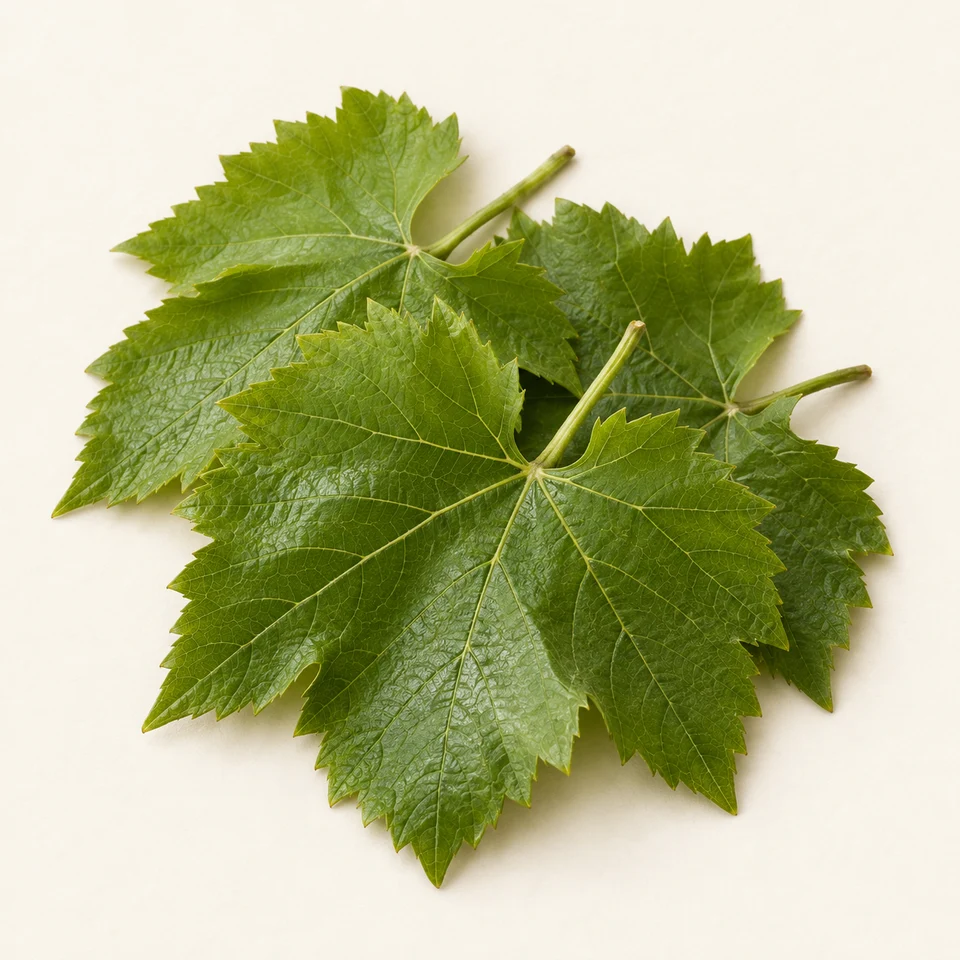
About Grape Leaves
Vine leaves are the edible leaves of grapevines, harvested while young and tender. They are most commonly used as wrappers for fillings of rice, grains, vegetables, herbs, or meat, then simmered or baked. They can also be sliced into salads, stews, and other cooked dishes, where they act as a leafy vegetable.
Fresh leaves are green, thin, and supple, with a mildly vegetal, slightly tangy flavour. Brined leaves are softer and saltier, sometimes with a sharper preserved taste. Cooking tenderizes the leaves and allows them to hold a filling while becoming easy to bite through.
Vine leaves are sold fresh, brined, or in other prepared forms. Fresh leaves may need blanching to soften them before wrapping, while preserved leaves are usually rinsed and drained to reduce excess salt. Whole leaves are rolled around fillings; sliced leaves can be stirred into cooked dishes.
- Ingredient type
- whole food
FOLLOW IT TO THE PLATE
Where will you meet it?
Explore the dishes that use this ingredient and their country and cuisine connections.
Explore linked dishesON A MENU OR LABEL
Find local names and written forms to help recognise this ingredient.
See local namesWhere grape leaves appears
21 linked foodsFind foods to recognise by country and type. Recipes and products vary; these are recorded ingredient connections.
Showing 13–21 of 21
Main dishes
Sides

Ingredient connections awaiting review · Coverage is still growing, including packaged snacks.
Name examples awaiting language review. Confirm the specific food or product.
Local names for grape leaves
Names and romanised forms to recognise on menus and labels.
feuilles de vigne
αμπελόφυλλα
ampelófylla
asma yaprağı
ورق عنب
waraq ʿinab
Vine Leaves
grape leaves
feuilles de vigne
αμπελόφυλλα
ampelófylla
asma yaprağı
Weinblätter
hojas de parra
foglie di vite
folhas de videira
druivenbladeren
виноградные листья
vinogradnye list'ya
виноградне листя
vynohradne lystia
برگ مو
barg-e mow
עלי גפן
alei gefen
frunze de viță
лозови листа
lozovi lista
лозов лист
lozov list
listovi vinove loze
szőlőlevél
ვაზის ფოთოლი
vazis potoli
խաղողի տերև
khaghoghi tेरև
ぶどうの葉
budō no ha
葡萄叶
pútáo yè
포도잎
podoip
अंगूर के पत्ते
aṅgūr ke patte
انگور کے پتے
angūr ke patte
ampelófylla
Romanised form
budō no ha
Romanised form
Grape leaves, canned
Search alias · Not a confirmed translation
Grape leaves, raw
Search alias · Not a confirmed translation
waraq al-ʿinab
Romanised form
waraq ʿinab
Romanised form
ورق العنب
vynohradne lystia
Romanised form
podoip
Romanised form
pútáo yè
Romanised form
angūr ke patte
Romanised form
aṅgūr ke patte
Romanised form
üzüm yaprağı
angūr ke patte
Romanised form
vinogradnye list'ya
Romanised form
vinogradnyye list'ya
Romanised form
lozovi lista
Romanised form
khaghoghi tेरև
Romanised form
alei gefen
Romanised form
barg-e mow
Romanised form
loze
Romanised form
lozov list
Romanised form
лозе
vazis potoli
Romanised form
Vine Leaves
Search alias · Not a confirmed translation
Available names only. Languages may be spoken in other countries; a name alone does not identify every ingredient in a dish.
Name not available yet.
A name in English has not been added for grape leaves. Choose another language to see its available names.
Grape Leaves nutrition & diet
Grape Leaves nutritional value
Grape leaves, raw
Per 100 g of the edible portion in the recorded food form.
- Calories
- 93kcal
- Protein
- 5.6g
- Carbs
- 17.3g
- Fat
- 2.1g
Reference values for the specific food form shown. Other varieties, brands and preparations can differ.
Portions & preparation
Specify grape-leaf variety and whether leaves are fresh, blanched, brined, canned, or otherwise preserved. Evaluate the edible leaf after stems and tough veins are removed. Wrapped preparations must be separated from their fillings, oil, brine, sauces, rice, meat, or other recipe ingredients.
Compare the right form: Match a reference for edible grape leaves in the exact fresh or preserved form, distinguishing plain leaves from stuffed, seasoned, or prepared dishes.
Diet considerations
Vine leaves are plant-derived grape leaves, but preserved products may contain brine, acid, oil, or seasonings. Stuffed versions can include rice or other cereals, meat, seafood, dairy, or egg, changing dietary compatibility and carbohydrate patterns. Confirm the grape species or local variety when the product identity is not stated.
AI-authored reading notes · Awaiting editorial review. Measured values, where available, have a separate source above.
Dietary compatibility
- VeganTypically compatible
- VegetarianTypically compatible
- PescatarianTypically compatible
- KetoDepends on the version
- PaleoTypically compatible
- Low-carbDepends on the version
- HalalNot established
- KosherNot established
What these diet assessments mean
- Vegan · Typically compatible
- The plain ingredient profile is plant, fungal or mineral based. Added ingredients in a prepared product need a separate check.
- Vegetarian · Typically compatible
- The plain ingredient profile is plant, fungal or mineral based. Added ingredients in a prepared product need a separate check.
- Pescatarian · Typically compatible
- The plain ingredient profile is plant, fungal or mineral based. Added ingredients in a prepared product need a separate check.
- Keto · Depends on the version
- Compatibility depends on the portion and preparation. A sourced carbohydrate amount for a defined serving is not available.
- Paleo · Typically compatible
- The plain form fits the conventional paleo food groups. Added ingredients and individual interpretations can differ.
- Low-carb · Depends on the version
- Compatibility depends on the portion and preparation. A sourced carbohydrate amount for a defined serving is not available.
- Halal · Not established
- Sourcing, processing and any applicable certification have not been verified. A food name alone does not establish halal status.
- Kosher · Not established
- Sourcing, processing and any applicable certification have not been verified. A food name alone does not establish kosher status.
For the plain ingredient · Awaiting review. Diet compatibility is not allergy suitability or halal/kosher certification. Keto and low-carb depend on the portion.
AI-generated illustration for visual context. It does not identify a particular product or establish allergen content.
Sources & review
Nutrition reference: USDA FoodData Central — Grape leaves, raw ↗. Values are scaled from 100 g of the recorded edible form. Individual portions have no assumed fixed weight.
Expanded overview, name examples and nutrition notes are database drafts awaiting editorial review. Numeric nutrition values, where shown, have their own source and food-form reference.
The ingredient description and dish connections come from the draft catalogue and may change after review.
Last recorded verification: .