
Coriander
Coriander is an aromatic herb or spice used fresh or dried to season a wide range of dishes.
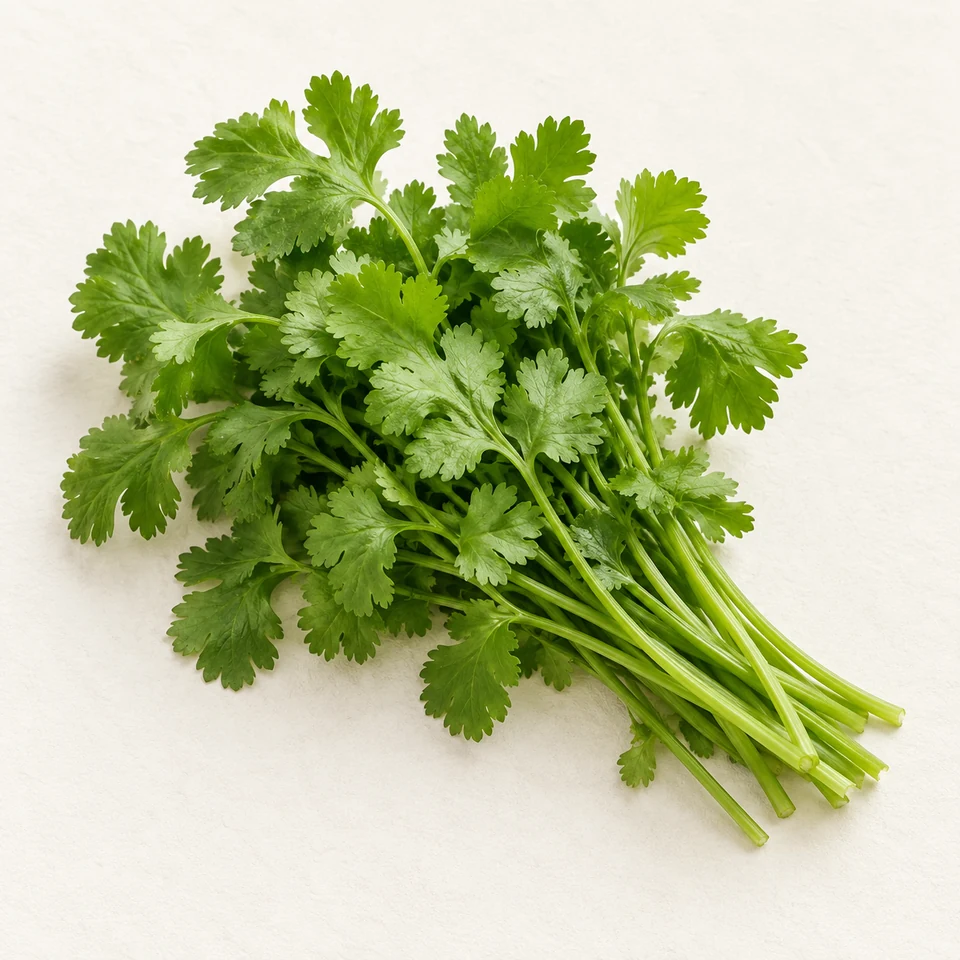
About Coriander
Coriander is the culinary name for a plant used in two distinct forms: its fresh leaves and tender stems are used as an herb, while its dried fruits are commonly sold as coriander seeds. The broad identity therefore covers different plant parts and products.
Fresh leaves are soft and green with a bright, citrus-like aroma; dried seeds are round, ridged, and hard, with warm, sweet, citrusy spice notes. Perception of fresh coriander’s aroma can vary among individuals, and the forms are not interchangeable in texture or flavour.
Fresh coriander is chopped into salads, sauces, salsas, soups, and finished dishes. Whole or ground coriander seed seasons curries, pickles, sausages, breads, and spice blends. Fresh, dried-leaf, whole-seed, and ground-seed products should be specified when preparation matters.
- Ingredient type
- whole food
Forms & related ingredients
FOLLOW IT TO THE PLATE
Where will you meet it?
Explore the dishes that use this ingredient and their country and cuisine connections.
Explore linked dishesON A MENU OR LABEL
Find local names and written forms to help recognise this ingredient.
See local namesWhere coriander appears
270 linked foodsFind foods to recognise by country and type. Recipes and products vary; these are recorded ingredient connections.
Showing 13–24 of 270
Main dishes


Boerewors
Optional addition


Cape Malay frikkadel
Optional addition

Cataplana de Marisco
Optional addition


Chashushuli
Optional addition
Ingredient connections awaiting review · Coverage is still growing, including packaged snacks.
Name examples awaiting language review. Confirm the specific food or product.
Local names for coriander
Names and romanised forms to recognise on menus and labels.
coriander
coriandre
Koriander
धनिया
dhania
cilantro
coriandolo
coentro
koriander
kolendra
кориандр
koriandr
коріандр
koriandr
kişniş
κόλιανδρος
kóliandros
كزبرة
kuzbara
گشنیز
gšنیز
ধনিয়া
dhoniya
دھنیا
dhania
ਧਨੀਆ
dhanīā
ધાણા
dhāṇā
धणे
dhaṇe
கொத்தமல்லி
kottamalli
ధనియాలు
dhaniyālu
ಕೊತ್ತಂಬರಿ
kottambari
മല്ലി
malli
කොත්තමල්ලි
kottamalli
ผักชี
phak chi
コリアンダー
koriandā
고수
gosu
芫荽
yuánsūi
rau mùi
ketumbar
ketumbar
giligilani
kóliandros
Romanised form
kottambari
Romanised form
koriandā
Romanised form
Coriander (cilantro) leaves, raw
Search alias · Not a confirmed translation
Coriander, fresh, raw
Search alias · Not a confirmed translation
Coriander, Raw
Search alias · Not a confirmed translation
kottamalli
Romanised form
kuzbara
Romanised form
koriandr
Romanised form
gosu
Romanised form
dhoniya
Romanised form
kottamalli
Romanised form
yuánsūi
Romanised form
dhania
Romanised form
malli
Romanised form
dhania
Romanised form
koriandr
Romanised form
gšنیز
Romanised form
dhāṇā
Romanised form
dhaṇe
Romanised form
phak chi
Romanised form
dhanīā
Romanised form
dhaniyālu
Romanised form
Available names only. Languages may be spoken in other countries; a name alone does not identify every ingredient in a dish.
Name not available yet.
A name in English has not been added for coriander. Choose another language to see its available names.
Coriander nutrition & diet
Coriander nutritional value
Coriander, fresh, raw
Per 100 g of the edible portion in the stated food form.
- Calories
- 31.5kcal
- Protein
- 3.1g
- Carbs
- 1.9g
- Fat
- 0.6g
Reference values apply to the named food form, not every preparation, variety or brand. © Food Standards Australia New Zealand. AFCD Release 3, food F003192. Available carbohydrate excludes sugar alcohols; energy converted from kJ to kcal (÷4.184). Australian data may not be appropriate for use in other countries. There are limitations associated with food composition databases. Food composition data used in the database or databases may represent an average of the nutrient content of a particular sample of foods and ingredients, determined at a particular time. The nutrient composition of foods and ingredients can vary substantially between batches and brands because of a number of factors, including changes in season, processing practices and ingredient source, and methods of calculation. Data licensed under the FSANZ Data User Licence Agreement, based on CC BY-SA 3.0 AU: https://www.foodstandards.gov.au/science-data/monitoringnutrients/afcd/datauserlicenceagreement.
Portions & preparation
Establish whether coriander means fresh leaves, dried leaves, whole seeds, or ground seed before using a reference; these are different plant parts and forms. Record the amount actually eaten, since a garnish, seasoning blend, and substantial herb portion represent different preparations.
Compare the right form: Match references to coriander leaf or seed, fresh, dried, whole, or ground, with the edible portion and any blend ingredients specified.
Diet considerations
Coriander is plant-origin, but the name is ambiguous between leaves and seeds. Compatibility can change when it appears in curry paste, seasoning blends, sauces, or coatings containing dairy, animal stock, or cereal ingredients. The herb or spice alone differs from the complete prepared recipe and its portion.
AI-authored reading notes · Awaiting editorial review. Measured values, where available, have a separate source above.
Dietary compatibility
- VeganNot established
- VegetarianNot established
- PescatarianNot established
- KetoNot established
- PaleoNot established
- Low-carbNot established
- HalalNot established
- KosherNot established
What these diet assessments mean
- Vegan · Not established
- The available profile does not establish the full composition or processing for this dietary pattern.
- Vegetarian · Not established
- The available profile does not establish the full composition or processing for this dietary pattern.
- Pescatarian · Not established
- The available profile does not establish the full composition or processing for this dietary pattern.
- Keto · Not established
- A defined serving and sourced carbohydrate data are needed before assessing this dietary pattern.
- Paleo · Not established
- The ingredient form and processing have not been assessed against this dietary pattern.
- Low-carb · Not established
- A defined serving and sourced carbohydrate data are needed before assessing this dietary pattern.
- Halal · Not established
- Sourcing, processing and any applicable certification have not been verified. A food name alone does not establish halal status.
- Kosher · Not established
- Sourcing, processing and any applicable certification have not been verified. A food name alone does not establish kosher status.
For the plain ingredient · Awaiting review. Diet compatibility is not allergy suitability or halal/kosher certification. Keto and low-carb depend on the portion.
AI-generated illustration for visual context. It does not identify a particular product or establish allergen content.
Sources & review
Nutrition reference: Australian Food Composition Database, Release 3, 2025 — Coriander, fresh, raw ↗. Values are scaled from 100 g of the recorded edible form. Individual portions have no assumed fixed weight.
Expanded overview, name examples and nutrition notes are database drafts awaiting editorial review. Numeric nutrition values, where shown, have their own source and food-form reference.
The ingredient description and dish connections come from the draft catalogue and may change after review.
Last recorded verification: .