
Cow Foot
Cow foot is gelatin-rich beef offal commonly simmered in broths, stews, and braises.
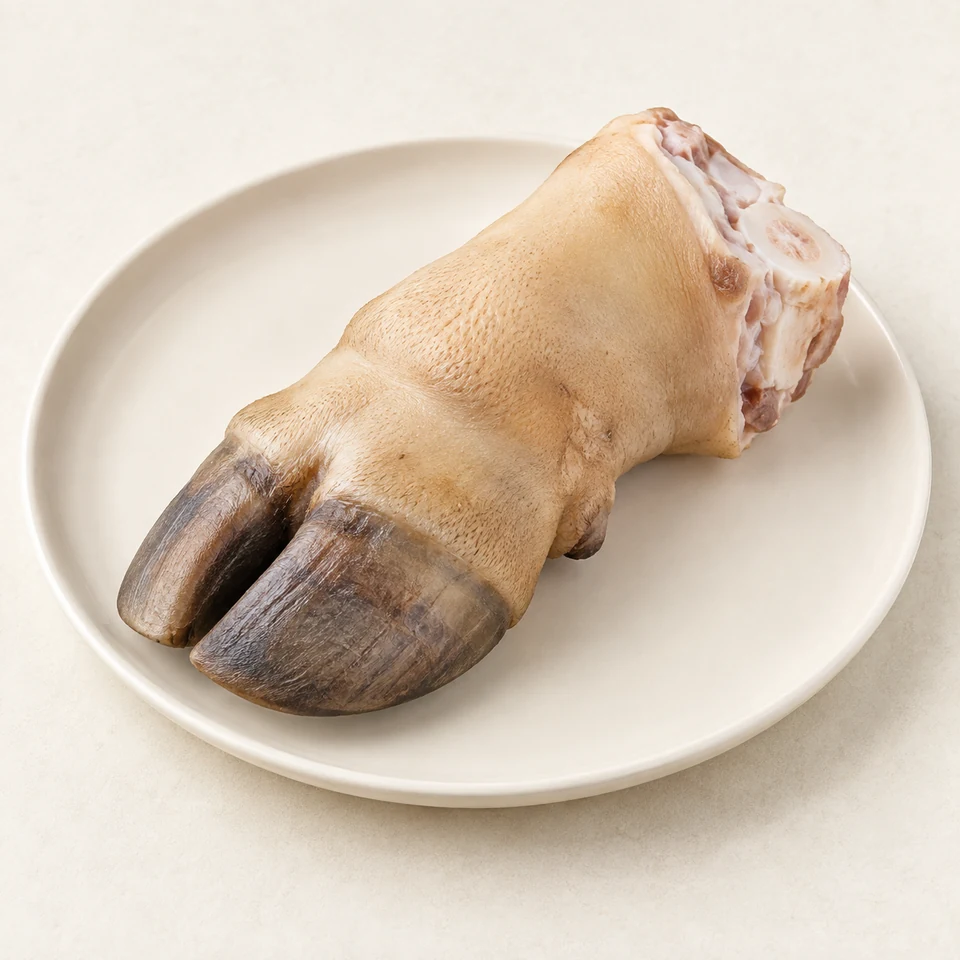
About Cow Foot
Beef trotters are the feet and lower-leg portions of cattle, usually cleaned and sold split or cut into pieces. They are valued in broths, soups, stews, braises, stocks, and other dishes where their skin, bones, and connective tissue add body. They are not a single lean muscle cut and usually contain only modest attached meat.
Raw trotters have a firm, bony appearance with skin, connective tissue, small bones, and sometimes attached meat. Their flavour is generally mild and becomes defined by the broth, aromatics, spices, and other ingredients used. Prolonged simmering softens the skin and connective tissue, creating a sticky, gelatinous texture and a richly textured cooking liquid.
They may appear as whole feet, split sections, or chopped pieces after hair and surface material have been removed. Cleaning, splitting, cutting, and bone removal change the visible form and edible portion. After cooking, the tender solids can be served separately or left in the broth, while chilling may make the gelatin set.
- Ingredient type
- whole food
FOLLOW IT TO THE PLATE
Where will you meet it?
Explore the dishes that use this ingredient and their country and cuisine connections.
Explore linked dishesON A MENU OR LABEL
Find local names and written forms to help recognise this ingredient.
See local namesWhere cow foot appears
10 linked foodsFind foods to recognise by country and type. Recipes and products vary; these are recorded ingredient connections.
Showing 1–10 of 10
Main dishes

Soups


Ingredient connections awaiting review · Coverage is still growing, including packaged snacks.
Name examples awaiting language review. Confirm the specific food or product.
Local names for cow foot
Names and romanised forms to recognise on menus and labels.
beef trotters
pieds de bœuf
patas de res
牛蹄
niú tí
beef feet
pés de boi
Rinderfüße
piedi di manzo
rundervoeten
wołowe nóżki
говяжьи ножки
govyazhi noz hki
牛足
gyūsoku
소족
sojok
أقدام البقر
aqdām al-baqar
dana paça
pódi védioú
Romanised form
πόδι βοδιού
gyūsoku
Romanised form
aqdām al-baqar
Romanised form
qadam al-baqar
Romanised form
قدم البقر
ialovycha noha
Romanised form
ialovychi nizhky
Romanised form
яловича нога
яловичі ніжки
sobal
Romanised form
sojok
Romanised form
소발
noga wołowa
nóżki wołowe
niú tí
Romanised form
pied de bœuf
sığır ayağı
sığır paçası
Rinderfuß
govyazh'i nozhki
Romanised form
govyazh'ya noga
Romanised form
govyazhi noz hki
Romanised form
говяжья нога
runderpoot
runderpoten
picioare de vită
picior de vită
piede di manzo
hovädzie nožičky
hovězí nožka
hovězí nožky
patas de boi
pé de vaca
pata de vaca
marhaláb
marhalábszár
mguu wa ng'ombe
Available names only. Languages may be spoken in other countries; a name alone does not identify every ingredient in a dish.
Name not available yet.
A name in English has not been added for cow foot. Choose another language to see its available names.
Cow Foot nutrition & diet
Cow Foot nutritional value
Representative benchmark: Beef, not further specified
Per 100 g of 100 g edible portion in the named official reference form.
- Calories
- 154kcal
- Protein
- 22.1g
- Carbs
- 0.0g
- Fat
- 7.2g
Representative benchmark from a comparable official food-composition category; it is not a laboratory measurement of this exact ingredient. The displayed reference form must be considered, and species, cultivar, recipe, brand, processing and preparation can change values.
Portions & preparation
Establish whether the reference is for cleaned cattle feet with skin, bones, connective tissue, and hooves removed as applicable. Slow cooking in soup or stew transfers some material to broth, but the consumed edible portion varies substantially. Record discarded bones, skin, and added ingredients separately.
Compare the right form: Use a reference for cleaned cattle feet in the matching cooked form, distinguishing edible skin and connective tissue from bones, hooves, and broth.
Diet considerations
Beef feet are animal-derived cattle parts. Plain cooked feet suit meat-based patterns, while broth, soup, or stew recipes may add cereals, legumes, vegetables, sauces, or other animal ingredients. Compatibility therefore depends on preparation and shared cooking liquids; carbohydrate patterns reflect those additions and the portion of edible tissue consumed.
AI-authored reading notes · Awaiting editorial review. Measured values, where available, have a separate source above.
Dietary compatibility
- VeganTypically incompatible
- VegetarianTypically incompatible
- PescatarianTypically incompatible
- KetoMay be compatible
- PaleoMay be compatible
- Low-carbMay be compatible
- HalalNot established
- KosherNot established
What these diet assessments mean
- Vegan · Typically incompatible
- The ingredient profile identifies an animal-derived food or derivative.
- Vegetarian · Typically incompatible
- The profile identifies animal flesh, seafood or a derivative excluded by a vegetarian diet.
- Pescatarian · Typically incompatible
- The profile identifies land-animal meat or a derivative, which is excluded by this pescatarian definition.
- Keto · May be compatible
- The plain form may fit a carbohydrate-restricted diet. Check the portion, added sugar, coatings and sauces against the nutrition values above.
- Paleo · May be compatible
- May fit a paleo pattern, depending on the cut or form, processing and added ingredients.
- Low-carb · May be compatible
- The plain form may fit a carbohydrate-restricted diet. Check the portion, added sugar, coatings and sauces against the nutrition values above.
- Halal · Not established
- Sourcing, processing and any applicable certification have not been verified. A food name alone does not establish halal status.
- Kosher · Not established
- Sourcing, processing and any applicable certification have not been verified. A food name alone does not establish kosher status.
For the plain ingredient · Awaiting review. Diet compatibility is not allergy suitability or halal/kosher certification. Keto and low-carb depend on the portion.
AI-generated illustration for visual context. It does not identify a particular product or establish allergen content.
Sources & review
Nutrition reference: Pacific Nutrient Database 2020 — 01.1.2.2.1_99 ↗. Values are scaled from 100 g of the recorded edible form. Individual portions have no assumed fixed weight.
Expanded overview, name examples and nutrition notes are database drafts awaiting editorial review. Numeric nutrition values, where shown, have their own source and food-form reference.
The ingredient description and dish connections come from the draft catalogue and may change after review.
Last recorded verification: .