
Durum wheat semolina
A coarse flour milled from durum wheat, commonly used to make pasta and some breads.
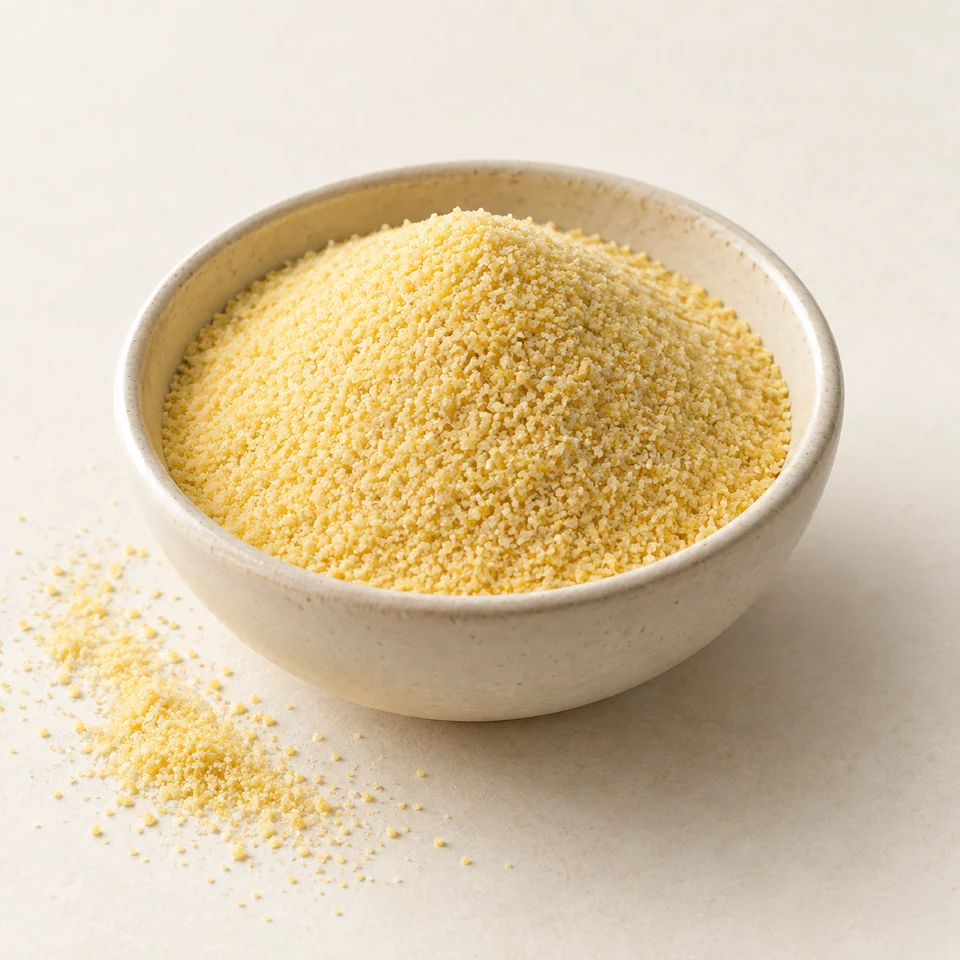
About Durum wheat semolina
Durum wheat semolina is a coarse-milled flour made from durum wheat. Its granular particles and yellow to golden colour make it especially useful for pasta, while it can also serve in breads, dumplings, porridges, and as a dusting flour. It is a raw flour rather than a finished pasta product.
Dry semolina has a mild wheat flavour and a firm, slightly gritty feel. The grind may be coarse or relatively fine, affecting how quickly it hydrates and how smooth a dough becomes. When cooked, it develops a firm, pleasantly chewy texture in pasta and a thicker, softer texture in porridge.
It appears as loose yellow or golden granules, with finer products resembling flour more closely. Mixing it with water produces dough; rolling, extruding, or shaping that dough creates pasta or other foods. Boiling, baking, or simmering then changes the dry flour into its finished form.
- Ingredient type
- flour
Forms & related ingredients
FOLLOW IT TO THE PLATE
Where will you meet it?
Explore the dishes that use this ingredient and their country and cuisine connections.
Explore linked dishesON A MENU OR LABEL
Find local names and written forms to help recognise this ingredient.
See local namesWhere durum wheat semolina appears
60 linked foodsFind foods to recognise by country and type. Recipes and products vary; these are recorded ingredient connections.
Showing 13–24 of 60
Desserts


Ingredient connections awaiting review · Coverage is still growing, including packaged snacks.
Name examples awaiting language review. Confirm the specific food or product.
Local names for durum wheat semolina
Names and romanised forms to recognise on menus and labels.
semola di grano duro
semoule de blé dur
Durum wheat semolina
durum wheat semolina
sémola de trigo duro
sêmola de trigo duro
Hartweizengrieß
durumtarwegries
sèmola de blat dur
σιμιγδάλι σκληρού σιταριού
simigdáli sklirú sitarióú
durum buğdayı irmiği
манная крупа из твёрдой пшеницы
mannaya krupa iz tverdoy pshenitsy
манна крупа з твердої пшениці
manna krupa z tverdoi pshenytsi
semolina z pszenicy durum
krupice z tvrdozrnné pšenice
krupica z tvrdej pšenice
griz od durum pšenice
durumbúzadara
griș de grâu dur
durumvetesemolina
durumhvedegryn
durumvehnäsemolina
硬粒小麦粗粒粉
yìng lì xiǎomài cūlì fěn
デュラム小麦のセモリナ粉
dyuramu komugi no semorina-ko
듀럼밀 세몰리나
dyureomil semollina
bột semolina lúa mì durum
سميد القمح الصلب
samīd al-qamḥ al-ṣulb
سمولینای گندم دوروم
semūlinā-ye gandom-e durum
simigdáli sklirú sitarióú
Romanised form
dyuramu komugi no semorina-ko
Romanised form
samīd al-qamḥ al-ṣulb
Romanised form
manna krupa z tverdoi pshenytsi
Romanised form
dyureomil semollina
Romanised form
yìng lì xiǎomài cūlì fěn
Romanised form
mannaya krupa iz tverdoy pshenitsy
Romanised form
semūlinā-ye gandom-e durum
Romanised form
Available names only. Languages may be spoken in other countries; a name alone does not identify every ingredient in a dish.
Name not available yet.
A name in English has not been added for durum wheat semolina. Choose another language to see its available names.
Durum wheat semolina nutrition & diet
Durum wheat semolina nutritional value
Semolina, raw
Per 100 g of the edible portion in the stated food form.
- Calories
- 349kcal
- Protein
- 10.6g
- Carbs
- 77.9g
- Fat
- 1.6g
Reference values apply to the named food form, not every preparation, variety or brand. CoFID 2021 food code 11-903. Carbohydrate follows the dataset’s available-carbohydrate convention. Contains public sector information licensed under the Open Government Licence v3.0: https://www.nationalarchives.gov.uk/doc/open-government-licence/version/3/.
Portions & preparation
Reference coarse durum-wheat semolina as sold or as used in a recipe, distinguishing dry flour from hydrated dough or cooked food. Milling grade, enrichment, added ingredients, and preparation affect the represented portion. Do not substitute ordinary wheat flour or finished pasta for this ingredient.
Compare the right form: Match the reference to dry coarse semolina milled from identified durum wheat, noting enrichment, milling grade, and any hydration or recipe use.
Diet considerations
Durum-wheat semolina is plant-derived cereal flour and contains wheat. Compatibility changes when it is combined with egg, dairy, animal fat, sweeteners, or other flours, or formed into bread, pasta, batter, or coatings. The dry ingredient differs from the finished food, and portion size affects carbohydrate patterns in prepared dishes.
AI-authored reading notes · Awaiting editorial review. Measured values, where available, have a separate source above.
Dietary compatibility
- VeganTypically compatible
- VegetarianTypically compatible
- PescatarianTypically compatible
- KetoDepends on the version
- PaleoTypically incompatible
- Low-carbDepends on the version
- HalalNot established
- KosherNot established
What these diet assessments mean
- Vegan · Typically compatible
- The plain ingredient profile is plant, fungal or mineral based. Added ingredients in a prepared product need a separate check.
- Vegetarian · Typically compatible
- The plain ingredient profile is plant, fungal or mineral based. Added ingredients in a prepared product need a separate check.
- Pescatarian · Typically compatible
- The plain ingredient profile is plant, fungal or mineral based. Added ingredients in a prepared product need a separate check.
- Keto · Depends on the version
- Compatibility depends on the portion and preparation. A sourced carbohydrate amount for a defined serving is not available.
- Paleo · Typically incompatible
- This profile falls outside the conventional paleo pattern used here (grains and pseudograins, legumes, dairy or refined sugar).
- Low-carb · Depends on the version
- Compatibility depends on the portion and preparation. A sourced carbohydrate amount for a defined serving is not available.
- Halal · Not established
- Sourcing, processing and any applicable certification have not been verified. A food name alone does not establish halal status.
- Kosher · Not established
- Sourcing, processing and any applicable certification have not been verified. A food name alone does not establish kosher status.
For the plain ingredient · Awaiting review. Diet compatibility is not allergy suitability or halal/kosher certification. Keto and low-carb depend on the portion.
AI-generated illustration for visual context. It does not identify a particular product or establish allergen content.
Sources & review
Nutrition reference: UK Composition of Foods Integrated Dataset (CoFID), 2021 — Semolina, raw ↗. Values are scaled from 100 g of the recorded edible form. Individual portions have no assumed fixed weight.
Expanded overview, name examples and nutrition notes are database drafts awaiting editorial review. Numeric nutrition values, where shown, have their own source and food-form reference.
The ingredient description and dish connections come from the draft catalogue and may change after review.
Last recorded verification: .