
Rye flour
Flour milled from rye grain and commonly used in breads, crackers, and some pastries.
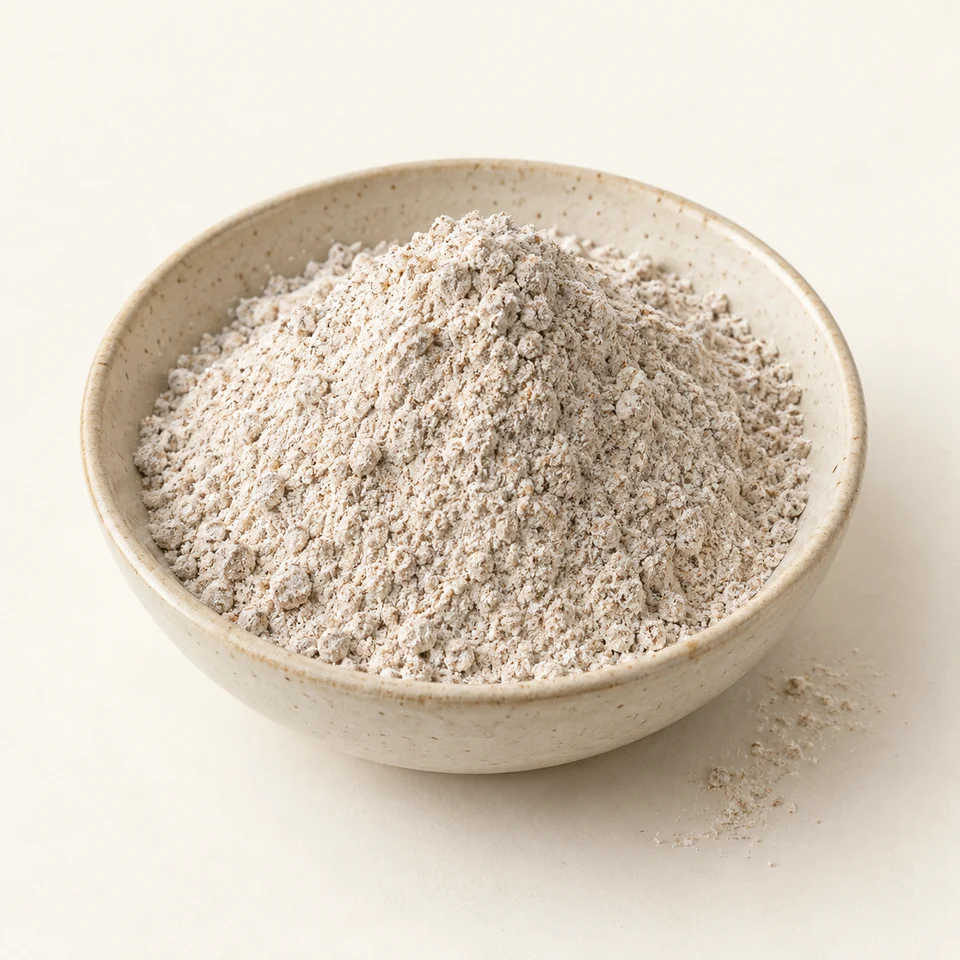
About Rye flour
Rye flour is milled flour made from rye grain and is used in rye breads, mixed-grain loaves, sourdoughs, crackers, pancakes, noodles, and selected cakes or pastries. It may be used alone or blended with wheat flour.
It contributes an earthy, malty flavor and can produce a denser, less elastic dough than many wheat flours. Color and particle characteristics depend on the grain fraction and milling degree.
Rye flour may be pale and finely milled or darker when more of the grain is retained. It is sold as light, medium, dark, whole-grain, or other regional grades, although naming systems differ; milling grade changes structure, color, and flavor.
- Ingredient type
- flour
Forms & related ingredients
FOLLOW IT TO THE PLATE
Where will you meet it?
Explore the dishes that use this ingredient and their country and cuisine connections.
Explore linked dishesON A MENU OR LABEL
Find local names and written forms to help recognise this ingredient.
See local namesWhere rye flour appears
32 linked foodsFind foods to recognise by country and type. Recipes and products vary; these are recorded ingredient connections.
Showing 1–12 of 32
Main dishes


Desserts


Ingredient connections awaiting review · Coverage is still growing, including packaged snacks.
Name examples awaiting language review. Confirm the specific food or product.
Local names for rye flour
Names and romanised forms to recognise on menus and labels.
Roggenmehl
farine de seigle
harina de centeno
rugmel
Rye flour
rye flour
rågmjöl
rugmel
roggemeel
ruisjauho
rukkijahu
mąka żytnia
žitná mouka
ražná múka
rozsliszt
făină de secară
farina di segale
farinha de centeio
farina de sègol
ржаная мука
rzhanaya muka
житнє борошно
zhytnie boroshno
çavdar unu
دقيق الجاودار
daqīq al-jāwdār
آرد چاودار
ārd-e chāvdār
黑麦粉
hēimài fěn
ライ麦粉
raimugi-ko
호밀가루
homilgaru
bột lúa mạch đen
แป้งข้าวไรย์
paeng khao rai
tepung gandum hitam
raimugi-ko
Romanised form
dextrinated rye flour
Search alias · Not a confirmed translation
farine de seigle complète type 130
Search alias · Not a confirmed translation
Farine de seigle T130
Search alias · Not a confirmed translation
Farine de seigle T170
Search alias · Not a confirmed translation
Farine de seigle T85
Search alias · Not a confirmed translation
mąka żytnia razowa typ 2000
Search alias · Not a confirmed translation
mąka żytnia typ 720
Search alias · Not a confirmed translation
ORGANIC DARK RYE FLOUR
Search alias · Not a confirmed translation
pregelatinized rye flour
Search alias · Not a confirmed translation
rye flour type 130
Search alias · Not a confirmed translation
Rye flour type 170
Search alias · Not a confirmed translation
Rye flour type 85
Search alias · Not a confirmed translation
Rye flour type type 1250
Search alias · Not a confirmed translation
Rye flour, dark
Search alias · Not a confirmed translation
Rye flour, gluten free
Search alias · Not a confirmed translation
Rye flour, light
Search alias · Not a confirmed translation
Rye flour, medium
Search alias · Not a confirmed translation
Rye flour, refined
Search alias · Not a confirmed translation
Rye flour, wholemeal
Search alias · Not a confirmed translation
sifted rye flour
Search alias · Not a confirmed translation
daqīq al-jāwdār
Romanised form
zhytnie boroshno
Romanised form
homilgaru
Romanised form
hēimài fěn
Romanised form
rzhanaya muka
Romanised form
ārd-e chāvdār
Romanised form
paeng khao rai
Romanised form
Available names only. Languages may be spoken in other countries; a name alone does not identify every ingredient in a dish.
Name not available yet.
A name in English has not been added for rye flour. Choose another language to see its available names.
Rye flour nutrition & diet
Rye flour nutritional value
Reference: Flour, rye
Per 100 g of the edible portion of the stated reference food.
- Calories
- 319kcal
- Protein
- 7.3g
- Carbs
- 73.5g
- Fat
- 1.6g
Reference example for the named food and preparation, per 100 g edible portion. This is not a universal value for every recipe or brand; packaged products should be compared with their own label. CoFID 2021 food code 11-897. Carbohydrate follows the dataset’s available-carbohydrate convention. Contains public sector information licensed under the Open Government Licence v3.0: https://www.nationalarchives.gov.uk/doc/open-government-licence/version/3/.
Portions & preparation
Use the exact rye flour grade and the dry amount incorporated into the recipe. Wholemeal, sifted, dark, light, and sprouted forms are not interchangeable, and baking, fermentation, hydration, and mixing with wheat or other flours determine the characteristics of the final food.
Compare the right form: Match references to dry rye flour of the specified milling grade, whole or sifted, before mixing; baked rye bread or rye meal requires separate form matching.
Diet considerations
Rye flour is plant-derived cereal flour. It is commonly used with wheat or other grains, and the surrounding recipe may add dairy, egg, fats, sweeteners, or animal ingredients. Compatibility therefore depends on the exact flour and recipe, while carbohydrate patterns depend on portion and accompanying ingredients.
AI-authored reading notes · Awaiting editorial review. Measured values, where available, have a separate source above.
Dietary compatibility
- VeganTypically compatible
- VegetarianTypically compatible
- PescatarianTypically compatible
- KetoDepends on the version
- PaleoTypically incompatible
- Low-carbDepends on the version
- HalalNot established
- KosherNot established
What these diet assessments mean
- Vegan · Typically compatible
- The plain ingredient profile is plant, fungal or mineral based. Added ingredients in a prepared product need a separate check.
- Vegetarian · Typically compatible
- The plain ingredient profile is plant, fungal or mineral based. Added ingredients in a prepared product need a separate check.
- Pescatarian · Typically compatible
- The plain ingredient profile is plant, fungal or mineral based. Added ingredients in a prepared product need a separate check.
- Keto · Depends on the version
- Compatibility depends on the portion and preparation. A sourced carbohydrate amount for a defined serving is not available.
- Paleo · Typically incompatible
- This profile falls outside the conventional paleo pattern used here (grains and pseudograins, legumes, dairy or refined sugar).
- Low-carb · Depends on the version
- Compatibility depends on the portion and preparation. A sourced carbohydrate amount for a defined serving is not available.
- Halal · Not established
- Sourcing, processing and any applicable certification have not been verified. A food name alone does not establish halal status.
- Kosher · Not established
- Sourcing, processing and any applicable certification have not been verified. A food name alone does not establish kosher status.
For the plain ingredient · Awaiting review. Diet compatibility is not allergy suitability or halal/kosher certification. Keto and low-carb depend on the portion.
AI-generated illustration for visual context. It does not identify a particular product or establish allergen content.
Sources & review
Nutrition reference: UK Composition of Foods Integrated Dataset (CoFID), 2021 — Flour, rye ↗. Values are scaled from 100 g of the recorded edible form. Individual portions have no assumed fixed weight.
Expanded overview, name examples and nutrition notes are database drafts awaiting editorial review. Numeric nutrition values, where shown, have their own source and food-form reference.
The ingredient description and dish connections come from the draft catalogue and may change after review.
Last recorded verification: .