
Salted fish
Salted fish is fish preserved with salt and used in savory dishes, sauces, and condiments.
About Salted fish
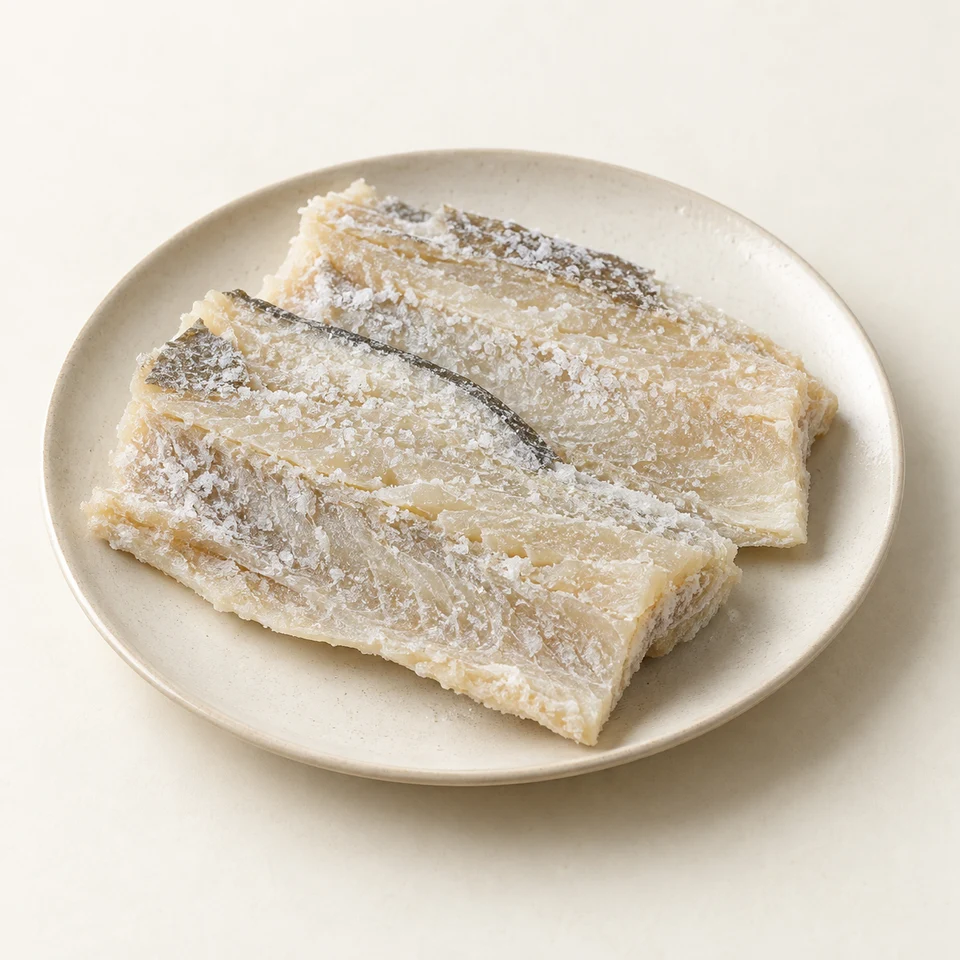
Salted fish is fish preserved by applying salt to whole fish, fillets, pieces, or split fish. It is an ingredient category rather than a single species or standardized product. It commonly contributes concentrated savoury flavour to cooked dishes, sauces, and condiments, and may be used after salting, rinsing, soaking, or cooking.
The flesh is usually firmer and drier than fresh fish, though moisture varies with the salting method and storage. Flavour ranges from mildly briny to strongly fishy and saline. Pieces may remain intact or be broken into flakes, with texture changing after rinsing, soaking, or cooking.
Products may retain skin, bones, or the original shape, while others are trimmed or flaked. Salted fish may be sold dry, semi-dry, packed in salt, or refrigerated. Preparation can soften and rehydrate the flesh, reduce surface salt, and make it easier to incorporate into sauces or cooked dishes.
- Ingredient type
- whole food
FOLLOW IT TO THE PLATE
Where will you meet it?
Explore the dishes that use this ingredient and their country and cuisine connections.
Explore linked dishesON A MENU OR LABEL
Find local names and written forms to help recognise this ingredient.
See local namesWhere salted fish appears
27 linked foodsFind foods to recognise by country and type. Recipes and products vary; these are recorded ingredient connections.
Showing 13–24 of 27
Main dishes
Snacks

Soups

Salads


Rice dishes
Ingredient connections awaiting review · Coverage is still growing, including packaged snacks.
Name examples awaiting language review. Confirm the specific food or product.
Local names for salted fish
Names and romanised forms to recognise on menus and labels.
Salted fish
salted fish
poisson salé
pescado salado
peixe salgado
pesce salato
Salzfisch
gezouten vis
saltet fisk
saltad fisk
saltet fisk
saltfiskur
suolakala
solona ryba
солёная рыба
solyonaya ryba
солона риба
solona ryba
παστό ψάρι
pastó psári
tuzlu balık
سمك مملح
samak mumallaḥ
ماهی شور
māhi-ye شور
नमकीन मछली
namkīn machlī
নোনা মাছ
nonā māch
உப்பிட்ட மீன்
uppiṭṭa mīn
ഉപ്പുമീൻ
uppumīn
ಉಪ್ಪಿನ ಮೀನು
uppina mīnu
咸鱼
xiányú
塩魚
shio-zakana
염장 생선
yeomjang saengseon
cá muối
ikan asin
ikan masin
isda na inasinan
samaki wa chumvi
soutvis
pastó psári
Romanised form
uppina mīnu
Romanised form
shio-zakana
Romanised form
uppiṭṭa mīn
Romanised form
samak mumallaḥ
Romanised form
solona ryba
Romanised form
yeomjang saengseon
Romanised form
nonā māch
Romanised form
xiányú
Romanised form
namkīn machlī
Romanised form
uppumīn
Romanised form
solyonaya ryba
Romanised form
māhi-ye شور
Romanised form
Available names only. Languages may be spoken in other countries; a name alone does not identify every ingredient in a dish.
Name not available yet.
A name in English has not been added for salted fish. Choose another language to see its available names.
Salted fish nutrition & diet
Salted fish nutritional value
Reference: FISH, FILLET, SALT-CURED
Per 100 g of 100 g edible portion in the named official reference form.
- Calories
- 100.4kcal
- Protein
- 17.5g
- Carbs
- 1.4g
- Fat
- 2.7g
Official national food-composition reference. The displayed food form is part of the estimate; cultivar, recipe, brand, processing and preparation can change values.
Portions & preparation
Identify the fish species, cut, edible portion, and whether it is dry-salted, brined, soaked, rinsed, or cooked. These forms are not interchangeable. Remove bones and inedible material when appropriate, and assess sauces, stews, or condiments separately because their added ingredients change the complete serving.
Compare the right form: Match salted fish by species, cut, curing method, and preparation state, including dry, brined, soaked, rinsed, or cooked form.
Diet considerations
Salted fish is animal-derived, but the species and formulation are not specified by this name. Compatibility may change with added shellfish, fish sauce, sugar, spices, oil, or cereal ingredients. Establish the exact fish and recipe before classification, especially for commercial condiments or mixed preparations.
AI-authored reading notes · Awaiting editorial review. Measured values, where available, have a separate source above.
Dietary compatibility
- VeganTypically incompatible
- VegetarianTypically incompatible
- PescatarianTypically compatible
- KetoMay be compatible
- PaleoMay be compatible
- Low-carbMay be compatible
- HalalNot established
- KosherNot established
What these diet assessments mean
- Vegan · Typically incompatible
- The ingredient profile identifies an animal-derived food or derivative.
- Vegetarian · Typically incompatible
- The profile identifies animal flesh, seafood or a derivative excluded by a vegetarian diet.
- Pescatarian · Typically compatible
- Seafood fits this pescatarian definition. Added meat-based stock or other ingredients would need checking separately.
- Keto · May be compatible
- The plain form may fit a carbohydrate-restricted diet. Check the portion, added sugar, coatings and sauces against the nutrition values above.
- Paleo · May be compatible
- May fit a paleo pattern, depending on the cut or form, processing and added ingredients.
- Low-carb · May be compatible
- The plain form may fit a carbohydrate-restricted diet. Check the portion, added sugar, coatings and sauces against the nutrition values above.
- Halal · Not established
- Sourcing, processing and any applicable certification have not been verified. A food name alone does not establish halal status.
- Kosher · Not established
- Sourcing, processing and any applicable certification have not been verified. A food name alone does not establish kosher status.
For the plain ingredient · Awaiting review. Diet compatibility is not allergy suitability or halal/kosher certification. Keto and low-carb depend on the portion.
AI-generated illustration for visual context. It does not identify a particular product or establish allergen content.
Sources & review
Nutrition reference: Fineli Finnish Food Composition Database, release 20.0 — 33154 ↗. Values are scaled from 100 g of the recorded edible form. Individual portions have no assumed fixed weight.
Expanded overview, name examples and nutrition notes are database drafts awaiting editorial review. Numeric nutrition values, where shown, have their own source and food-form reference.
The ingredient description and dish connections come from the draft catalogue and may change after review.
Last recorded verification: .